Yakcheonsa Temple
Vairocana fills a modern Jeju hall whose name remembers a spring
Understand sacred places, explore living traditions, and learn how to engage respectfully with Pilgrim Map.
Access has not been verified. Check current local guidance before planning a visit.
Seogwipo, Jeju-do, South Korea
Read the sources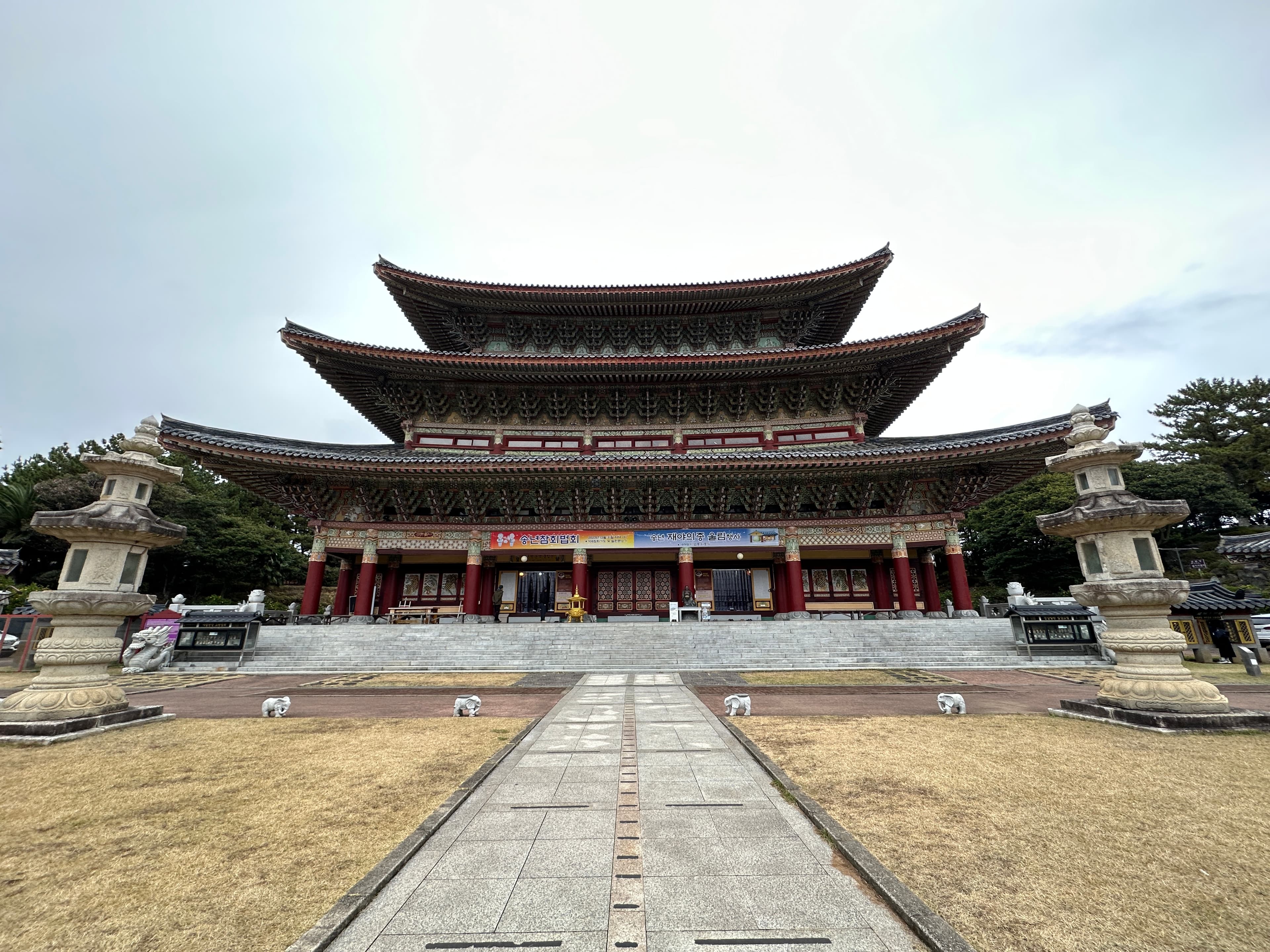
Yakcheonsa Temple in Seogwipo, Jeju Special Self-Governing Province, South Korea. Image source · CC BY-SA 4.0
Visit essentials
A quick read before you go
- Duration
- Allow about ninety minutes outside a booked program.
- Access
- Google lists the exact address, +82-64-738-5000, operational status, and continuous opening; KTO…
Overview
The first impression is architectural volume. KTO describes a thirty-metre-high hall with Vairocana at its center and large relief Buddha images along the side walls. Those dimensions can invite superlatives, yet size is not the source of sanctity. Vairocana represents awakened reality illuminating all things; the spacious hall allows many people to bow, chant, and sit within one ordered field. The temple also keeps memorial tablets for two royal couples, joining Buddhist practice to later acts of royal remembrance.
Modern construction, island tourism, and monastic discipline therefore meet without making the temple an ancient survival or a monument detached from worship.
Why this place is sacred
Yakcheonsa's spring-derived name easily attracts claims about healing or unusual power. The reviewed official sources establish a famous mineral spring as the reason for the name; they do not establish that its water cures illness. The safer spiritual frame is Buddhist. Vairocana is not a local wish machine but a cosmic Buddha whose imagery points beyond a separate, isolated self. Relief figures, central image, bell, floor space, and repeated practice organize the visitor's body toward that teaching.
Jeju's light and sea-facing climate can affect mood, but weather and scenery should not be presented as paranormal evidence.
The earlier Yaksuam hermitage provided a small Buddhist practice place associated by name with the nearby mineral spring.
Modern expansion produced the present monumental hall, large Vairocana, bell, memorial functions, and visitor retreat programs.
Experience and orientation
Pause before entering so the hall's height and broad roof can be seen in relation to the courtyard. Inside, wait until the eyes adjust and locate Vairocana before scanning the reliefs. Observe how side images repeat across the walls while the central figure anchors the room. If worship is underway, remain behind devotees and avoid crossing their sightline to the altar. The bell is an instrument under custodial control, not an interactive attraction.
When a Templestay group is present, its schedule and silence do not imply that casual visitors may enter program spaces.
Identify the public courtyard, main hall, Vairocana altar, bell pavilion, memorial areas, and boundaries around residential rooms.
Context and lineage
Official tourism records say a small hermitage named Yaksuam preceded the current temple and that a renowned mineral spring nearby supplied the name Yakcheonsa. The sources reviewed here do not provide a securely documented ancient foundation date for the present complex. They do document its modern hall, Vairocana image, memorial tablets, bell, and visitor programs. The architecture recalls an earlier Korean style, but stylistic reference must not be mistaken for original Joseon-period fabric.
Yakcheonsa belongs to Korean Buddhism, with Vairocana as the main documented veneration target in the principal hall.
Traditions and practice
Devotees approach Vairocana through Korean Buddhist hall practice. Visitors should follow the resident community's sequence rather than importing gestures from another temple or tradition.
KTO lists day, overnight experience, and rest-oriented Templestay formats for Korean and international guests; book only through the official temple channel and recheck current availability.
Choose one position at the public edge of the hall and notice how the repeated side figures redirect attention toward the center.
Korean Buddhism
ActiveKorean Buddhist life at Yakcheonsa directs monumental space toward Vairocana devotion, memorial care, and supervised practice.
Bowing, chanting, offerings, meditation, memorial observance, and Templestay.
Perspectives and open questions
Modern architecture, Buddhist iconography, spring memory, and tourism require separate evidence labels.
Scholarly perspective
Architectural scale and historical style can be studied without backdating the present fabric; iconography identifies Vairocana's religious role independently of promotional size claims.
Living and traditional perspectives
Within Buddhist interpretation, Vairocana expresses an all-pervading awakened reality and receives disciplined homage.
Open questions
The spring explains the temple's name, but no independently verified healing effect is asserted.
Plan your visit
Access and arrival
Google lists the exact address, +82-64-738-5000, operational status, and continuous opening; KTO confirms the address, phone, parking, free general entry, and yakchunsa.org. Hall and program access still require same-day confirmation.
Overnight access is limited to confirmed Templestay bookings.
Respectful visit
Wear modest clothing suitable for sitting on a temple floor.
Ask before photographing altar activity, memorial tablets, monks, or Templestay participants; flash may be prohibited.
Use only the temple's marked donation, candle, or incense systems.
Do not enter residential rooms, touch images, or handle bells and ritual implements.
Do not drink from an unmarked source, promise medicinal effects, strike the bell, or describe the Vairocana as granting wishes.
Current practical details
Address
293-28 Ieodo-ro, Seogwipo, Jeju-do, South Korea
Phone
Hours
Hours, fees, and access can change — verify on the official source before you travel. Practical details last checked Jul 2026.
Location
Map loads as you approach this section.
Pilgrim reflections
A portrait of encounter, not a score
Pilgrims describe what they felt, how present they could become, and whether the place would shape a journey. There are no stars and no ranking of traditions.
No reviewed reflections yet
The first pilgrims can help describe the character of being here.
Share a reflection
Available after an account-backed “Been there.” Every reflection is reviewed before publication.
Nearby sacred places
Explore other sacred places in the region. Proximity does not establish access or travel time; check each place’s guidance.

References
Sources consulted for this page. Source categories describe the publication, not a guarantee that every claim is verified. Traditional accounts and outside interpretations may differ.
- 01Jeju Yakcheonsa Temple — Korea Tourism OrganizationofficialLive official tourism record used for site identity, heritage context, and visitor logistics; time-sensitive details require rechecking.
- 02Korea Heritage Service public heritage search — Korea Heritage ServiceofficialAuthoritative national search portal retained as a verification route; not used alone for site-specific claims.
- 03Jeju Yakcheonsa Temple — Korea Tourism OrganizationofficialEnglish exact-site record for Yaksuam and spring-derived name, royal memorial tablets, Templestay, address, website, telephone, free general entry, and parking.
- 04Yakcheonsa Temple on Jeju — Korea Tourism OrganizationofficialOfficial Korea Tourism Organization exact-site record for the main hall's scale, central five-metre Vairocana, relief Buddhas, large bell, Templestay, address, telephone, parking, and website.
- 05Yakcheonsa Temple — Google Maps place record — GoogleSource contextStrong identity match used only for current practical fields and coordinates.
Share a photo
Help visitors recognize Yakcheonsa Temple. Every submission is reviewed before publication.