Samseonghyeol
Three openings in the earth and a people’s account of beginning
Understand sacred places, explore living traditions, and learn how to engage respectfully with Pilgrim Map.
Access has not been verified. Check current local guidance before planning a visit.
Cheju, Jeju-do, South Korea
Read the sources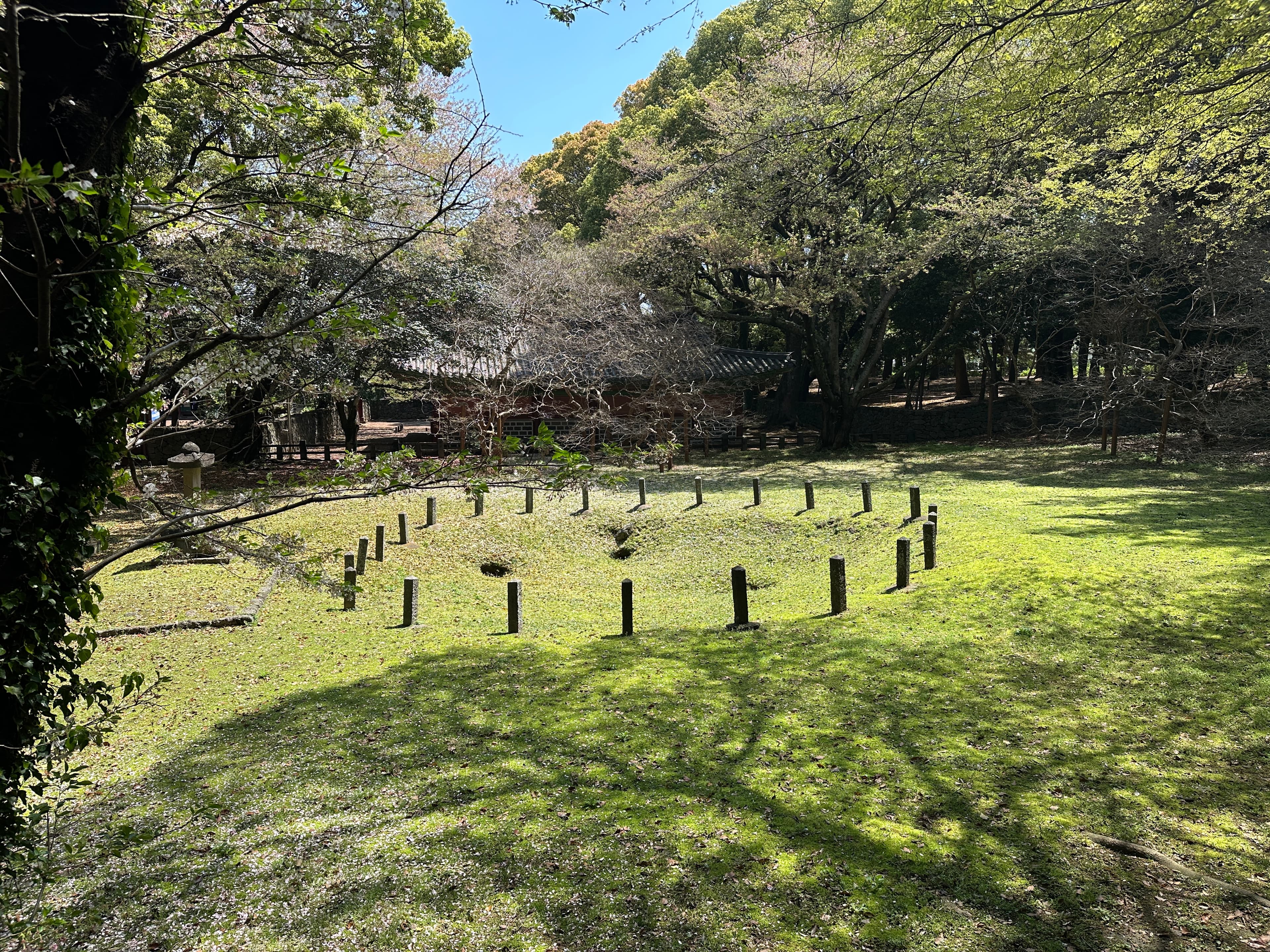
Samseonghyeol in Jeju City, Jeju Special Self-Governing Province, South Korea. Image source · CC BY-SA 4.0
Visit essentials
A quick read before you go
- Duration
- KTO suggests about forty minutes; allow an hour for both the grove and interpretive halls.
- Access
- KTO and Google list 09:00–18:00 daily; KTO also provides samsunghyeol.or.kr, admission fees,…
Overview
KTO reports the traditional claim that rain or snow does not fill the holes. Because this is a prevalent account on official and visitor pages, it belongs in the record with a clear boundary: it is not presented here as proof of supernatural intervention. Drainage, observation conditions, and the protected shape of the ground would require site-specific study. The more important truth is cultural.
Communities have treated these features as evidence-bearing sacred forms, preserved them through ritual and Joseon-period structures, and built modern interpretation around the founders’ emergence. Myth is not a failed scientific report; it communicates belonging, precedence, kinship, and obligations to Jeju.
Why this place is sacred
The three openings complicate a single-founder story. Difference is present at the beginning: three names, three lines, one island society. The grove reinforces this plurality because no tree stands alone; roots, shade, leaf litter, weather, and human protection sustain a community of living forms. This contemplative reading does not claim the holes radiate energy or that lineage biology can be established from myth. It asks what changes when origin is placed beneath one’s feet.
Ground becomes inherited rather than owned outright, and ancestry becomes a responsibility to descendants as well as pride in the past.
The natural depressions became an ancestral origin place through Jeju’s Go-Yang-Bu emergence tradition and related commemoration.
Joseon structures, maintained rites, protected woodland, exhibition halls, and media interpretation formalized the sacred landscape.
Experience and orientation
Walk beneath the grove without leaving the marked path. The holes can be visually understated, so do not push past others or lean over barriers for proof of the rain story. Look at their relation to trees, walls, gates, and ritual buildings before entering the exhibition hall. There, distinguish mythic sequence, historical patronage, family lineage, and archaeological or natural description. Traditional games offered on site belong to cultural interpretation but should not turn the inner sacred area into a playground.
Forty minutes is KTO’s average; a slower visit allows the contrast between quiet ground and elaborate origin narrative to emerge.
Separate the protected holes, ancestral ritual structures, grove paths, exhibition and media rooms, and activity areas.
Context and lineage
Tradition says Go, Yang, and Bu emerged from three holes here and became founding ancestors of Jeju society. KTO identifies the site as revered and notes old trees, Joseon-period structures, and displays explaining the lore. The often-repeated claim that the depressions never fill during rain or snow is retained as tradition or observation reported by the source, not validated as paranormal fact. The page does not convert ancestral narrative into a literal genetic claim about every Jeju resident.
The place belongs to Jeju ancestral and Korean ritual traditions rather than to a deity-centered temple lineage.
Traditions and practice
Ritual honor directed toward the three founders expresses lineage continuity and collective origin.
Exhibitions and supervised activities translate the narrative for residents, students, and visitors.
Name three communities that formed you and one responsibility you carry back to each.
Korean ritual traditions
ActiveJeju ancestral tradition locates collective beginning in a protected local landscape and renews it through remembrance.
Ancestral rites, commemoration, lineage teaching, respectful viewing, cultural education, and grove care.
Perspectives and open questions
Samseonghyeol can hold ritual truth, lineage identity, landscape history, and scientific uncertainty without forcing them into one claim.
Scholarly perspective
Researchers can study texts, rites, institutions, geology, hydrology, and genealogy while recognizing that each answers different questions.
Living and traditional perspectives
The three founders embody Jeju’s emergence from its own ground and the continuity of ancestral communities.
Open questions
The never-filling-water claim is widespread in official and visitor narratives but is not independently verified here.
Plan your visit
Access and arrival
KTO and Google list 09:00–18:00 daily; KTO also provides samsunghyeol.or.kr, admission fees, parking information, and the site telephone. Recheck final admission and ceremony closures.
This is a daytime heritage and ritual visit; no on-site accommodation is indicated.
Respectful visit
Ordinary modest outdoor clothing is suitable; ceremonial events may call for quieter dress.
Avoid drones, barrier crossings, staged emergence poses, and close photography of ritual participants without consent.
Do not place coins, food, stones, or paper in the depressions; follow custodial instructions for tribute.
The holes, grove interior, ritual furnishings, and closed Joseon buildings must not be touched or entered.
Do not test the holes with water, toss objects, claim paranormal proof, or reduce origin tradition to a quaint legend.
Current practical details
Address
22 Samseong-ro, Cheju, Jeju-do, South Korea
Phone
Hours
Hours, fees, and access can change — verify on the official source before you travel. Practical details last checked Jul 2026.
Location
Map loads as you approach this section.
Pilgrim reflections
A portrait of encounter, not a score
Pilgrims describe what they felt, how present they could become, and whether the place would shape a journey. There are no stars and no ranking of traditions.
No reviewed reflections yet
The first pilgrims can help describe the character of being here.
Share a reflection
Available after an account-backed “Been there.” Every reflection is reviewed before publication.
Nearby sacred places
Explore other sacred places in the region. Proximity does not establish access or travel time; check each place’s guidance.

References
Sources consulted for this page. Source categories describe the publication, not a guarantee that every claim is verified. Traditional accounts and outside interpretations may differ.
- 01Jeju Samseonghyeol — Korea Tourism OrganizationofficialLive official tourism record used for site identity, heritage context, and visitor logistics; time-sensitive details require rechecking.
- 02Korea Heritage Service public heritage search — Korea Heritage ServiceofficialAuthoritative national search portal retained as a verification route; not used alone for site-specific claims.
- 03Jeju Samseonghyeol — Korea Tourism OrganizationofficialOfficial tourism record for the three origin holes, Go-Yang-Bu founding narrative, old grove, rain claim, Joseon structures, exhibition facilities, website, hours, and access.
- 04Samseonghyeol — Google Maps place record — GoogleSource contextStrong identity match used only for current practical fields and coordinates.
Share a photo
Help visitors recognize Samseonghyeol. Every submission is reviewed before publication.