Key questions
- What is Three Jewel Temples of Korea?
- Three Jewel Temples of Korea is a Buddhism pilgrimage route in South Korea, Gyeongsangnam-do and Jeollanam-do. Three temples, each keeping one Jewel of Buddhism — Buddha, Dharma, Sangha — still living centers of Korean practice
- How many stations are on Three Jewel Temples of Korea?
- This guide currently maps 3 stations, with 3 total sites noted in the route metadata.
- When is the best time to walk Three Jewel Temples of Korea?
- Spring (April–May) and autumn (October–November); the mountain approaches to Haeinsa and Songgwangsa are cold in winter
Opening
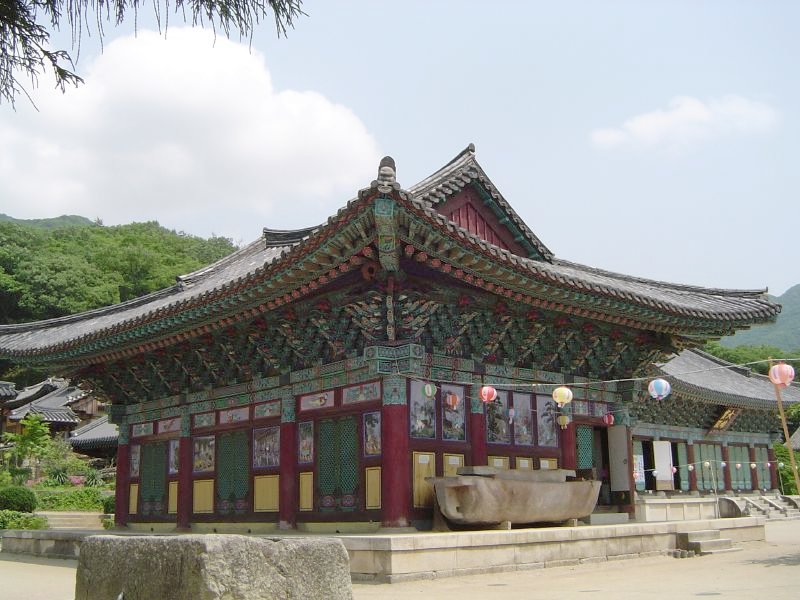
There is no single road between these three temples, and no expectation that a visitor walks them in sequence. Tongdosa sits in a broad valley near Yangsan, its precincts opening one gate after another along a stream lined with old pines. Haeinsa is higher and harder to reach, folded into the forested slopes of Mount Gaya in Hapcheon, the last stretch a climb past stone markers into cooler air. Songgwangsa lies further southwest again, on Mount Jogyesan above Suncheon, its halls set along a mountain stream crossed by small wooden bridges. Each temple is approached on its own, at its own pace, and each is understood by Korean Buddhists to hold something the other two do not: one keeps a relic of the Buddha himself, one keeps the whole of his recorded teaching, and one has kept, across the centuries, an unbroken line of monks who embody the teaching's practice. To visit any one of them is to enter a single Jewel; to visit all three, over however many years it takes, is to complete a devotional set that has organized Korean Buddhist practice since the medieval period.
Origins
Tongdosa's founding is traditionally dated to 646 CE, when the monk Jajang is said to have returned from Tang China carrying relics of the historical Buddha — a robe fragment and śarīra (relics from the Buddha's cremation) — and built a temple to enshrine them, naming it 'Tongdo' after the idea that one reaches enlightenment (do) by passing through (tong) this teaching. Because it holds physical relics of the Buddha, Tongdosa's main hall, unusually, contains no Buddha statue: the object of worship is the relic itself, housed in a stone stupa behind the hall. Haeinsa was founded in 802 CE by the monks Suneung and Jeongyeong under royal patronage of the Silla kingdom, but the temple's deeper significance dates to the 13th century, when the Tripitaka Koreana — the complete Buddhist canon, carved onto more than 81,000 wooden printing blocks — was produced under the Goryeo court as an act of religious merit intended to repel a Mongol invasion. The blocks were moved to Haeinsa in the 15th century and have been preserved there since, in a set of Joseon-era storage halls engineered with a passive ventilation and humidity system still studied by conservators; both the temple's Janggyeong Panjeon depositories and the woodblocks themselves carry UNESCO recognition. Songgwangsa's origins reach back further, to a small hermitage founded in the late Silla period, but its transformation into a major monastic center is credited to the monk Jinul (1158–1210), who reformed and expanded the temple in the late 12th and early 13th centuries as a base for Seon meditation practice and produced there some of the most influential texts of Korean Buddhist reform.
Why pilgrims walk it
Korean Buddhists visit these three temples for reasons as varied as the temples themselves. Some come to Tongdosa specifically to bow before the Buddha's relics, treating the visit as the closest physical proximity to the historical Buddha available anywhere in Korea. Others travel to Haeinsa to see, or simply to be near, the Tripitaka Koreana — a canon so vast and so carefully preserved that encountering it in person is often described less as sightseeing than as standing inside eight centuries of continuous religious labor. Still others go to Songgwangsa because it remains an active training monastery, home to a functioning Seon meditation hall and a long, continuous line of monks and nuns; visitors go there less to see an object than to sit near people still doing what the temple was built for. Many devout Korean Buddhists aim, over the course of a life, to visit all three — not as a single trip but as three separate acts of devotion, each completing a different part of taking refuge in the Three Jewels, a formula (Buddham saranam gacchami, Dhammam saranam gacchami, Sangham saranam gacchami) recited at the start of nearly every Buddhist ritual. Some visit with express intention tied to that formula; many more arrive simply as pilgrims, tourists, or hikers drawn to three of the most architecturally and historically significant Buddhist sites in the country, and find the devotional structure explained to them only once they arrive.
Significance
The Three Jewel Temples are among the clearest institutional expressions in any Buddhist country of the Triratna — Buddha, Dharma, Sangha — as three distinct, visitable, physically embodied objects of devotion rather than only abstract categories of refuge. Tongdosa is called the Buddha-bo-sachal (Buddha Jewel Temple) for its relics; Haeinsa the Beop-bo-sachal (Dharma Jewel Temple) for the Tripitaka Koreana; Songgwangsa the Seung-bo-sachal (Sangha Jewel Temple) for its unbroken production of accomplished Seon masters, a lineage tradition Korean Buddhism traces back through sixteen national teachers associated with the temple since Jinul's reforms. All three remain functioning monasteries rather than museums: monks and nuns train and live at each site today, liturgy continues on its historical schedule, and lay Buddhists visit for ordinary devotional purposes as much as for the sites' historical weight. Haeinsa and its woodblocks hold UNESCO World Heritage and Memory of the World status respectively; Tongdosa and Songgwangsa are both major temples within the modern Jogye Order, the dominant school of Korean Buddhism, and all three continue to shape how contemporary Korean Buddhists understand the structure of their own tradition.