Key questions
- What is Saigoku Kannon Pilgrimage?
- Saigoku Kannon Pilgrimage is a Buddhism pilgrimage route in Japan, Kansai. The oldest Kannon circuit in Japan — thirty-three temples across western Honshu, walked since the eighth century
- How many stations are on Saigoku Kannon Pilgrimage?
- This guide currently maps 36 stations, with 33 total sites noted in the route metadata.
- When is the best time to walk Saigoku Kannon Pilgrimage?
- Mid-March through early May; mid-October through early December
Opening
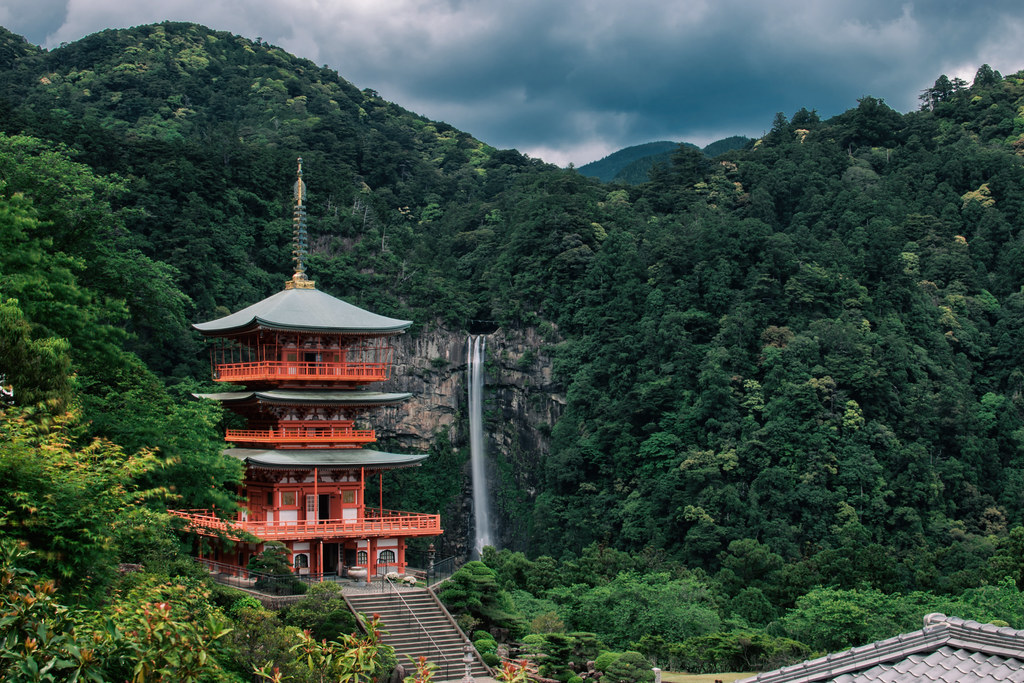
The Saigoku route is the original. Of the three great Kannon pilgrimages that together form the Hyakkasho — One Hundred Kannon — Saigoku came first, by several centuries. The circuit begins at Seiganto-ji on the Wakayama coast, where the first Kannon image is sheltered beside Nachi Falls, and turns north and east through Wakayama, Nara, Osaka, Kyoto, Hyōgo, and Shiga before climbing into the mountains of Gifu, where the thirty-third temple, Kegon-ji, sits in deep cedar forest above the village of Tanigumi. To walk Saigoku is to follow the migration of Kannon devotion through medieval Japan — from the Kii peninsula's coastal mountains into the imperial capitals, then out across the plains of Lake Biwa.
Origins
Saigoku tradition holds that the priest Tokudō Shōnin received the circuit in a vision from Enma, the king of the dead, in 718 CE. According to the legend, Enma told him that the suffering of beings could be eased if Tokudō opened thirty-three Kannon temples to the world and recorded them on stone tablets; Tokudō did so, but the circuit lay unpopularized for over two centuries until the cloistered emperor Kazan revived it in the late tenth century, walking it himself. The dates and personages in this account are devotional rather than verifiable history; what is documented is that by the late Heian period Saigoku had become the foremost lay pilgrimage of imperial-court Japan, and by the late medieval period it was being walked by commoners, samurai, monks, and members of the imperial family alike. Many of the temples on the circuit predate the formalization of the route by centuries — Hase-dera in Nara, for example, was founded in the eighth century, and Kiyomizu-dera in Kyoto in 778.
Why pilgrims walk it
To walk Saigoku is, for most pilgrims, to walk through the geography of one's own life. The thirty-three temples are scattered across cities one may have lived in, mountains one may have grown up beside, valleys one's parents are buried in. Walkers describe the pilgrimage as a way of stitching back together a country and a personal history that have come unstuck — a way of carrying a deceased parent's stamp book to its final temple, of asking for a child after a long wait, of marking a recovery, of fulfilling a vow that has been outstanding for years. The Kannon temples on the route tend to be larger and more public than those of the Bandō or Chichibu — Kiyomizu-dera, Sanjūsangen-dō, Hase-dera each draw thousands of non-pilgrim visitors a day — and a Saigoku walker moves repeatedly between the loud terraces of major temples and the deep silence of remote hill temples like Maki-no-o-ji or Iwama-dera. The contrast itself is held to be a teaching: Kannon meets people both in crowds and in solitude, and the pilgrim is asked to recognize her in both.
Significance
Saigoku is the prototype on which every other Japanese Kannon circuit is modeled. Its thirty-three-station structure — drawn from the thirty-three forms the bodhisattva is said to take in the twenty-fifth chapter of the Lotus Sutra — became the template for Bandō, Chichibu, Chūgoku, and the dozens of smaller regional circuits that followed. Cardinal practices of Japanese pilgrimage — the goshuin stamp, the nōkyōchō stamp book, the white pilgrim coat — were standardized by Saigoku walkers in the medieval period and exported east. The cultural footprint of the pilgrimage is enormous: the temples on the route include several of Japan's most-visited religious sites and three UNESCO World Heritage components. Within Buddhist scholarship, Saigoku is regarded as the moment Kannon devotion in Japan moved from the elite court to the broader population — a transition that arguably shaped the form of popular Buddhism for the next thousand years.


