Daeheungsa Temple
Mountain basin, monk-soldier memory, and the discipline of tea
Understand sacred places, explore living traditions, and learn how to engage respectfully with Pilgrim Map.
Access has not been verified. Check current local guidance before planning a visit.
Haenam, Jeollanam-do, South Korea
Read the sources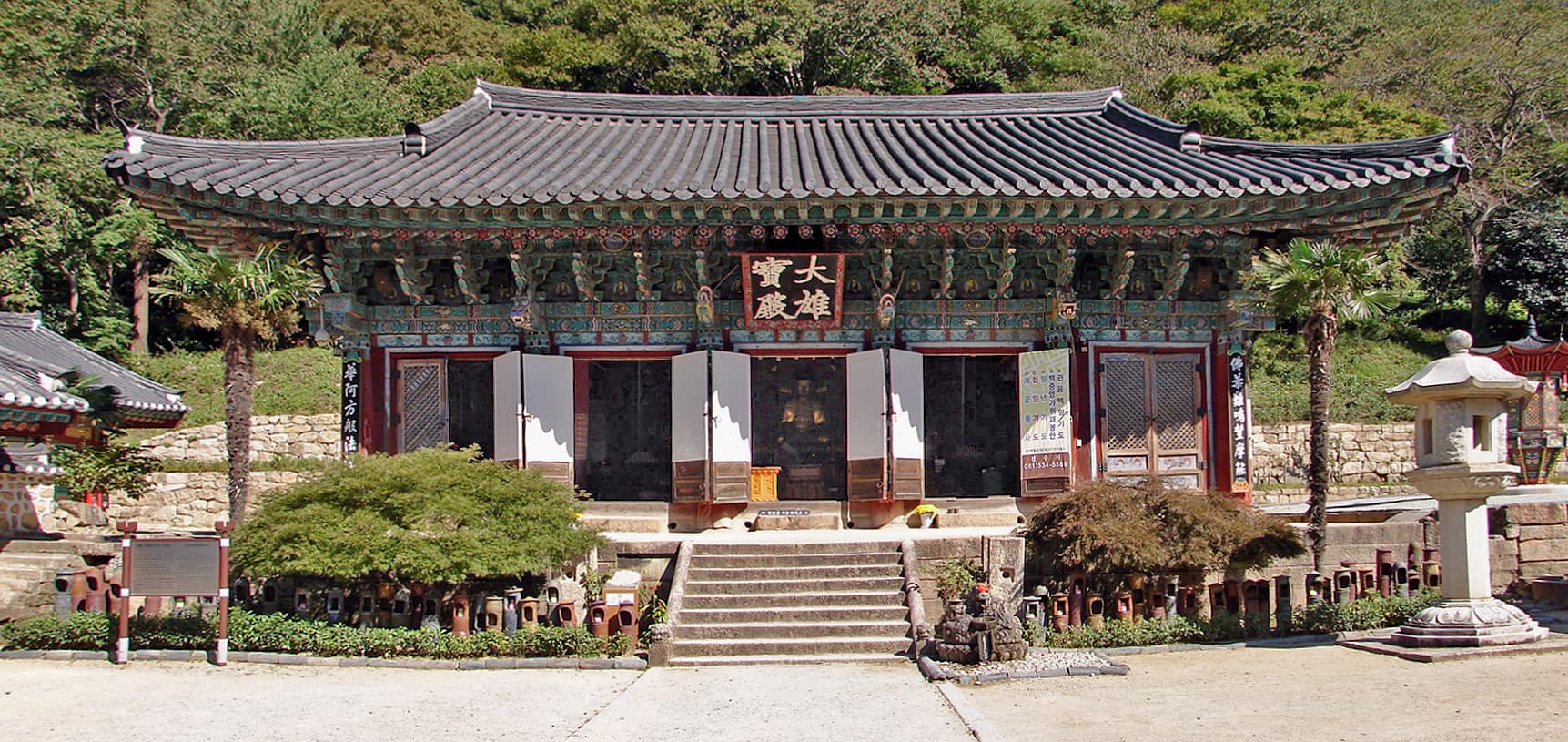
Daeheungsa Temple in Haenam, South Jeolla, South Korea. Image source · CC BY-SA 3.0
Visit essentials
A quick read before you go
- Duration
- Allow two to three hours for the main groups, and longer only if an authorized route or program…
- Access
- KTO lists free admission, year-round access, parking, and +82-61-534-5502, but asks visitors to…
Overview
Daeheungsa's unusual width changes how a visitor understands a Buddhist monastery: water separates building groups, paths fork, and important places lie beyond the first courts. Pyochungsa honors Seosan Daesa, whose monk soldiers answered the Japanese invasions, while Iljiam recalls Choui's decades joining solitary meditation and tea. Together they show public duty and inward cultivation held in one landscape. UNESCO's Sansa inscription recognizes the continuing religious function of such mountain monasteries.
Daeheungsa's sacred significance lies in this durable capacity to contain different forms of Buddhist responsibility.
Why this place is sacred
Duryunsan is sometimes described as resembling a reclining Buddha, and Seosan Daesa’s tradition calls the area a refuge from calamity. These are inherited interpretations, not geographical proof of supernatural protection. Their importance lies in how they shaped the choice to safeguard relics and sustain practice here. The stream-divided plan makes unity something a visitor must build by walking.
Moving from a main hall toward Pyochungsa or farther into the valley toward Iljiam reveals different scales of devotion: communal ceremony, memorial loyalty, and solitary cultivation. Tea is not a wellness accessory in this account; through Choui it belongs to a disciplined meeting of taste, meditation, and ethical attention.
Daeheungsa’s traditional foundation is attributed to the monk Ado, while the present page treats that account as received temple history.
The monastery became a center for Seosan Daesa’s legacy and later for Choui’s tea and Seon practice, while maintaining active worship.
Experience and orientation
Pause where Geumdangcheon divides the grounds and decide which cluster you are entering rather than assuming every roof belongs to one court. At Pyochungsa, the focus is memorial: objects and architecture point toward Seosan Daesa’s defense of the country. A route toward Iljiam shifts the register toward retreat and tea, requiring more time and attention to terrain. Distant ridges enclose the basin without making it feel narrow.
If you drink tea locally, resist claiming Choui’s lineage for an ordinary refreshment; first understand why his practice linked preparation, meditation, and sustained study.
Consult the precinct map, distinguish the north and south groups, and ask before taking paths toward hermitages or residential practice areas.
Context and lineage
KTO gives the temple tradition that Ado founded Daeheungsa during Baekje. Later history is more specific. During the Japanese invasions, it became the principal base for monk soldiers led by Seosan Daesa; Pyochungsa and a relic hall preserve his memory. In the nineteenth century, Choui lived and practiced for more than forty years at Iljiam, developing a tea lineage inseparable from Seon cultivation.
The current complex, rebuilt and maintained through successive periods, entered the World Heritage List in 2018 as a component of Sansa.
Daeheungsa belongs to Korean Buddhism, with especially visible lineages connected to Seosan Daesa and Seon Master Choui.
Traditions and practice
Rites in the main halls and at Pyochungsa should be understood through the temple’s own calendar. Tea associated with Choui is a form of cultivated practice, not a promise of therapeutic effect.
The monastery continues worship and visitor programs while interpreting cultural assets and the two major teacher lineages.
At the stream, name the form of attention each direction invites—communal, memorial, or solitary—then choose one path rather than collecting all of them hurriedly.
Korean Buddhism
ActiveKorean Buddhism at Daeheungsa encompasses public service, memorial lineage, Seon cultivation, and tea discipline.
Hall worship, memorial rites, meditation, teaching, tea preparation, and monastic stewardship.
Perspectives and open questions
Daeheungsa resists a single label by holding military memory, Seon, tea, worship, and heritage in relationship.
Scholarly perspective
Historians can separate the received foundation account from later documentary lineages and examine how rebuilding produced the present divided plan.
Living and traditional perspectives
Seosan Daesa and Choui exemplify different Buddhist responses—protection of community and refinement of contemplative life—within one monastery.
Open questions
Claims that the mountain guarantees safety or renewal remain traditional or promotional interpretations, not verified effects.
Plan your visit
Access and arrival
KTO lists free admission, year-round access, parking, and +82-61-534-5502, but asks visitors to inquire about operating hours. Verify before departure.
Use the official temple for current retreat or program arrangements; no independent lodging endorsement is made.
Respectful visit
Choose restrained clothing and walking shoes suitable for a large, uneven mountain precinct.
Ask before photographing ceremonies, relics, monks, or interiors; landscape photography must not block bridges and paths.
Use the temple’s own offering points and do not leave tea, food, or personal objects at shrines.
Respect closures around hermitages, monastic housing, archives, and conserved treasures.
Do not handle relic displays, enter hermitage quarters, or turn the reclining-Buddha description of Duryunsan into a factual energetic claim.
Current practical details
Address
South Korea, Haenam, Samsan-myeon, Daeheungsa-gil, 400 전남광주통합특별시
Phone
Hours
Hours, fees, and access can change — verify on the official source before you travel. Practical details last checked Jul 2026.
Location
Map loads as you approach this section.
Pilgrim reflections
A portrait of encounter, not a score
Pilgrims describe what they felt, how present they could become, and whether the place would shape a journey. There are no stars and no ranking of traditions.
No reviewed reflections yet
The first pilgrims can help describe the character of being here.
Share a reflection
Available after an account-backed “Been there.” Every reflection is reviewed before publication.
Nearby sacred places
Explore other sacred places in the region. Proximity does not establish access or travel time; check each place’s guidance.

References
Sources consulted for this page. Source categories describe the publication, not a guarantee that every claim is verified. Traditional accounts and outside interpretations may differ.
- 01Sansa, Buddhist Mountain Monasteries in Korea — UNESCO World Heritage CentreofficialAuthoritative World Heritage property record, dossier 1562; component scope preserved.
- 02Daeheungsa Temple — World Heritage nomination dossier — State Party of the Republic of Korea / UNESCOofficialPrimary nomination documentation for UNESCO property 1562, including serial-component identity, mapping, and heritage context.
- 03Daeheungsa Temple official website — Daeheungsa TempleofficialDomain matches the site or its managing religious/heritage body.
- 04Daeheungsa Temple [UNESCO World Heritage] — Korea Tourism OrganizationofficialOfficial tourism record for the Duryunsan setting, Seosan Daesa, Choui, tea culture, precinct layout, address, and current contact.
- 05Daeheungsa — Wikipedia — Wikipedia contributorsacademicCorroborates identity, location, and general historical context; key claims require higher-tier support.
- 06Daeheungsa — Wikidata — Wikidata contributorsSource contextCommunity-maintained structured identity and coordinate cross-check; not treated as scholarship or an official custodian record.
- 07Daeheungsa Temple — Google Maps place record — GoogleSource contextStrong identity match used only for current practical fields and coordinates.
Share a photo
Help visitors recognize Daeheungsa Temple. Every submission is reviewed before publication.