Key questions
- What is Serbian Orthodox Monasteries of Kosovo?
- Serbian Orthodox Monasteries of Kosovo is a Christianity pilgrimage route in Kosovo, Kosovo and Metohija. Four frescoed medieval Serbian Orthodox monuments under UNESCO protection in the contested heart of the Balkans
- How many stations are on Serbian Orthodox Monasteries of Kosovo?
- This guide currently maps 4 stations, with 4 total sites noted in the route metadata.
- When is the best time to walk Serbian Orthodox Monasteries of Kosovo?
- Late spring through autumn; the mountain approach to Dečani is cold and can be snowbound in winter
Opening
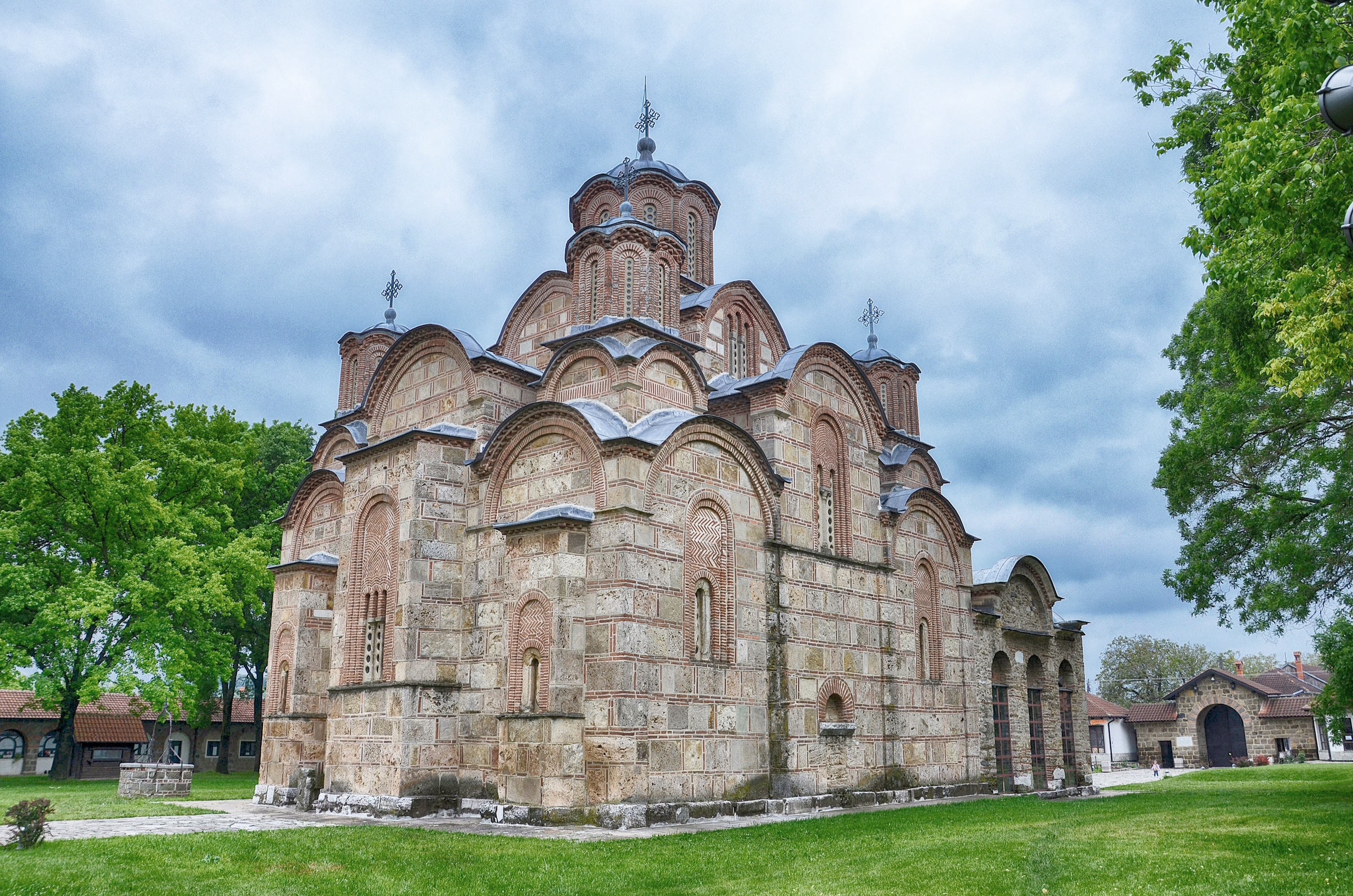
This is less a single road than a circle of four sanctuaries held within the same medieval world. A visit usually begins at the Patriarchate of Peć, where a cluster of churches stands against the mouth of the Rugova gorge, and moves to Visoki Dečani an hour south, its pale marble church rising in a chestnut wood beneath the mountains. From there the way crosses the plain of Kosovo to Gračanica, set now within a Serb village near Prishtina, and ends at the Church of Our Lady of Ljeviš in the old streets of Prizren. The four are not joined by a waymarked trail but by lineage, liturgy, and paint — to move between them is to walk the length of a vanished kingdom's devotion, and to pass, today, through checkpoints and quiet that mark how contested this ground remains.
Origins
The four monuments belong to the high medieval period of the Serbian Nemanjić dynasty, between the 13th and 14th centuries, when royal and ecclesiastical patronage raised churches whose interiors became among the richest fresco cycles in the Orthodox world. The Patriarchate of Peć grew into the seat of the autocephalous Serbian Church; Visoki Dečani, built for King Stefan Dečanski in the 1320s–30s, preserves more than a thousand painted figures under a Romanesque-Gothic and Byzantine fusion of stone; Gračanica, the foundation of King Milutin, is counted a masterwork of late Byzantine architecture; and the Church of Our Lady of Ljeviš at Prizren carries layered frescoes spanning centuries. UNESCO inscribed Dečani in 2004 and extended the listing to the other three in 2006 as the 'Medieval Monuments in Kosovo'; in the same year it placed them on the List of World Heritage in Danger, where they remain.
Why pilgrims walk it
For Serbian Orthodox faithful these monasteries are not monuments but the living body of a Church and a people's memory — the ground where the medieval kingdom, its saints, and the idea of Kosovo as a spiritual homeland are most concentrated. Pilgrims come to venerate relics and miracle-working icons, to attend the long sung liturgies of communities of monks and nuns who have kept the offices through war and exile, and to mourn and remember at a place many regard as a wellspring of national and religious identity. Others arrive as pilgrims of a different kind — historians, conservators, and travellers drawn by frescoes that rank among the summits of medieval art. The journey is rarely simple: it crosses a landscape where the same places carry profoundly different meanings for the communities who live around them, and to come at all is, for many, an act of devotion sharpened by that fragility.
Significance
Together the four churches preserve the golden age of Serbian medieval culture and one of the most complete surviving programmes of Palaiologan-era fresco painting anywhere. They are at once functioning Orthodox monasteries, UNESCO World Heritage, and emblems at the centre of one of the Balkans' most painful disputes. Dečani and Peć remain home to monastic communities; several of the sites were damaged in the violence of 1999 and the riots of 2004, and the listing's 'in danger' status reflects both that history and continuing concerns over security and protection. They are guarded and managed under arrangements that the surrounding communities and authorities understand in very different terms — a reality this page records without taking a position on the political status of the territory.