Key questions
- What is Four Sacred Buddhist Mountains of China?
- Four Sacred Buddhist Mountains of China is a Buddhism pilgrimage route in China, Shanxi, Sichuan, Anhui, Zhejiang. Four mountains across China, each held as the earthly abode of a different bodhisattva, visited in any order pilgrims choose
- How many stations are on Four Sacred Buddhist Mountains of China?
- This guide currently maps 4 stations, with 4 total sites noted in the route metadata.
- When is the best time to walk Four Sacred Buddhist Mountains of China?
- Late spring through early autumn; Wutai and Emei are cold and can be snowbound in winter
Opening
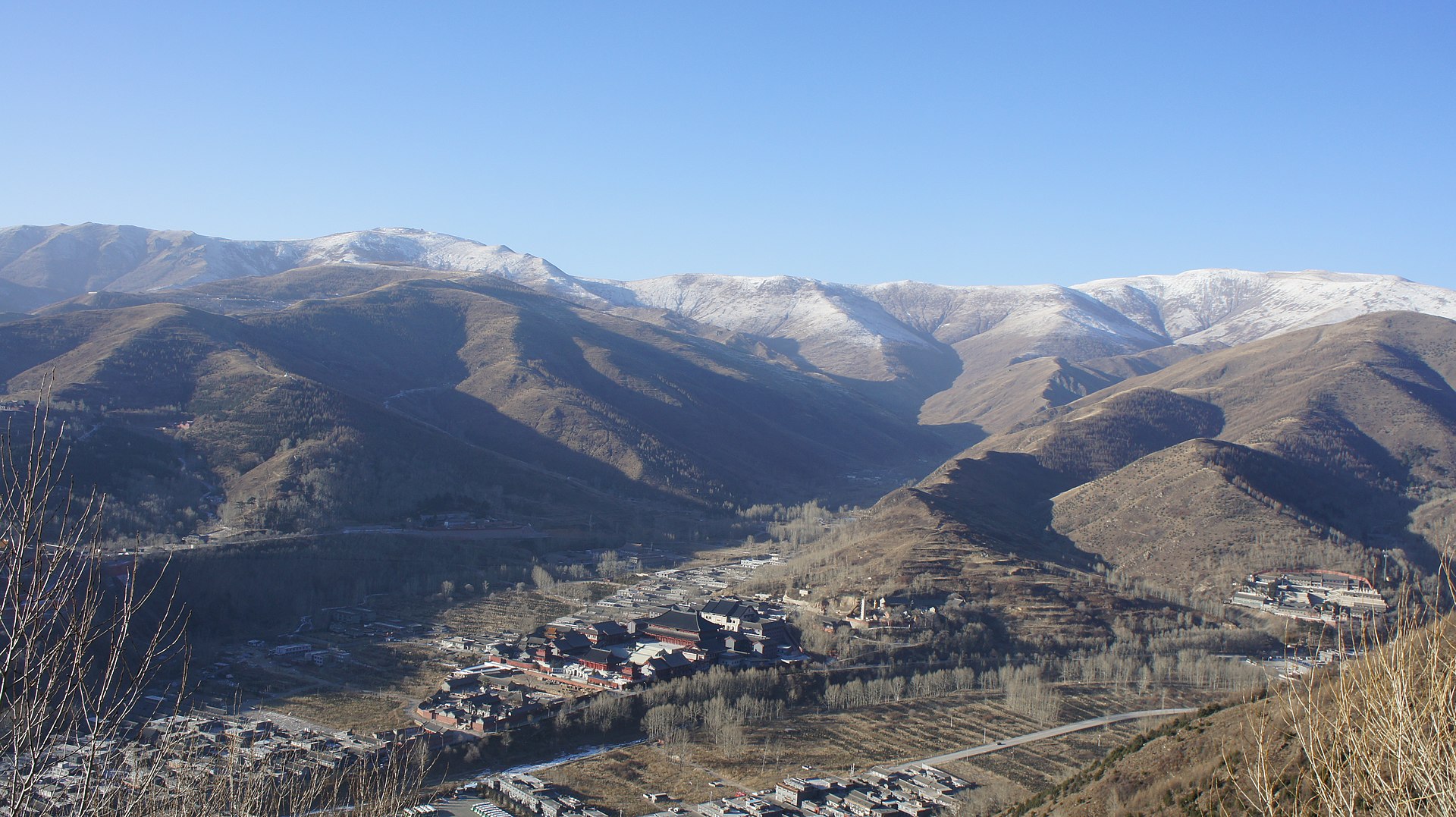
The four mountains sit far apart from one another — Wutai in the north's Shanxi highlands, Emei rising out of the Sichuan basin to the west, Jiuhua in the hill country of Anhui, and Putuo on a small island off the coast of Zhejiang — and no single route connects them. There is no fixed order to visiting them and no expectation that a pilgrim will complete all four in one lifetime, let alone one journey; they are approached individually, as a set held together by devotion rather than geography. Each mountain is understood as the earthly residence of a specific bodhisattva, and to climb any one of them is to enter a landscape where a particular quality of enlightened compassion is said to still be resident and reachable.
Origins
Monastic settlement developed at each mountain over centuries rather than by any single founding act. Wutai's association with Manjushri, the bodhisattva of wisdom, is attested from as early as the Northern Wei and Tang dynasties, when Chinese and foreign pilgrims alike — including monks from Japan and Korea — traveled to its terraced peaks; Emei's connection to Samantabhadra, bodhisattva of practice and meditation, grew through the Tang and Song periods around monasteries built into its steep, forested slopes; Jiuhua's identification with Ksitigarbha, who vowed not to achieve buddhahood until the hells were emptied, is tied to the Tang-dynasty account of the Korean monk Kim Kiao-kak, venerated after his death as an incarnation of the bodhisattva; and Putuo's link to Guanyin (Avalokiteshvara), bodhisattva of compassion, grew from a ninth-century account of a Japanese monk prevented by storms from carrying a Guanyin statue away from the island, who left it there instead — the origin, by tradition, of the island's temple. The grouping of all four into a single set — "the four great [Buddhist] mountains" — became conventional by the late imperial period.
Why pilgrims walk it
Pilgrims come to each mountain for the particular bodhisattva it holds rather than for the set as a whole: Wutai draws those seeking wisdom and clarity of mind, often students and scholars alongside monastics; Emei draws those pursuing sustained meditative practice, its long stone stairways treated as a physical discipline in themselves; Jiuhua draws mourners and those praying for the dead, given Ksitigarbha's vow to deliver beings from hell-realms before his own liberation; Putuo, easily reached by ferry from the mainland, draws enormous numbers seeking Guanyin's compassion for illness, family trouble, and everyday hardship, and is often a pilgrim's first experience of any of the four. Many devout Chinese Buddhists do aim, over a lifetime, to visit all four — not as a single circuit but as four separate acts of devotion undertaken whenever life and opportunity allow, each one complete in itself regardless of whether the other three are ever reached.
Significance
The four-mountain framework organizes an enormous share of Chinese Buddhist devotional geography around the concept that bodhisattvas are not only cosmic figures but beings who maintain an ongoing, locatable presence in the physical world. Each mountain developed its own dense monastic culture — Wutai alone holds monasteries in the Han Chinese, Tibetan, and Mongolian Buddhist styles side by side, a legacy of Qing-dynasty imperial patronage that brought Tibetan Buddhism into a historically Han Chinese pilgrimage site. Emei and Wutai both carry UNESCO World Heritage recognition tied to their monastic and natural landscapes; Putuo has become one of the most heavily visited pilgrimage sites in China, its ferry terminals handling large-scale devotional tourism during Guanyin's major festival days. The four mountains, taken together, are often cited as the clearest working demonstration of how Chinese Buddhism localized abstract cosmological figures into specific, climbable, visitable terrain.


