All pilgrimages

Pilgrimage · Turkey · Aegean and western Anatolia (ancient Roman Asia)

Seven Churches of Revelation

Ἀποκάλυψις Ἰωάννου — αἱ ἑπτὰ ἐκκλησίαι

Seven first-century congregations addressed by name in the Book of Revelation, each given a specific commendation or rebuke.

Stations
6 of 7
Founded
1st century CE; the letters are traditionally dated to the reign of Domitian, c. 95 CE
Focus
The seven letters of Revelation 2–3, dictated to John of Patmos for the churches of Roman Asia
Best season
April–June and September–October; summer heat is severe across the Aegean lowlands

Key questions

What is Seven Churches of Revelation?
Seven Churches of Revelation is a Christianity pilgrimage route in Turkey, Aegean and western Anatolia (ancient Roman Asia). Seven first-century congregations addressed by name in the Book of Revelation, each given a specific commendation or rebuke
How many stations are on Seven Churches of Revelation?
This guide currently maps 9 stations, with 7 total sites noted in the route metadata.
When is the best time to walk Seven Churches of Revelation?
April–June and September–October; summer heat is severe across the Aegean lowlands

Opening

The route runs down the Aegean coast of Anatolia and inland along the Lycus valley, tracing seven Roman cities that once held Christian congregations prosperous enough, or troubled enough, to be named individually in a single vision. It begins at Ephesus, where a harbor city's colonnaded streets and a great library facade still stand inland from a coastline that has silted away since antiquity, and moves north to the old acropolis at Pergamon, east through the plains toward Thyatira and Sardis, and south again to Philadelphia and, at the end of the line, Laodicea above the Lycus River. To walk or drive between them today is to move through a landscape of ruins, minarets, and modern Turkish towns built into and around the old civic centers — Ephesus a UNESCO-listed field of marble, Laodicea still mid-excavation, Thyatira and Philadelphia barely marked beneath modern Akhisar and Alaşehir.

Origins

Tradition holds that John, exiled on the island of Patmos, received a vision of the risen Christ who dictated seven letters, one for each of these cities' churches, later assembled as the opening chapters of the Book of Revelation. The letters are traditionally dated to the last years of the emperor Domitian's reign, around 95 CE, and internal evidence — an author writing as a prisoner addressing named, contemporary congregations by their specific local troubles — is treated by most scholars as placing the text within living memory of the churches it describes, even where the wider authorship and dating of Revelation remain debated. Each of the seven cities was already an established center of Roman civic life by the first century; the congregations addressed were established communities within cities with their own imperial cults, trade guilds, and civic identities, which is part of why each letter speaks to a distinct local temptation — commerce at Laodicea, imperial worship at Pergamon, division at Thyatira.

Why pilgrims walk it

Few people walk this route as a single physical pilgrimage in the way one might walk the Camino; most who come are Christian travelers building a broader itinerary of Pauline and Johannine sites across western Turkey, and they arrive by tour bus or rental car rather than on foot between towns that are, in places, a full day's drive apart. What draws them is the text itself, read aloud in situ: the promise to the church that endured at Ephesus, the warning against complacency at Laodicea whose lukewarm water still runs mineral-white over the travertine terraces at nearby Hierapolis, the commendation of the poor and persecuted church at Smyrna, a city that continued as an important Christian center for centuries after the letter was written. Others come as archaeologists and history travelers with no devotional stake at all, drawn by Ephesus's scale or Sardis's excavated synagogue and gymnasium complex. Both kinds of visitor tend to leave struck by the same thing: that a text this specific, this personally addressed, was written to describe named, particular communities rather than an abstract church — and that walking their streets closes some of the distance between the reader and that specificity.

Significance

Together the seven letters form a rhetorical unit — praise, rebuke, and warning distributed across seven distinct civic and spiritual situations — that has shaped Christian reading of Revelation for nineteen centuries, from patristic commentary through medieval allegory to modern historical-critical scholarship. Religiously, the seven churches are read variously as historical congregations, as archetypes of the wider Church across ages, or as both at once; this page does not resolve that tension, since neither reading has displaced the other in nearly two thousand years of use. Culturally, the cities themselves carry independent weight far beyond their biblical mentions: Ephesus was among the largest cities of the Roman world and held the Temple of Artemis, one of the Seven Wonders of the ancient world; Sardis was the capital of the Lydian kingdom credited with inventing coinage; Pergamon's library rivaled Alexandria's. The Christian association is one layer among several that make these sites significant, and most of what a visitor encounters on the ground is the deeper Greco-Roman and Anatolian history the early church grew out of.

The route

9 stations on the map

Click any marker to open that station. Numbered pins follow the traditional route order.

Loading map...

Stations

Walk the route in order

Each station opens onto its own page. Origins, the experience of arrival, what is held there. Stations not yet on Pilgrim Map will appear here as their pages are completed.

  1. 1

    Station 1

    Ephesus

    Selçuk, Aegean Region

    For three millennia, the hills above Ephesus have been sacred to feminine divinity—first Cybele, then Artemis whose temple was one of the Seven Wonders, and now Mary, mother of Jesus, whose traditional final home draws pilgrims from across the world. This is where the Council of 431 declared Mary 'Theotokos' (God-bearer), where St. John wrote his Gospel, and where Christians and Muslims share veneration of the same sacred figure.

  2. 2

    Station 2

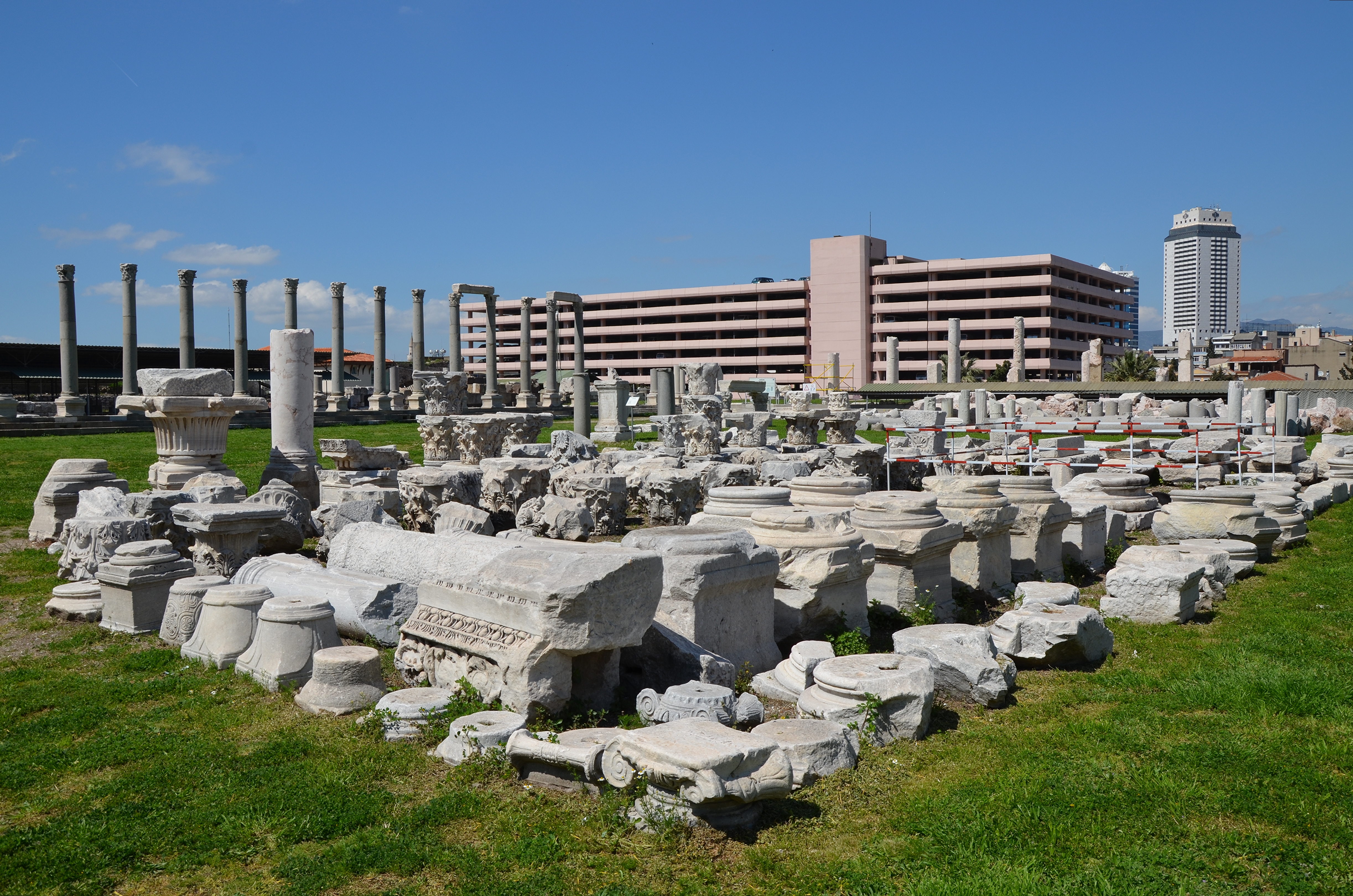
    Old Smyrna

    Within a residential neighbourhood of modern İzmir, the Tepekule mound rises ten metres above the surrounding streets — a compressed record of human settlement from the Bronze Age through the Hellenistic period. Here, around 1000 BC, Aeolian Greek colonists built one of the earliest planned cities in Ionia, raised a sequence of Athena temples among the oldest in Anatolia, and may have sheltered a poet named Homer. The mound has been inhabited for five millennia and excavated for nearly a century.

  3. 3

    Station 3

    Red Basilica

    The Red Basilica at Pergamon is one of the ancient world's most layered sacred spaces. Built by Hadrian in the 2nd century CE as a sanctuary for the Egyptian gods Serapis, Isis, Osiris, and Harpocrates, it was later converted into one of Asia Minor's largest churches and addressed directly in the Book of Revelation. One of its rotunda towers has been an active mosque since the early Republican period. The same site has served three distinct religious traditions across nearly twenty centuries.

  4. 4

    Station 4

    Thyatira

    Akhisar, Akhisar, Manisa Province

    Thyatira was the smallest of the seven cities addressed in the Book of Revelation, yet it received the longest of Christ's seven letters — commended for endurance, admonished for tolerating a self-styled prophetess who blurred the line between guild life, pagan ritual, and Christian teaching. Today its remains sit fenced within the working streets of Akhisar, a modest excavation whose scriptural weight outweighs its visible ruins.

  5. 6

    Station 6

    Philadelphia (Asia Minor)

    Alaşehir, Alaşehir, Manisa Province

    Ancient Philadelphia survives only in fragments — three worn pillars of a Byzantine basilica, a stretch of city wall, an unexcavated theater — scattered through the streets of modern Alaşehir. Among the Seven Churches addressed in the Book of Revelation, it alone received no rebuke, only a promise: an open door no one could shut. That promise outlasted the city itself, which held on as Byzantium's last free Christian outpost in Asia Minor until 1390.

  6. 7

    Station 7

    Laodicea on the Lycus

    Denizli, Denizli, Denizli Province

    Laodicea on the Lycus was a wealthy Hellenistic and Roman city in Turkey's Lycus Valley, refounded around 261-253 BC by the Seleucid king Antiochus II. It later became a Christian bishopric, and its congregation received the most severe of the seven letters in the Book of Revelation - rebuked not for wickedness but for lukewarmness. Today the unroofed ruins stand under active excavation, still yielding new understanding of the city Christ criticized rather than commended.

  7. Station —

    Pergamon

    Pergamon rises 330 metres above the Bakırçay plain on a natural acropolis that the Attalid kings transformed into one of the ancient world's densest concentrations of sacred architecture: temples to Zeus, Athena, Dionysus, and Demeter, a library of 200,000 scrolls, and a theatre so steep it seems to pour into the sky. The Book of Revelation named it the city 'where Satan's throne is' — a reference to its Roman imperial cult temples. Today it carries UNESCO inscription and two living pilgrimage traditions: Christian and scholarly.

  8. Station —

    Sardis

    Manisa, Salihli

    Sardis was the capital of the Lydian Empire, the city where coinage was invented, and a site where Artemis, Cybele, Yahweh, and Christ each in turn held sacred space. Now a UNESCO World Heritage Site (inscribed 2025), Sardis offers two visitable areas — the massive Temple of Artemis and the extraordinary Roman Gymnasium with its synagogue — that together represent the widest arc of sacred layering in western Anatolia.

  9. Station —

    Sardis Temple of Artemis

    Two surviving Ionic columns rising against the Lydian hills are what remains of the fourth largest temple in the ancient world — a structure that replaced a Lydian sanctuary to the Great Mother, absorbed Roman imperial cult into its own cella, and finally sheltered an early Christian church. The sacred landscape here was never still; it was always becoming something else.

Walking it today

The seven sites are scattered across a broad stretch of western Turkey — from Ephesus near modern Selçuk to Laodicea near Denizli — and are practically visited by car over several days rather than walked as a continuous route; no waymarked trail links them. Ephesus and the travertine terraces of Hierapolis (adjacent to Laodicea) draw large numbers of general tourists and can be crowded at midday; the other five sites, especially Thyatira (largely built over by modern Akhisar) and Old Smyrna, are quieter and in places minimally marked. Spring and early autumn avoid both the harsh Aegean summer heat and winter closures. Most travelers base themselves in İzmir or Selçuk and drive the circuit over three to five days, supplementing site visits with the biblical text read at each stop.

Sources

  • Book of Revelation, chapters 2–3 (the seven letters to Ephesus, Smyrna, Pergamon, Thyatira, Sardis, Philadelphia, and Laodicea).
  • Hemer, Colin J. The Letters to the Seven Churches of Asia in Their Local Setting. Eerdmans, 1986/2001.
  • Turkish Ministry of Culture and Tourism — archaeological site documentation for Ephesus, Pergamon, Sardis, and Laodicea; Ephesus UNESCO World Heritage listing (whc.unesco.org/en/list/1018).