Regional guide
Sacred sites in Sedona
A compact desert cluster of vortex landscapes, red-rock canyons, and multi-faith sanctuaries in northern Arizona.
Sedona-linked sites
The current atlas entries that make up the Sedona cluster.

Airport Mesa, Sedona
Sedona, Arizona, United States
Perched above Sedona with 360-degree views of the red rock landscape, Airport Mesa offers the most accessible encounter with vortex energy. The masculine, upflow quality here supports clarity, motivation, and the kind of expanded perspective that comes from seeing far. Sunrise and sunset transform this overlook into something numinous.
Vortex at Boynton Canyon, Sedona
Sedona, Arizona, United States
Boynton Canyon holds the creation story of the Yavapai-Apache people, who understand this as the literal birthplace of their nation. The 80-foot Kachina Woman spire stands sentinel at the canyon's entrance, marking ground so sacred that tribal members gather here still for sunrise blessing ceremonies. For New Age seekers, this represents Sedona's most powerful balanced vortex. For the Yavapai-Apache, it is home.
Vortex at Cathedral Rock, Sedona
Sedona, Arizona, United States
Cathedral Rock rises from the Sedona landscape like hands raised in prayer, its twin spires reflected in the waters of Oak Creek below. Known as the deepest magnetic vortex in Sedona, this formation carries feminine energy—receptive, nurturing, drawing seekers inward toward emotional release and gentle self-discovery. Where the creek flows closest to the rock, something softens.
Sedona, Arizona
Sedona, Arizona, United States
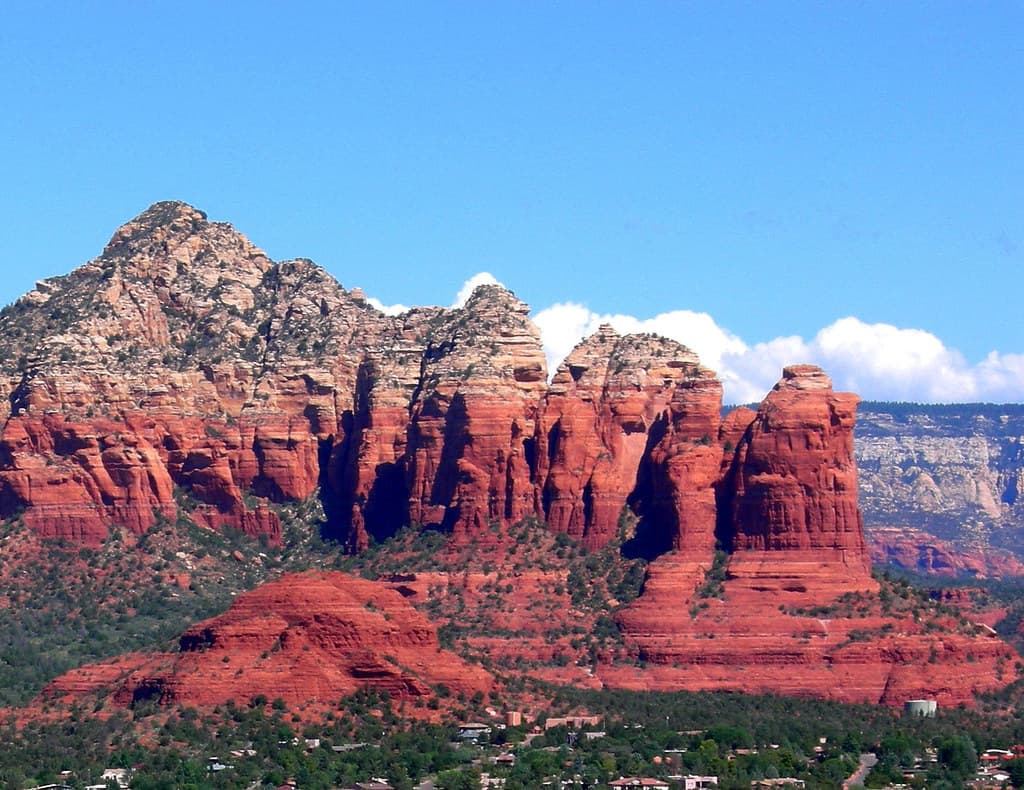
Sedona, Arizona is a site of sacred significance. Approximate coordinates: 34.88613, -111.80722. Sedona ( si-DOH-nə) is a city that straddles the county line between Coconino and Yavapai counties in the northern Verde Valley region of the U.S. state of Arizona. As of the 2010 census, its population was 10,031. The city is within the Coconino National Forest. Sedona s main attraction is its array of red sandstone formations. The formations appear to glow in brilliant orange and red when illuminated by the rising or setting sun. The red rocks form a popular backdrop for many activities, ranging from spiritual pursuits to the hundreds of hiking and mountain biking trails. Sedona was named after Sedona Schnebly whose husband, Theodore Carlton Schnebly, was the city s first postmaster. She was celebrated for her hospitality and industriousness. Her mother, Amanda Miller, claimed to have made the name up because it sounded pretty . Located in Arizona, United States.