Tadzong National Museum, Trongsa
A 17th-century watchtower above Trongsa Dzong, now housing the royal and Buddhist heritage of the Wangchuck dynasty
Understand sacred places, explore living traditions, and learn how to engage respectfully with Pilgrim Map.
Access has not been verified. Check current local guidance before planning a visit.
Bagochen Boolingpang Ueling, Trongsa, Bhutan
Read the sources
Image of Tadzong National Museum, Trongsa. Image source · CC-BY-SA-4.0
Visit essentials
A quick read before you go
- Duration
- 1 to 2 hours.
- Access
- Short uphill walk from Trongsa town.
Overview
Above Trongsa Dzong, a cylindrical watchtower has commanded views in every direction since 1652. Chogyal Minjur Tenpa, the first Governor of Trongsa, built the Ta Dzong as the eyes of the fortress below, with four surveillance points aligned to the Dragon, Garuda, Tiger, and Lion — Bhutanese cosmology's celestial guardians of the four directions.
Restored with Austrian technical support, the tower was inaugurated by King Jigme Khesar Namgyel Wangchuck in 2008 as the Royal Heritage Museum, or Tower of Trongsa. Eleven galleries across five floors present Bhutan's intertwined Buddhist and monarchical history. Active chapels dedicated to King Gesar of Ling and Buddha Maitreya preserve its sacred dimension.
From the ground-floor directional guardians, the collection moves through Buddhist ritual practice, royal regalia, and personal artifacts of the Wangchuck kings. The first king's Raven Crown, ceremonial robes, ancient armour, 17th-century clay statues, a diamond scepter, and a ritual dagger show how Bhutanese spiritual authority and governance have remained inseparable.
Why this place is sacred
A watchtower is built to see without being seen. Its purpose is surveillance — the scanning of horizons for threat. The Ta Dzong performed this function for over three centuries, its four points oriented to the four celestial animals, each guarding a direction. The building was an instrument of attention.
That quality of attention has not disappeared; it has been redirected. The eleven galleries ask the visitor to look carefully — at a clay statue from the 17th century, at the Raven Crown of the first king, at a ritual dagger used in Buddhist ceremonies. The act of seeing, which was once military, becomes contemplative. The chapels of King Gesar and Buddha Maitreya ensure that the building's sacred function endures alongside its new role as museum.
There is something appropriate about a watchtower becoming a place of reflection. Both activities require sustained attention. Both ask you to look longer and more carefully than comfort demands.
Built in 1652 as a military watchtower to protect Trongsa Dzong, with four surveillance points aligned to the four celestial animals of Bhutanese cosmology.
From watchtower to museum (2005-2008 restoration and conversion). The addition of two active chapels ensures the building continues to serve a devotional function alongside its educational role.
Experience and orientation
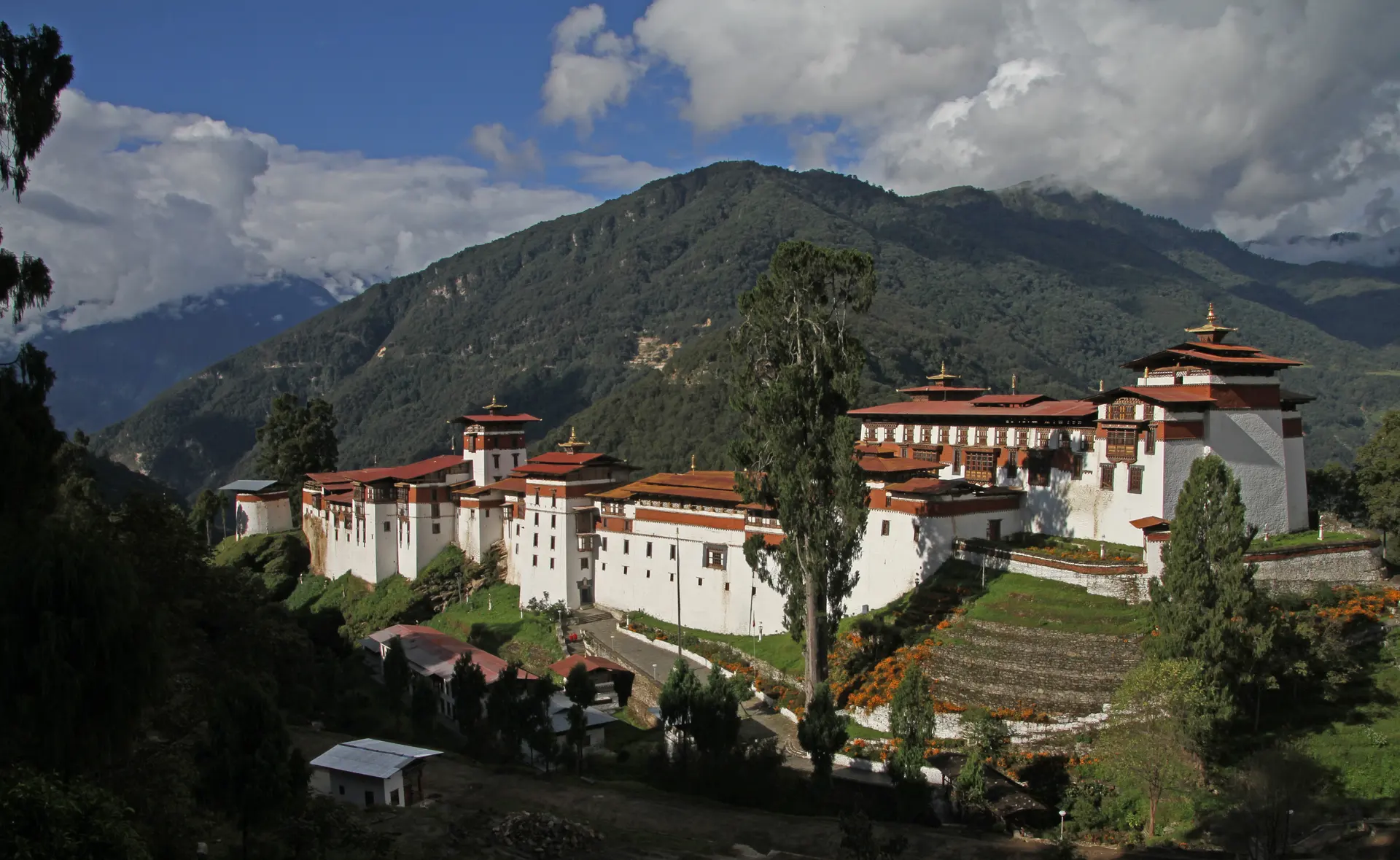
The approach is uphill from Trongsa town, and the panorama that opens as you reach the Ta Dzong is the first exhibit. Below, Trongsa Dzong spreads across its spur in all its labyrinthine complexity — the largest dzong in Bhutan, the cradle of the monarchy. Beyond, the Mangde Chhu gorge drops away and the Black Mountains rise in the distance. This view was the watchtower's purpose, and it remains extraordinary.
Inside, the galleries ascend through five floors. The ground floor introduces the four guardian kings, setting the cosmological frame. Higher floors move through Buddhist ritual practice — sculptures of Shakyamuni, a diamond scepter, a ritual bell and dagger — to the personal realm of the Wangchuck dynasty. The first king's possessions, photographs, and ceremonial robes are displayed with a restraint that allows the objects to speak for themselves.
The two chapels offer a different register. The Gesar Lhakhang honors the legendary warrior-king whose exploits are central to Tibetan and Bhutanese epic tradition. The Maitreya Lhakhang looks forward, housing the Buddha of the future. Between these two — past legend and future hope — the museum holds the present.
Visit the Ta Dzong before or after Trongsa Dzong to understand the relationship between watchtower and fortress. Begin on the ground floor with the guardian kings and ascend through the galleries in sequence. Spend time with the view from the upper floors. Visit the chapels last, allowing the devotional register to conclude the experience.
Context and lineage
Chogyal Minjur Tenpa, the first Governor of Trongsa, built the watchtower in 1652 to guard the dzong that would become the seat of the Wangchuck dynasty. Its four surveillance points, shaped to resemble the four celestial animals, aligned the structure with Bhutanese cosmological principles of directional protection.
The Ta Dzong belongs to the Drukpa Kagyu lineage through its association with Trongsa Dzong. The museum preserves artifacts from the Wangchuck dynasty, whose authority is rooted in the Drukpa Kagyu tradition.
Chogyal Minjur Tenpa
1st Governor of Trongsa, builder of the Ta Dzong in 1652
King Jigme Khesar Namgyel Wangchuck
Inaugurated the Royal Heritage Museum on December 10, 2008
Traditions and practice
The two chapels — Gesar Lhakhang and Maitreya Lhakhang — remain active for prayer and devotion. Buddhist ritual objects in the galleries are presented in their devotional context rather than as purely aesthetic artifacts.
Functions as a state-of-the-art museum with English-language interpretation. Rotating exhibitions complement the permanent collection.
Allow the Buddhist ritual gallery (sixth gallery) time. The diamond scepter, bell, and dagger are not merely objects but instruments of practice. The chapels offer space for quiet reflection after the galleries.
Drukpa Kagyu
ActiveHouses artifacts of the Wangchuck dynasty, whose authority derives from the Drukpa Kagyu lineage. Two active chapels maintain the devotional function.
Museum exhibition, chapel worship, preservation of royal-Buddhist heritage
Perspectives and open questions
The Ta Dzong can be understood as military architecture repurposed for contemplation, as a repository of Bhutan's inseparable spiritual and political heritage, and as a cosmological structure aligned to the four directions.
Scholarly perspective
The museum is well-curated and effectively presents the relationship between Buddhism and governance in Bhutan. The Austrian-supported restoration preserved the traditional architecture while adding modern conservation infrastructure.
Living and traditional perspectives
The four celestial animals — Dragon, Garuda, Tiger, Lion — are not decorative motifs but expressions of directional protection rooted in Buddhist cosmology. Their presence on a military structure extends this protection from the spiritual plane to the physical.
Alternative interpretations
The transformation from watchtower to museum mirrors a broader shift in Bhutan: from a society organized around military defense to one that seeks to preserve and transmit its heritage through education and cultural institutions.
Open questions
Some royal artifacts in the collection are not publicly displayed. The full inventory of the museum's holdings is not available in public sources.
Plan your visit
Access and arrival
Short uphill walk from Trongsa town. Trongsa is approximately 6-7 hours by road from Thimphu in central Bhutan, on the route between western and eastern Bhutan.
Guesthouses and small hotels in Trongsa town.
Respectful visit
Modest dress appropriate for a museum with sacred spaces.
May be restricted in certain galleries and is prohibited in the chapels. Check current policy at the entrance.
Possible in the chapels.
Do not touch artifacts | Shoes removed in chapels | Quiet throughout | Follow gallery route
The steep internal stairs may be challenging for those with mobility limitations. Natural light is best between 9 AM and 2 PM.
Current practical details
Address
FGX5+P2H, Bumthang - Ura Hwy, Trongsa, Bhutan
Phone
Hours
Hours, fees, and access can change — verify on the official source before you travel. Practical details last checked Jun 2026.
Location
Map loads as you approach this section.
Pilgrim reflections
A portrait of encounter, not a score
Pilgrims describe what they felt, how present they could become, and whether the place would shape a journey. There are no stars and no ranking of traditions.
No reviewed reflections yet
The first pilgrims can help describe the character of being here.
Share a reflection
Available after an account-backed “Been there.” Every reflection is reviewed before publication.
Nearby sacred places
Explore other sacred places in the region. Proximity does not establish access or travel time; check each place’s guidance.

References
Sources consulted for this page. Source categories describe the publication, not a guarantee that every claim is verified. Traditional accounts and outside interpretations may differ.
- 01The Royal Heritage Museum - Tower of Trongsa (official site) — Tower of TrongsaSource contextOfficial museum website
- 02Royal Heritage Museum - National Museums of Bhutan — Museums of BhutanSource contextGovernment museum information
- 03Lonely Planet - Tower of Trongsa — Lonely PlanetguideVisitor guide
- 04Druk Asia - Royal Heritage Museum — Druk AsiaguideVisitor overview
- 05Taa Dzong - Authentic Bhutan Tours — Authentic Bhutan ToursguideHistory and galleries
- 06Tower of Trongsa - Little Bhutan — Little BhutanguideOverview and exhibits
Share a photo
Help visitors recognize Tadzong National Museum, Trongsa. Every submission is reviewed before publication.