Choedrak Monastery
A cliff hermitage where Guru Rinpoche rode a tigress and Longchenpa wrote the Seven Treasures
Understand sacred places, explore living traditions, and learn how to engage respectfully with Pilgrim Map.
Access has not been verified. Check current local guidance before planning a visit.
Gyaltsa, Bumthang, Bhutan
Read the sources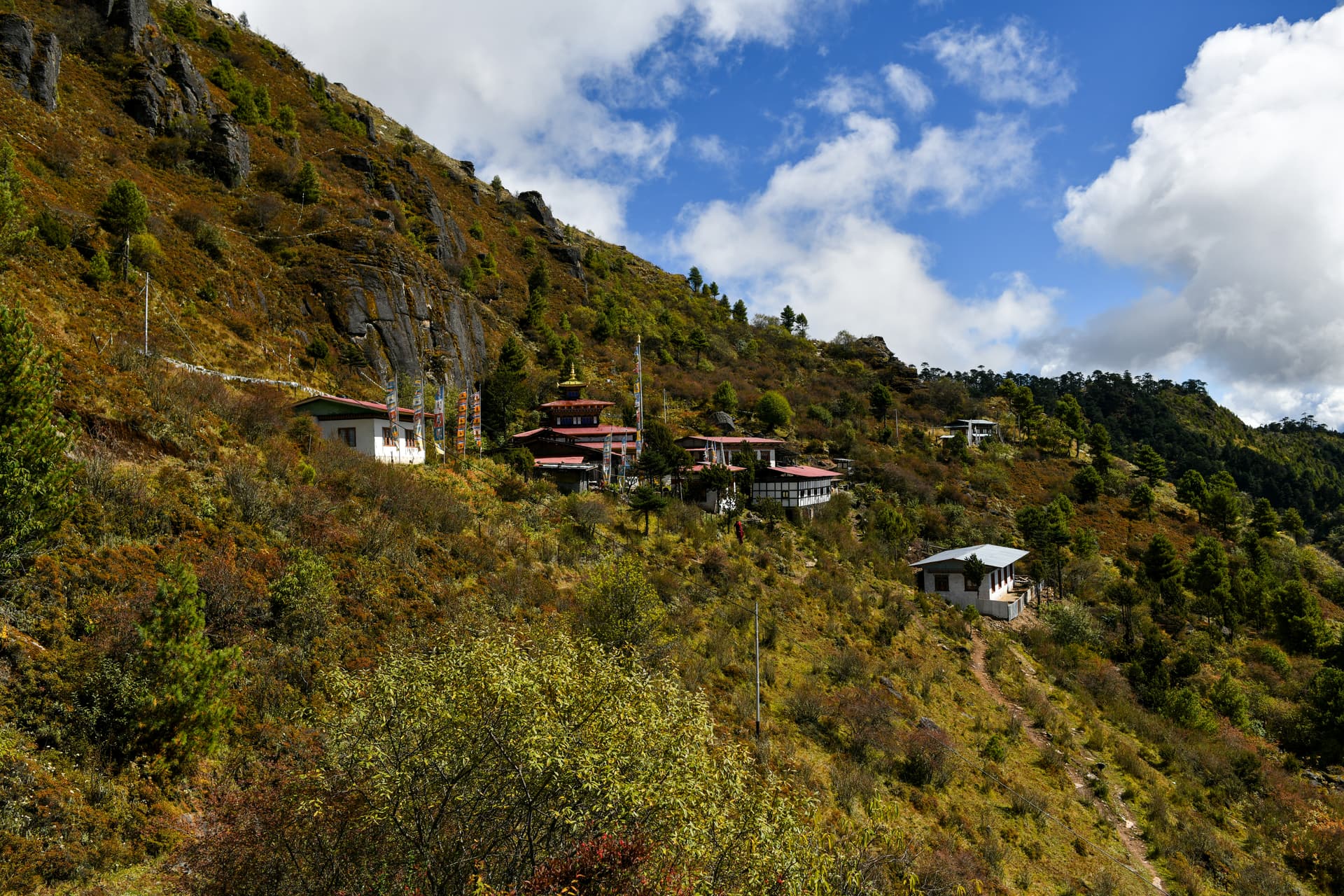
Image of Choedrak Monastery. Image source · CC-BY-SA-4.0
Visit essentials
A quick read before you go
- Duration
- Full day from Bumthang, including 2-6 hours of hiking depending on route
- Access
- Two routes: (1) From Tharpaling Monastery (37km from Chamkhar), a steep 1-hour climb.
Overview
Choedrak does not invite casual visitation. It is one of four Bumthang Valley cliffs where Guru Rinpoche is said to have meditated after arriving on a tigress. The cliff itself — rock face, altitude, sky, and weather — is the sacred object, reducing the boundary between practitioner and element. Gyalwa Lorepa found it in the twelfth century and remained for twenty-two years, a sustained inhabitation of silence remembered beside Guru Rinpoche's stone footprint in a chapel.
Above the monastery, a cave recalls Longchenpa's composition here of part of the Seven Treasures, among the Nyingmapa tradition's most important texts, at the edge of habitable altitude. White structures against the cliff now hold chapels, a sacred chorten, and a spring, while monks continue retreat practice. Rebuilt in the eighteenth century after an exorcism, Choedrak carries a recurring pattern of difficulty, clearing, and renewal.
Why this place is sacred
The four sacred meditation cliffs of Guru Rinpoche in Bumthang function as a mandala across the landscape, each cliff anchoring a direction and a quality of practice. Choedrak is the cliff where solitude becomes absolute. At 3,800 metres, above the forest line, pressed against rock that drops away below and rises above, a practitioner here occupies a position where the usual supports of human life — shelter, company, warmth — are reduced to their minimum.
This reduction is the point. Gyalwa Lorepa's twenty-two years here were not an endurance test but an investigation into what remains when everything unnecessary is removed. Longchenpa's decision to compose the Seven Treasures at this altitude suggests that certain texts require certain conditions — that the clarity of high places and bare rock participates in the clarity of the teaching.
The spring that flows near the monastery adds a counterpoint to the austerity. Water, the minimum requirement for life, emerging from stone at nearly four thousand metres. The chapels, white against grey rock, hold their ground between sky and depth.
Sacred meditation cliff of Guru Rinpoche, later used by Gyalwa Lorepa for his extended twenty-two-year retreat.
The site moved from legendary association with Guru Rinpoche to active hermitage under Gyalwa Lorepa, to a period of inaccessibility when a demon was said to inhabit it, to rebuilding after Ngawang Trinley's eighteenth-century exorcism. This cycle of occupation, abandonment, and return characterizes hermitage sites across the Himalayan Buddhist world.
Experience and orientation
There are two approaches to Choedrak. The first begins at Tharpaling Monastery, thirty-seven kilometres from Chamkhar, and climbs steeply for about one hour. The second follows a three-hour trail through deep forest from Lamey Goenpa in the Choekhor Valley, crossing a pass. Both approaches demand physical effort and both accomplish the same thing — they separate the visitor from the ordinary world by increments of altitude and exertion.
The monastery appears as white structures against grey cliff. Two ancient chapels, a chorten, and a spring form the core of the complex. Inside the chapels, Guru Rinpoche's stone footprint and the skull of a celestial being are held as sacred objects. The Thukje Lhakhang houses a striking thousand-armed statue of Chenresig, the Buddha of Compassion. Above the monastery, Longchenpa's meditation cave and rock throne can be visited, though the additional climb requires care.
The quality of the place is one of exposure and shelter in equal measure — the cliff provides a wall, but the sky is immediate above and the valley drops far below. Sound carries differently at this altitude. The silence is not empty but pressurized, as though the air itself has been listening for centuries.
Start early. The hike demands attention and fitness. When you arrive, do not rush to the chapels. Sit first and let the altitude settle in your body. Visit the chapels slowly. If you climb to Longchenpa's cave, go carefully and take time to sit where he sat. The descent will feel different from the ascent — lighter, as though you have left something at the cliff.
Context and lineage
Guru Rinpoche is said to have arrived at this cliff riding a tigress, establishing it as one of four sacred meditation sites in the Bumthang landscape. Centuries later, Gyalwa Lorepa found the cliff and remained for twenty-two years in meditation. The great scholar Longchenpa later used a cave above the monastery to compose part of the Seven Treasures.
In the eighteenth century, a demon was said to have made the site unapproachable until Ngawang Trinley from Siula performed an exorcism and rebuilt the monastery.
The site bridges two major lineages: the Drukpa Kagyu tradition through Gyalwa Lorepa's connection, and the Nyingmapa tradition through Guru Rinpoche's original consecration and Longchenpa's literary composition.
Guru Rinpoche (Padmasambhava)
Established the cliff as a sacred meditation site, arriving by tradition on a tigress
Gyalwa Lorepa
Built the monastery and meditated at the cliff for twenty-two years
Longchenpa
Composed part of the Seven Treasures in a cave above the monastery
Ngawang Trinley
Exorcised the site and rebuilt the monastery
Traditions and practice
Extended solitary meditation retreat in the tradition of Gyalwa Lorepa. Veneration at the stone footprint of Guru Rinpoche. Meditation in the caves used by earlier practitioners.
The hermitage continues to serve monks undertaking periods of solitary retreat. The chapels are maintained by a small number of resident monks.
The journey to Choedrak is itself a practice. Walk slowly, attend to the forest, and allow the climb to quiet the mind before arriving. At the monastery, sit with the cliff at your back and the valley below. If the chapels are open, view the sacred objects with unhurried attention.
Drukpa Kagyu / Nyingmapa
ActiveChoedrak bridges the Drukpa Kagyu tradition (through Gyalwa Lorepa) and the Nyingmapa tradition (through Guru Rinpoche and Longchenpa), making it a site where two of Bhutan's most important Buddhist lineages intersect.
Extended solitary meditation retreat, veneration of sacred relics, hermitage practice
Perspectives and open questions
Choedrak can be understood as a geological formation, a hermitage, or a node in the sacred geography of Bumthang — and in each reading, the cliff itself is the central presence.
Scholarly perspective
The scholarly paper 'Spiritual and Spatial Significance of Choedrak Monastery in the Cultural Geography of Bhutan' situates the site within Bumthang's broader sacred landscape, arguing that the four cliffs of Guru Rinpoche function as a spatial mandala organizing the valley's spiritual geography. Longchenpa's composition of the Seven Treasures here provides textual evidence of the site's importance in the Nyingmapa intellectual tradition.
Living and traditional perspectives
Within the Buddhist understanding, the four sacred cliffs anchor the enlightened activity of Guru Rinpoche in the Bumthang landscape. Each cliff holds a particular quality of spiritual power. Choedrak's quality is associated with solitude and the depth of prolonged practice — the twenty-two years of Gyalwa Lorepa serving as the measure of what this place asks of those who come to it.
Alternative interpretations
The hermitage tradition represents an ecology of spiritual practice — certain locations offer conditions that support certain forms of inner work, and the relationship between practitioner and place is collaborative rather than incidental. Choedrak's altitude, exposure, and stone are not merely the backdrop for meditation but active participants in it.
Open questions
The identity and nature of the demon that made the site inaccessible before Ngawang Trinley's exorcism remains a matter of tradition. Whether this represents a literal spiritual encounter or a metaphor for the site's deterioration and the difficulty of maintaining a hermitage at extreme altitude is a question that different perspectives answer differently.
Plan your visit
Access and arrival
Two routes: (1) From Tharpaling Monastery (37km from Chamkhar), a steep 1-hour climb. (2) From Lamey Goenpa in Choekhor Valley, a 3-hour hike through forest over a pass. Both require good fitness and hiking boots.
Lodges and guesthouses in Bumthang (Jakar) town. No accommodation at the monastery.
Respectful visit
Hiking clothing. Cover shoulders and knees when entering chapels.
Ask permission inside chapels. Exterior photography should be done quietly and without disrupting the atmosphere.
Butter lamp offerings welcome at the chapels.
Do not disturb retreatants | Maintain silence throughout the complex | Stay on established paths | Do not enter areas that appear closed
The hike is demanding and should not be attempted without proper footwear and reasonable fitness. Weather at 3,800 metres changes rapidly. Carry water and a warm layer. Some areas may be closed during active retreat periods.
Current practical details
Address
GMMP+HR8, Jakar, Bhutan
Hours, fees, and access can change — verify on the official source before you travel. Practical details last checked Jun 2026.
Location
Map loads as you approach this section.
Pilgrim reflections
A portrait of encounter, not a score
Pilgrims describe what they felt, how present they could become, and whether the place would shape a journey. There are no stars and no ranking of traditions.
No reviewed reflections yet
The first pilgrims can help describe the character of being here.
Share a reflection
Available after an account-backed “Been there.” Every reflection is reviewed before publication.
Nearby sacred places
Explore other sacred places in the region. Proximity does not establish access or travel time; check each place’s guidance.


References
Sources consulted for this page. Source categories describe the publication, not a guarantee that every claim is verified. Traditional accounts and outside interpretations may differ.
- 01Choedrak Monastery - WikipediaencyclopediaBasic overview
- 02Spiritual and Spatial Significance of Choedrak Monastery — Archaeologies journalacademicScholarly analysis
- 03Choedrak - Sacred Gem in Bhutan's Spiritual Landscape — Bhutan Luxury TourguideCultural context
- 04Choedrak Monastery - Bhutan Pilgrimage — Bhutan PilgrimageguideDetailed site description
Pilgrim glossary
- Mandala
- A symbolic diagram of the cosmos used in meditation and ritual.
Share a photo
Help visitors recognize Choedrak Monastery. Every submission is reviewed before publication.