Jampa Lhakhang
One of Bhutan's oldest temples, built in 659 CE to pin a demoness and dedicated to the future Buddha
Understand sacred places, explore living traditions, and learn how to engage respectfully with Pilgrim Map.
Access has not been verified. Check current local guidance before planning a visit.
Dawathang_Dorjibi_ Kashingtsawa, Bumthang, Bhutan
Read the sources
Visit essentials
A quick read before you go
- Duration
- 1 hour for the temple; 3-4 days for the full festival
- Access
- Located in Changwang village, Choekhor Gewog, Bumthang, at 2,630m elevation.
Overview
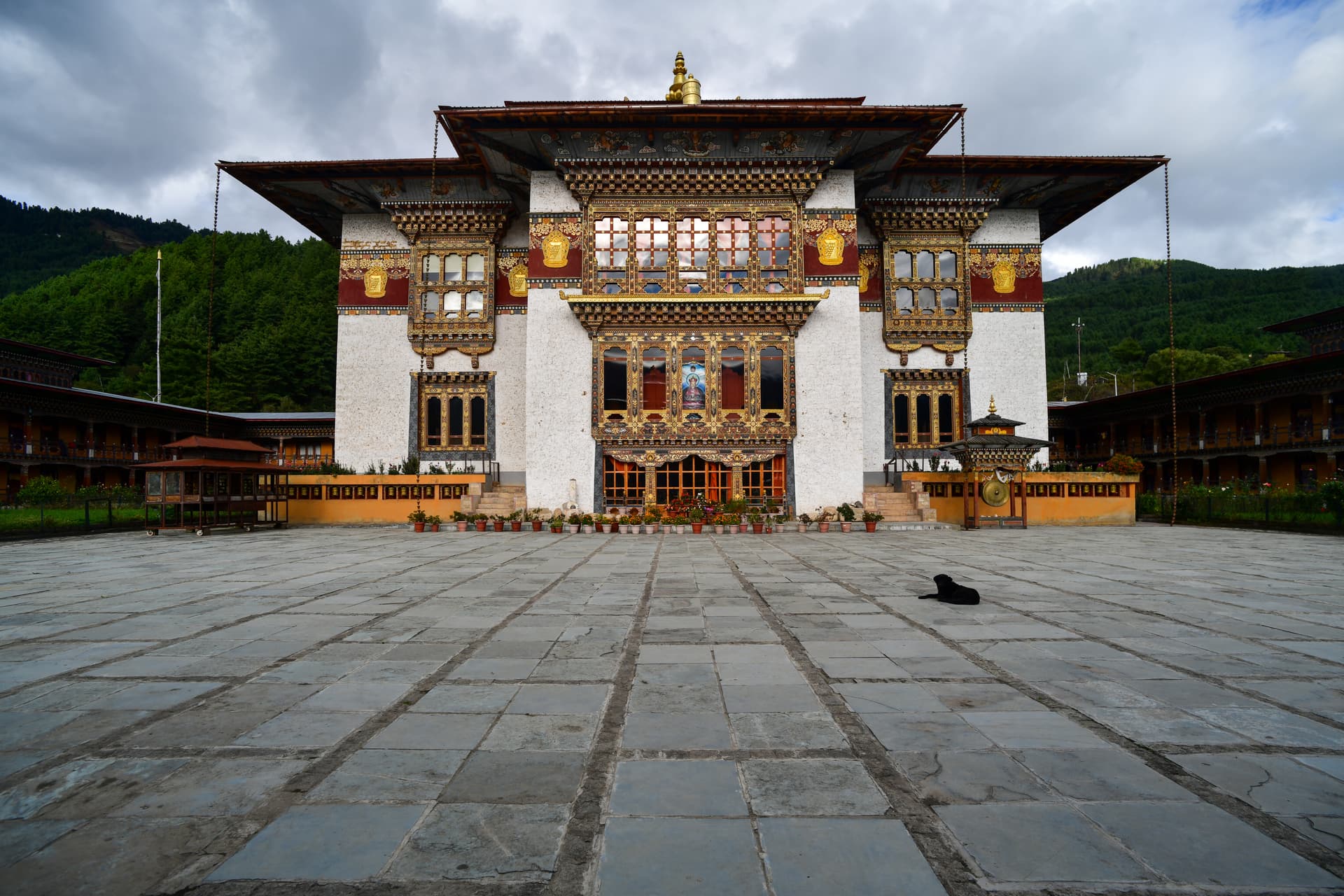
For thirteen centuries, Jampa Lhakhang has remained a place where the deepest past and furthest future share the same ground. It is dedicated to Jowo Jampa—Maitreya, the Buddha who has not yet come—while its founding belongs to the earliest stratum of Buddhism's arrival in the Himalayan world.
Tradition holds that King Songtsen Gampo of Tibet divined a supine demoness whose body blocked the dharma's spread across Tibet, Bhutan, and the borderlands. In a single day he built 108 temples, each on part of her body; Jampa Lhakhang pins her left knee to earth in Bumthang's Choekhor Valley at 2,630 metres. Guru Rinpoche later visited, restoring King Sindhu Raja's life force and deepening the temple's significance.
The annual Jambay Lhakhang Drup most fully reveals the place. During the Mewang fire dance, villagers run beneath flaming arches of dry grass as embers fall around them. Just before midnight, the Tercham naked dance is performed by sixteen bare-bodied men wearing masks and white cloth over their faces. Initiated by Terton Dorji Lingpa, it is said to represent primordial wisdom beyond anxiety and fear, and simply witnessing it is held transformative.
The temple is simple, centered on its Maitreya statue; its complexity lies in accumulated layers of time and practice within a building standing since before most European cathedrals were imagined.
Why this place is sacred
Jampa Lhakhang exists at the intersection of three temporal registers. The first is historical depth — thirteen centuries of continuous use in a building that was already ancient when the European Middle Ages began. The second is cosmological — the demoness pinned by the temple's foundation is not a creature of the past but a permanent condition of the landscape, held in place by 108 temples including this one.
The third is eschatological — the dedication to Maitreya, the future Buddha, means the temple is oriented toward something that has not yet happened.
These registers do not conflict. They coexist in the same structure, the same ground, the same practice. The annual festival intensifies their convergence. Fire purifies the present. The naked dance accesses a state before clothing, before convention, before the distinction between sacred and profane. The darkness in which the Tercham is performed is not theatrical but ritual — a return to the condition before distinction, where awareness and emptiness are not separate.
To stand in Jampa Lhakhang is to occupy a point where seven centuries BCE of demoness-pinning, eight centuries CE of Guru Rinpoche's healing, and the indefinite future of Maitreya's arrival are all simultaneously present.
One of 108 temples built by Songtsen Gampo in 659 CE to pin down a supine demoness obstructing Buddhism. This temple pins her left knee.
From its founding in 659 CE through Guru Rinpoche's visit and King Sindhu Raja's healing, through centuries of continuous worship, to the establishment of the Jambay Lhakhang Drup festival with its fire and naked dances. The temple has accreted significance while maintaining its original function.
Experience and orientation
On an ordinary day, Jampa Lhakhang presents as a venerable but unassuming temple in the Choekhor Valley. The interior is dim, scented with butter lamps. The Maitreya statue sits in the center of the main hall — a figure of calm anticipation, the Buddha-to-come waiting in the oldest of buildings. Local devotees circumambulate. Monks may be at prayer. The sense is of deep continuity rather than spectacle.
During the annual Jambay Lhakhang Drup festival, this changes entirely. The festival runs for several days in October or November, and its two signature events occur at night. The Mewang — the fire dance — sees villagers running beneath a blazing arch of dry grass. Embers fall, heat radiates, and participants emerge on the other side believing themselves purified of obstacles. The fire is real. The heat is real. The purification is understood as equally real.
Later, approaching midnight on the full moon, the Tercham begins. Sixteen men, naked, their faces covered by white cloth and masks, dance in firelight. The dance was initiated by Terton Dorji Lingpa and represents what the tradition calls primordial wisdom — awareness before the constructions of self and other, sacred and profane, clothed and unclothed. To witness it, according to the tradition, is to be empowered to overcome anxiety and fear.
The atmosphere among the Bhutanese pilgrims during the Tercham is one of reverent intensity.
If visiting outside the festival, spend time in the temple's dim interior and let the age of the space register. If attending the festival, arrive early in the evening for the fire dance and remain through the night for the Tercham. Do not treat the naked dance as spectacle — observe it as you would any sacred rite, with attention and respect. The festival's power is in the immersion, not in the documentation.
Context and lineage
King Songtsen Gampo of Tibet divined that a supine demoness lay across the Himalayan landscape, her body obstructing Buddhism's spread. He built 108 temples in a single day, each pinning a part of her anatomy. Jampa Lhakhang was built on her left knee, in the Choekhor Valley of Bumthang. The temple is dedicated to Jowo Jampa (Maitreya), the future Buddha.
In the eighth century, Guru Rinpoche visited and restored the life force of King Sindhu Raja, who had fallen ill after offending a local deity.
The temple belongs to the broad Vajrayana Buddhist tradition, with connections to both the early Tibetan imperial period (Songtsen Gampo) and the later treasure-revelation tradition (Dorji Lingpa). Its festival draws from multiple Buddhist lineages.
King Songtsen Gampo
Built the temple in 659 CE as one of 108 demoness-pinning temples
Guru Rinpoche (Padmasambhava)
Visited the temple and healed King Sindhu Raja
Terton Dorji Lingpa
Initiated the Tercham (naked dance) performed at the annual festival
Traditions and practice
The Mewang involves villagers running beneath a blazing arch of dry grass, believing the fire purifies the body and removes obstacles. The Tercham, performed near midnight by sixteen naked, masked men, represents primordial awareness beyond conventional reality. The tradition holds that witnessing the Tercham overcomes anxiety and fear. The festival was established to commemorate the temple's founding and honor Guru Rinpoche.
Daily monastic worship continues at the Maitreya statue. The annual festival draws pilgrims from across Bhutan and international visitors. The Tercham retains its midnight timing and ritual form.
Attend the Jambay Lhakhang Drup festival if possible — it is among Bhutan's most powerful religious events. Outside the festival, visit the temple in the morning when monks are at prayer. Circumambulate the temple clockwise. Sit with the Maitreya statue and consider what it means to dedicate a temple to a Buddha who has not yet arrived.
Vajrayana Buddhism
ActiveOne of the oldest continuously functioning Buddhist temples in Bhutan, hosting rituals that range from daily Maitreya veneration to annual tantric ceremonies of fire and revelation.
Daily worship, Maitreya veneration, annual Jambay Lhakhang Drup with Mewang and Tercham
Perspectives and open questions
Jampa Lhakhang can be understood as a historical monument, a node in a vast geomantic network, or a place where the most radical Buddhist rituals are performed within one of the tradition's oldest structures.
Scholarly perspective
The 659 CE founding date and the story of 108 temples built in a single day belong to religious tradition rather than verified historiography, though archaeological evidence supports the temple's great antiquity. The Tercham and Mewang have been studied as examples of tantric Buddhist ritual practice that preserves elements of pre-Buddhist religion.
Living and traditional perspectives
Within the Buddhist understanding, the 108 temples function as a vast geomantic intervention across the Himalayan landscape. Each temple pins a part of the demoness's body, transforming destructive energy into the foundation for dharma. Jampa Lhakhang's dedication to Maitreya positions it as a temple that looks both backward to the demoness and forward to the future Buddha.
Alternative interpretations
The Tercham represents a radical Buddhist anthropology — the teaching that beneath clothing, convention, and identity lies a primordial awareness that is the ground of all experience. The naked dance is not a stripping away but a revealing of what was always already present.
Open questions
The Tercham's initiation by Terton Dorji Lingpa and the transmission of its meaning through witnessing rather than explanation place it in a category of teaching that resists verbal interpretation by design.
Plan your visit
Access and arrival
Located in Changwang village, Choekhor Gewog, Bumthang, at 2,630m elevation. Accessible by road from Bumthang (Jakar) town.
Hotels and guesthouses in Bumthang (Jakar) town. Book well in advance for festival visits.
Respectful visit
Shoulders and knees covered inside the temple. Warm clothing essential for the nighttime festival events.
Generally not permitted inside the temple. Festival photography may be permitted but flash should not be used during the Tercham.
Butter lamp offerings welcome at the temple.
No photography inside the main temple | No flash photography during the Tercham | Walk clockwise around the temple | Do not touch sacred statues | Maintain reverent behavior during all festival events
The festival involves real fire and large crowds. During the fire dance, maintain a safe distance. The Tercham is a sacred ritual — photographing or filming it may be restricted or inappropriate. Follow the guidance of local attendees regarding appropriate behavior.
Current practical details
Address
HPGM+4C6, Jakar, Bhutan
Phone
Hours
Hours, fees, and access can change — verify on the official source before you travel. Practical details last checked Jun 2026.
Location
Map loads as you approach this section.
Pilgrim reflections
A portrait of encounter, not a score
Pilgrims describe what they felt, how present they could become, and whether the place would shape a journey. There are no stars and no ranking of traditions.
No reviewed reflections yet
The first pilgrims can help describe the character of being here.
Share a reflection
Available after an account-backed “Been there.” Every reflection is reviewed before publication.
Nearby sacred places
Explore other sacred places in the region. Proximity does not establish access or travel time; check each place’s guidance.


References
Sources consulted for this page. Source categories describe the publication, not a guarantee that every claim is verified. Traditional accounts and outside interpretations may differ.
- 01Jambay Lhakhang - WikipediaencyclopediaComprehensive overview
- 02Jambay Lhakhang - Bumthang Dzongkhag Administration — Government of BhutanSource contextOfficial source
- 03Jambay Lhakhang Drup - Visit Bhutan — Tourism Council of BhutanSource contextOfficial festival info
- 04Jambay Lhakhang - Bhutan Pilgrimage — Bhutan PilgrimageguideDetailed history
- 05Jambay Lhakhang Drup Festival — Bhutan MysticalguideFestival details
Photo gallery
4 curated photos
Pilgrim glossary
- Dharma
- The teachings of the Buddha; also the universal law underlying them.
Share a photo
Help visitors recognize Jampa Lhakhang. Every submission is reviewed before publication.