Museong Seowon
Scholar veneration held inside an ordinary village
Understand sacred places, explore living traditions, and learn how to engage respectfully with Pilgrim Map.
Access has not been verified. Check current local guidance before planning a visit.
Jeongeup, Jeollabuk-do, South Korea
Read the sources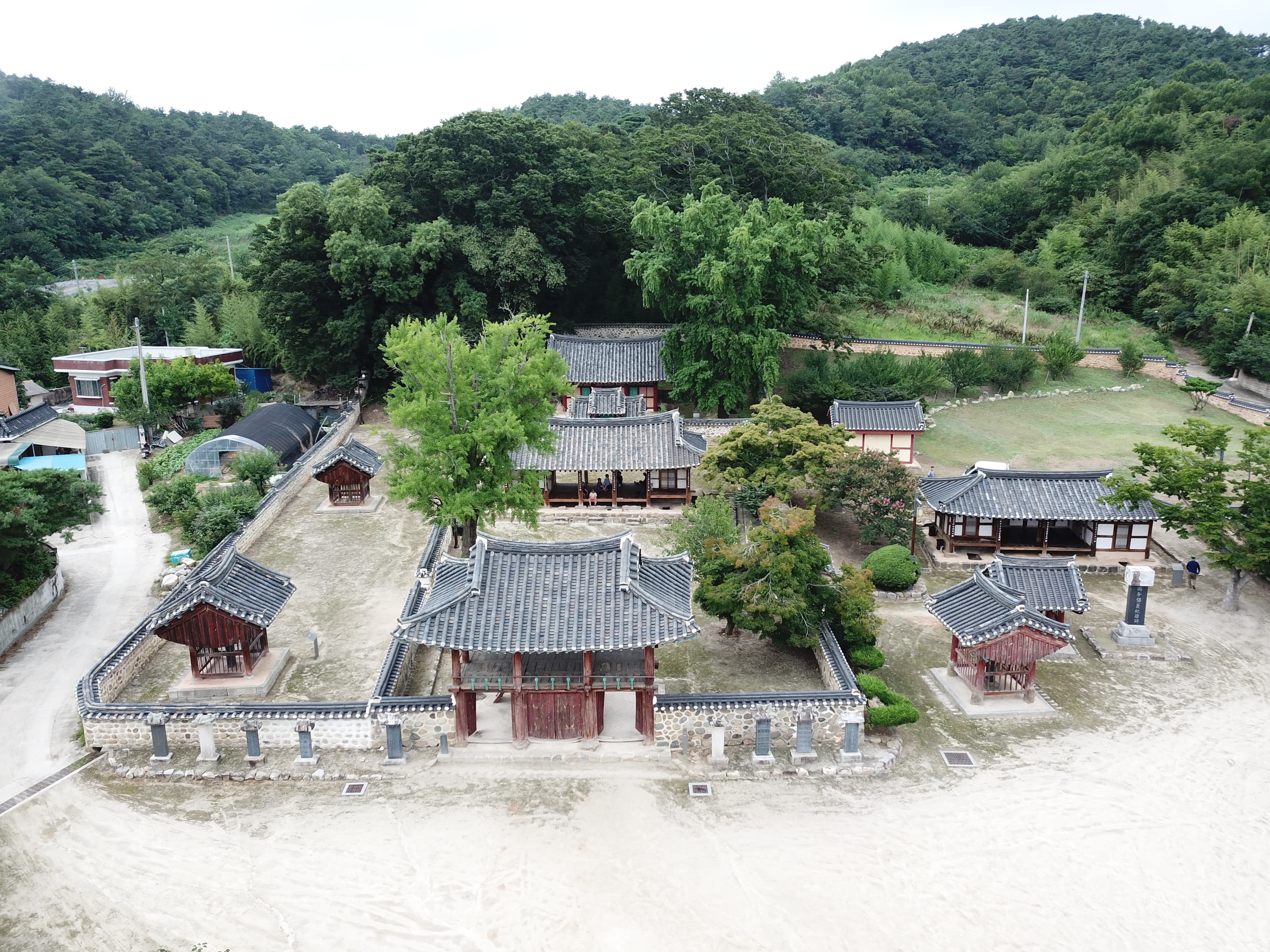
Museong Seowon in Jeongeup, North Jeolla, South Korea. Image source · CC BY-SA 4.0
Visit essentials
A quick read before you go
- Duration
- KTO suggests about one hour, appropriate for the academy and village relationship.
- Access
- KTO lists continuous grounds access, free entry, parking, the Jeongeup culture website, and…
Overview
The UNESCO serial property identifies learning, scholar veneration, and interaction with environment as essential seowon functions. Museong, component 1498-008, gives interaction a distinctive social dimension because the academy remains embedded in a settlement. Choe Chiwon lived centuries before the academy and belongs to Silla intellectual history; the 1615 institution is therefore a later community of remembrance, not his preserved school. That temporal distance matters. A spirit tablet and rites establish continuity through chosen commemoration.
Old ginkgo trees intensify seasonal memory but are not claimed to house supernatural power.
Why this place is sacred
Seclusion can support study, but Museong suggests another discipline: ethical learning must return to neighbors, fields, roads, and shared institutions. The compact compound makes boundaries visible without pretending that scholarship exists outside ordinary obligations. Ginkgo leaves mark annual change; wooden buildings record repair; ritual dates gather people at intervals. These rhythms offer a grounded account of sacred continuity.
Choe Chiwon is honored not as a god who grants wishes but as a scholar whose remembered character and writing remain available for reflection and emulation.
Museong was established in 1615 for Neo-Confucian education and rites honoring Choe Chiwon.
Village stewardship, survival through political change, periodic ritual, conservation, and World Heritage recognition broadened its responsibilities.
Experience and orientation
Approach on foot if local conditions permit and observe the transition from lane to academy entrance. Mature ginkgo trunks and canopies may dominate photographs, especially in autumn, but do not let them obscure lecture and shrine relationships. Identify which structures served learning and which served veneration. A compact site does not mean every room is public. If residents or caretakers are working nearby, treat them as community members rather than heritage scenery.
Spend time listening to the difference between village sound outside the wall and controlled quiet within.
Distinguish village lanes, entrance, lecture space, shrine and ritual preparation rooms, trees, and modern visitor areas.
Context and lineage
KTO identifies Choe Chiwon, born in 857, as the honored scholar and dates construction to 1615. UNESCO’s nomination explains that Museong is the eighth of nine components and that veneration areas contain tablets or portraits, observance altars, preparation rooms, and ritual stores. The current academy does not date to Choe’s lifetime. Its significance comes from how later local literati institutionalized memory, learning, and landscape interaction.
Museong belongs to Korean Neo-Confucian traditions of local education and scholar commemoration.
Traditions and practice
Authorized participants honor Choe Chiwon through prepared offerings, formal positions, and ritual sequence.
Municipal interpretation and community conservation open the site while preserving locally governed ritual space.
Consider one way intellectual work should remain answerable to the place and people around it.
Korean Neo-Confucianism
ActiveMuseong keeps Neo-Confucian learning and Choe Chiwon’s memory accountable to a living local community.
Study, discussion, memorial rites, offering preparation, heritage education, and village stewardship.
Perspectives and open questions
Museong invites analysis through ritual history, local intellectual networks, village landscape, ecology, and conservation.
Scholarly perspective
The gap between Choe Chiwon’s Silla life and the 1615 academy is a feature of memorial history, not an error to erase.
Living and traditional perspectives
Rites make gratitude to a formative scholar a continuing communal obligation.
Open questions
Ancient trees and quiet grounds are not claimed to produce verified spiritual or therapeutic effects.
Plan your visit
Access and arrival
KTO lists continuous grounds access, free entry, parking, the Jeongeup culture website, and contact information; Google has a strong identity but no hours. Confirm shrine and building access locally.
No on-site lodging is indicated; choose accommodation that does not burden village access.
Respectful visit
Modest everyday clothing is suitable; choose weather-ready footwear and restrained dress for ceremonies.
Avoid photographing residents or homes without consent and ask before shrine, tablet, interior, or rite images.
Do not improvise offerings; memorial rites use specific food, vessels, and roles.
Shrine rooms, tablets, preparation spaces, residences, tree roots, and conservation areas are protected.
Do not call Choe Chiwon a deity, collect leaves from protected grounds, disturb residents, or treat a quiet village as empty.
Current practical details
Address
44-12 Wonchon 1-gil, Chilbo-myeon, Jeongeup, Jeonbuk State, South Korea
Phone
Hours, fees, and access can change — verify on the official source before you travel. Practical details last checked Jul 2026.
Location
Map loads as you approach this section.
Pilgrim reflections
A portrait of encounter, not a score
Pilgrims describe what they felt, how present they could become, and whether the place would shape a journey. There are no stars and no ranking of traditions.
No reviewed reflections yet
The first pilgrims can help describe the character of being here.
Share a reflection
Available after an account-backed “Been there.” Every reflection is reviewed before publication.
Nearby sacred places
Explore other sacred places in the region. Proximity does not establish access or travel time; check each place’s guidance.
References
Sources consulted for this page. Source categories describe the publication, not a guarantee that every claim is verified. Traditional accounts and outside interpretations may differ.
- 01Seowon, Korean Neo-Confucian Academies — UNESCO World Heritage CentreofficialAuthoritative World Heritage property record, dossier 1498; component scope preserved.
- 02Museong Seowon — World Heritage nomination dossier — State Party of the Republic of Korea / UNESCOofficialPrimary nomination documentation for UNESCO property 1498, including serial-component identity, mapping, and heritage context.
- 03Korean Neo-Confucian academies — Korea Tourism OrganizationofficialLive official tourism record used for site identity, heritage context, and visitor logistics; time-sensitive details require rechecking.
- 04Museongseowon Confucian Academy [UNESCO World Heritage] — Korea Tourism OrganizationofficialOfficial tourism record for the 1615 academy, Choe Chiwon veneration, traditional buildings, ginkgo setting, UNESCO status, address, municipal website, and continuous grounds listing.
- 05Museong Seowon — Google Maps place record — GoogleSource contextStrong identity match used only for current practical fields and coordinates.
Share a photo
Help visitors recognize Museong Seowon. Every submission is reviewed before publication.