Baegyangsa Temple
A reflected pavilion and a kitchen disciplined by non-harm
Understand sacred places, explore living traditions, and learn how to engage respectfully with Pilgrim Map.
Access has not been verified. Check current local guidance before planning a visit.
Jangseong-gun, Jeollanam-do, South Korea
Read the sources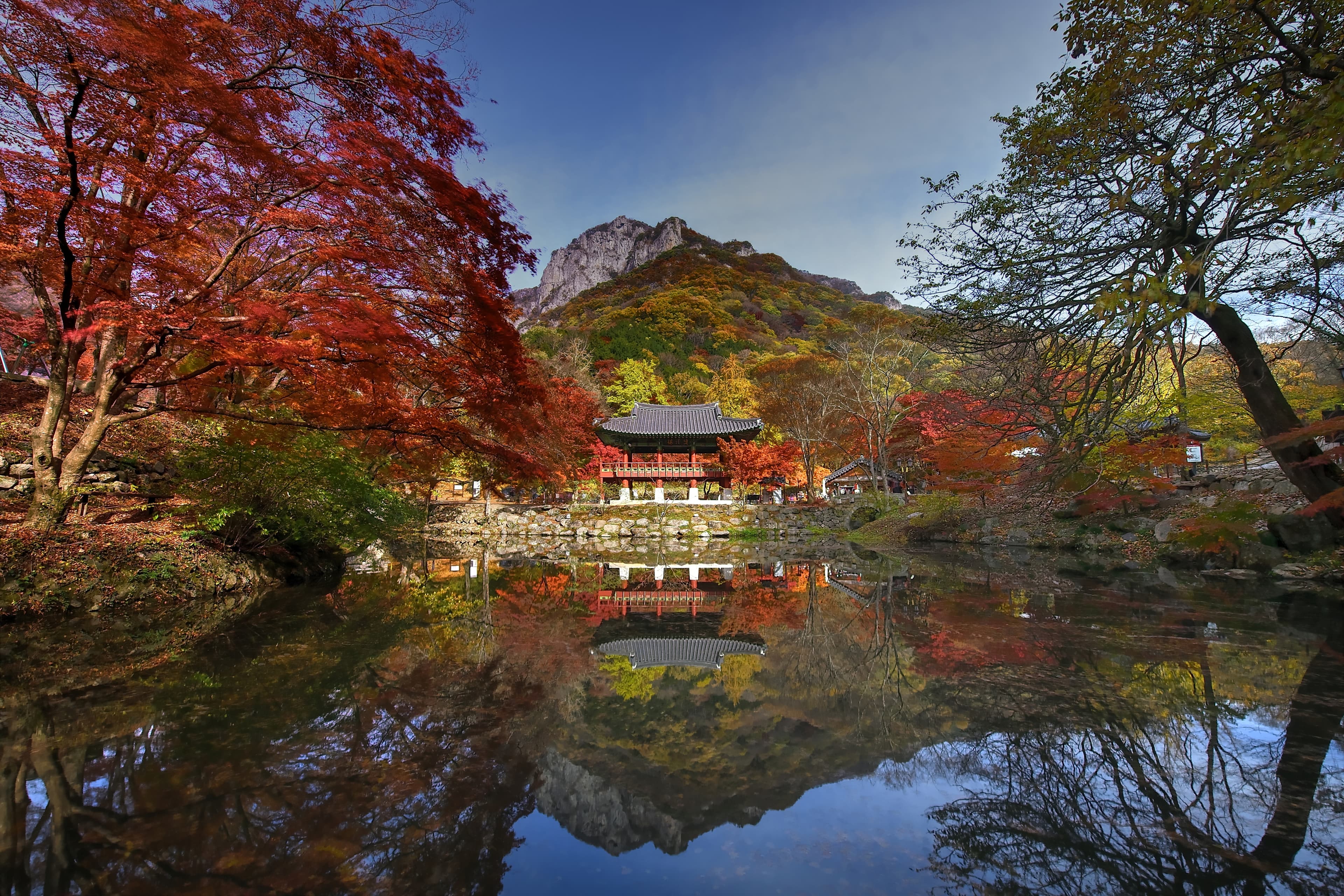
Baegyangsa Temple in Jangseong, South Jeolla, South Korea. Image source · KOGL Type 1
Visit essentials
A quick read before you go
- Duration
- Allow two hours for the forest approach and public precinct; booked food or retreat programs…
- Access
- KTO and Google list continuous grounds access and KTO supplies baekyangsa.com, parking, and…
Overview
A still pond offers an analogy for attention: wind and passing bodies break its clear image, without implying that the water has metaphysical power. Baegyangsa's kitchens make discipline tangible through Korean temple food, avoiding ingredients and habits according to Buddhist ethical and monastic traditions while working with season, restraint, preservation, and shared labour. Venerable Jeong Kwan has made this practice more visible, but should not eclipse the community that grows, prepares, serves, cleans, teaches, prays, and maintains the monastery.
Why this place is sacred
The pond receives pavilion, cliff, cloud, and foliage without holding them. A meal receives soil, water, labor, heat, time, and appetite in a similarly temporary form. Both can support a Buddhist reading of interdependence. That reading remains an interpretation grounded in practice, not a guarantee that scenery or cuisine will heal a visitor. More than five thousand torreya trees, some described by KTO as over five centuries old, widen the time scale.
Their survival depends upon ecological protection, while the monastery’s hospitality depends upon limits: not every kitchen is open, not every program is available, and not every beautiful grove can absorb unlimited footfall.
The sixth-century institution was established for Buddhist community and worship within the Baegamsan landscape.
Forest stewardship, Templestay, temple-food teaching, and major visitor flows now accompany monastic and devotional functions.
Experience and orientation
Approach through the forest without leaving the path or collecting torreya material. At Ssanggyeru, share the limited viewpoints and let others pass before composing a photograph. Notice that the reflected pavilion changes with light, wind, and crowds. Inside the precinct, locate public halls and observe how kitchens and residences remain partly concealed because they are working spaces. If attending a food program, receive the meal on its own terms: listen to instruction, waste nothing, and avoid demanding celebrity access.
Autumn color is intense but heavily visited; another season may reveal bark, water, and daily routine more clearly.
The national-park approach, pond viewpoint, worship courts, grove, kitchens, and retreat facilities have separate boundaries.
Context and lineage
KTO identifies Baegyangsa as a historic sixth-century temple but the source used here does not provide a precise founder and year, so neither is invented. It documents the Ssanggyeru approach, the surrounding torreya population, and current Templestay. A separate current KTO feature describes the temple’s food teaching and Venerable Jeong Kwan’s international recognition. These sources establish contemporary prominence without converting publicity into proof that all programs operate daily.
Baegyangsa is an active Korean Buddhist monastery whose Seon, culinary, ecological, and liturgical practices remain connected.
Traditions and practice
Worship and monastic routine frame food as ethical practice rather than luxury consumption.
Reservable Templestay and culinary programs offer structured encounters; schedules and teachers vary.
Before eating, identify three visible forms of labor that made the meal possible and leave no waste.
Korean Buddhism
ActiveBaegyangsa shows Korean Buddhism embodied in hospitality, Seon attention, ecological restraint, and daily nourishment.
Meditation, worship, temple cooking, communal eating, retreat, teaching, and forest stewardship.
Perspectives and open questions
Baegyangsa can be read through optics, ecology, food ethics, monastic labor, and visitor desire.
Scholarly perspective
Tree counts, ages, program descriptions, and celebrity recognition are dated claims rather than timeless attributes.
Living and traditional perspectives
Food preparation becomes Dharma practice when attention, restraint, gratitude, and non-harm govern each task.
Open questions
Claims that a view, tree, or meal automatically restores mind or body are not verified.
Plan your visit
Access and arrival
KTO and Google list continuous grounds access and KTO supplies baekyangsa.com, parking, and contact details. Confirm hall, museum, meal-program, and park restrictions before arrival.
Templestay must be reserved through the official channel, especially for culinary programs.
Respectful visit
Choose quiet, modest clothing suited to forest weather and seated meals.
Ask before photographing cooks, monastics, diners, food preparation, ceremonies, or hall interiors.
Use formal offerings; ecological care means leaving no food, cairns, ribbons, or litter outdoors.
Protected trees, kitchens, residential courts, retreat rooms, and altar spaces require explicit permission.
Do not promise detoxification, healing, or enlightenment from temple food, and do not forage in the protected grove.
Current practical details
Address
1239 Baegyang-ro, Bukha-myeon, Jangseong-gun, Jeollanam-do, South Korea
Phone
Hours
Hours, fees, and access can change — verify on the official source before you travel. Practical details last checked Jul 2026.
Location
Map loads as you approach this section.
Pilgrim reflections
A portrait of encounter, not a score
Pilgrims describe what they felt, how present they could become, and whether the place would shape a journey. There are no stars and no ranking of traditions.
No reviewed reflections yet
The first pilgrims can help describe the character of being here.
Share a reflection
Available after an account-backed “Been there.” Every reflection is reviewed before publication.
Nearby sacred places
Explore other sacred places in the region. Proximity does not establish access or travel time; check each place’s guidance.
References
Sources consulted for this page. Source categories describe the publication, not a guarantee that every claim is verified. Traditional accounts and outside interpretations may differ.
- 01Baegyangsa Temple — Korea Tourism OrganizationofficialOfficial tourism record for sixth-century history, Ssanggyeru approach, torreya grove, Templestay, website, address, and continuous grounds listing.
- 02Baegyangsa — Wikipedia — Wikipedia contributorsacademicCorroborates identity, location, and general historical context; key claims require higher-tier support.
- 03Baegyangsa — Wikidata — Wikidata contributorsSource contextCommunity-maintained structured identity and coordinate cross-check; not treated as scholarship or an official custodian record.
- 04Baegyangsa Temple — Google Maps place record — GoogleSource contextStrong identity match used only for current practical fields and coordinates.
Pilgrim glossary
- Dharma
- The teachings of the Buddha; also the universal law underlying them.
Share a photo
Help visitors recognize Baegyangsa Temple. Every submission is reviewed before publication.