Jeonju Jeondong Cathedral
Martyr memory carried by brick, arch, and reused wall stone
Understand sacred places, explore living traditions, and learn how to engage respectfully with Pilgrim Map.
Access has not been verified. Check current local guidance before planning a visit.
Jeonju, Jeollabuk-do, South Korea
Read the sources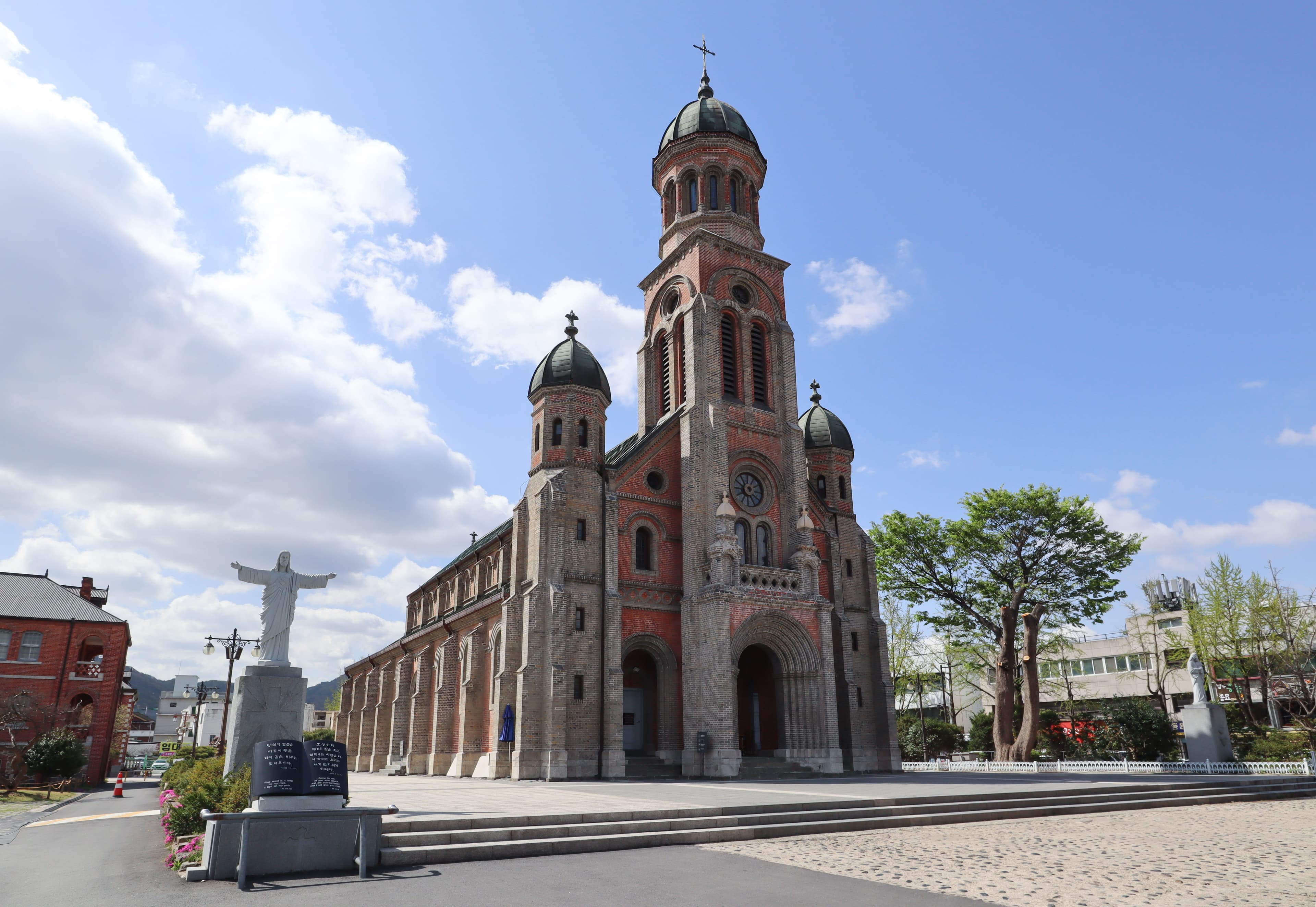
Jeonju Jeondong Cathedral in Jeonju, North Jeolla, South Korea. Image source · CC BY-SA 4.0
Visit essentials
A quick read before you go
- Duration
- Allow one hour, with additional time for historical context outside the church.
- Access
- KTO publishes the cathedral website, telephone, and a Mass schedule rather than general…
Overview
Jeondong Cathedral's beauty can eclipse the conflict it remembers. Catholic rejection of prescribed ancestral rites was treated as a threat to late Joseon order, and believers were killed. The church honors these martyrs but does not worship them as gods: Mass directs worship to God through Christ, while commemoration presents conscience and fidelity for emulation. Father Baudenet bought the land in 1891; Father Poisnel designed the later cathedral with Romanesque massing and Byzantine elements.
Construction under Japanese rule adds political context to its reused fortress stone and urban transformation.
Why this place is sacred
Reused stone does not erase the wall’s history. It holds destruction, appropriation, adaptation, and memorial intention together. In Christian interpretation, such reversal can evoke redemption: an instrument or structure of exclusion no longer determines the final meaning of a life. This is a theological reading, not a claim that masonry itself changes spiritual energy. The cathedral’s arches distribute weight through relation; its liturgy gathers a community through relation.
Both forms ask visitors to see martyr memory as responsibility toward conscience and dignity, not as a picturesque story of suffering.
The cathedral was built for Catholic worship and to honor martyrs killed at the Jeonju execution site.
Land purchase, colonial-era construction, parish and cathedral life, heritage tourism, and expanding martyr commemoration shaped its present role.
Experience and orientation
Approach from Pungnammun and Gyeonggijeon to understand the church inside a dense historical district. Identify the three towers and rounded arches without treating style labels as the whole story. Near the foundation, remember the account of material from the dismantled wall. Check the posted Mass schedule before entering. During liturgy, remain in a pew or wait outside rather than circulating for ceiling photographs. If memorial interpretation names individual martyrs, read their biographies instead of reducing them to anonymous victims.
Distinguish forecourt, main nave, sanctuary, memorial features, clergy areas, foundation fabric, and surrounding Hanok Village circulation.
Context and lineage
Official sources identify Paul Yun Ji-chung and James Kwon Sang-yeon as early Joseon Catholic martyrs connected to the site. Father Baudenet purchased the land in 1891; construction began in 1908 and finished in 1914 under Father Poisnel. KTO describes the building as the first Romanesque church in Honam with Byzantine elements and reports that stone or brick material from Jeonjueupseong entered its foundations. The page preserves reported-material wording where the source does.
Jeondong belongs to Roman Catholic Christianity in Korea and remains an active cathedral community.
Traditions and practice
Catholics worship God and honor martyrs as witnesses whose fidelity points toward Christ.
Regular Mass coexists with heavy tourism from Jeonju Hanok Village; the parish controls access during services.
Learn why the 1791 conflict arose before deciding what the martyrs’ refusal means in its historical setting.
Roman Catholic Christianity
ActiveJeondong roots living Korean Catholic worship in the memory of early martyrs and the transformed fabric of Jeonju.
Mass, sacrament, prayer, martyr commemoration, sacred music, teaching, and works of conscience.
Perspectives and open questions
Jeondong can be read through Catholic theology, persecution, architecture, colonial urbanism, reuse, and tourism pressure.
Scholarly perspective
The execution site, 1891 purchase, 1908–1914 building campaign, and reported wall-material reuse require distinct evidence.
Living and traditional perspectives
Martyr honor remembers fidelity to conscience and Christ without confusing saints with God.
Open questions
Claims of miraculous favors at the cathedral are not asserted without documented and qualified evidence.
Plan your visit
Access and arrival
KTO publishes the cathedral website, telephone, and a Mass schedule rather than general sightseeing hours. Google has a strong identity but no hours. Confirm current service and visitor access with jeondong.or.kr.
Use independently verified Jeonju lodging; the cathedral is not visitor accommodation.
Respectful visit
Wear modest clothing appropriate to a cathedral; costume rentals from the surrounding district do not override church decorum.
No photography during Mass unless explicitly authorized; ask about sanctuary, memorial, clergy, and worshipper images.
Use formal candles, collections, Mass intentions, and donation points rather than placing objects on memorial fabric.
Sanctuary, sacristy, confessionals, bell towers, foundation stones, and clergy rooms are restricted.
Do not glorify execution, stage martyr poses, interrupt Mass, or describe martyrs as deities who mechanically grant wishes.
Current practical details
Address
51 Taejo-ro, Wansan-gu, Jeonju, Jeonbuk State, South Korea
Phone
Hours, fees, and access can change — verify on the official source before you travel. Practical details last checked Jul 2026.
Location
Map loads as you approach this section.
Pilgrim reflections
A portrait of encounter, not a score
Pilgrims describe what they felt, how present they could become, and whether the place would shape a journey. There are no stars and no ranking of traditions.
No reviewed reflections yet
The first pilgrims can help describe the character of being here.
Share a reflection
Available after an account-backed “Been there.” Every reflection is reviewed before publication.
Nearby sacred places
Explore other sacred places in the region. Proximity does not establish access or travel time; check each place’s guidance.
References
Sources consulted for this page. Source categories describe the publication, not a guarantee that every claim is verified. Traditional accounts and outside interpretations may differ.
- 01Jeondong Catholic Cathedral — Korea Tourism OrganizationofficialLive official tourism record used for site identity, heritage context, and visitor logistics; time-sensitive details require rechecking.
- 02Korea Heritage Service public heritage search — Korea Heritage ServiceofficialAuthoritative national search portal retained as a verification route; not used alone for site-specific claims.
- 03Jeonju Jeondong Catholic Cathedral — Korea Tourism OrganizationofficialOfficial tourism record for the martyr site, 1891 land purchase, 1908–1914 construction, Poisnel design, Romanesque and Byzantine forms, reused fortress material, address, website, and Mass schedule.
- 04Jeonju Jeondong Cathedral — Google Maps place record — GoogleSource contextStrong identity match used only for current practical fields and coordinates.
Share a photo
Help visitors recognize Jeonju Jeondong Cathedral. Every submission is reviewed before publication.