Guksadang Shrine
A displaced state shrine that remains a working house for gut
Understand sacred places, explore living traditions, and learn how to engage respectfully with Pilgrim Map.
Access has not been verified. Check current local guidance before planning a visit.
Seoul, Seoul, South Korea
Read the sources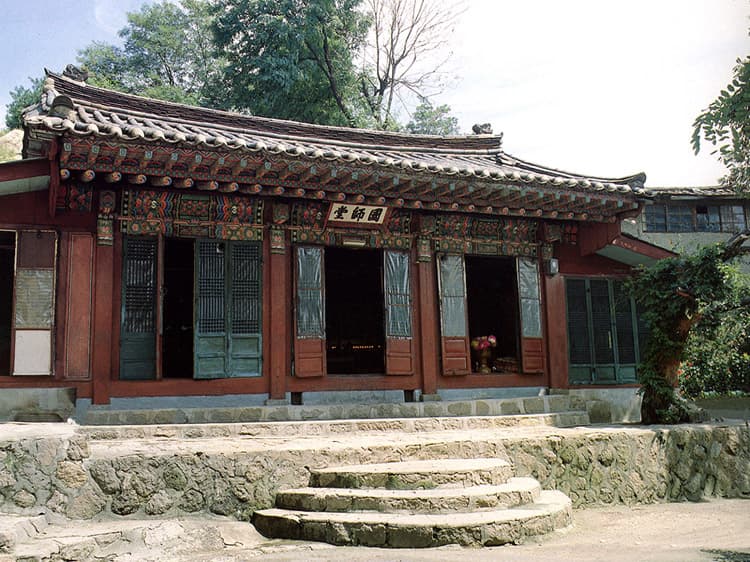
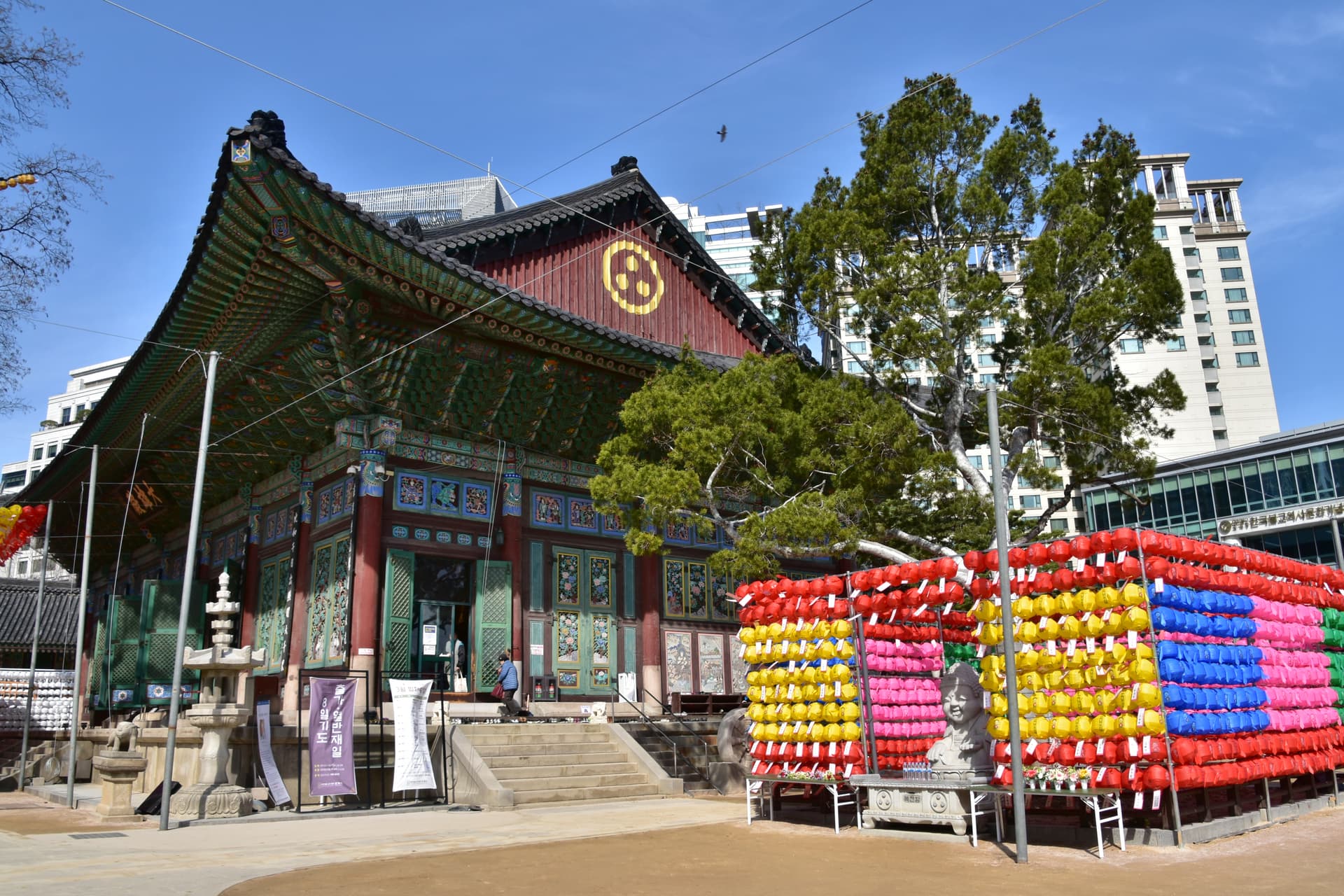
Guksadang Shrine in Seoul, Jongno District, South Korea. Image source · CC BY 4.0
Visit essentials
A quick read before you go
- Duration
- Let any ceremony determine your pace rather than expecting a timed attraction.
- Access
- Current public opening hours were not established; verify locally before visiting.
Overview
Guksadang was built for enacted ritual, not quiet display. Korea Heritage Service describes a dang-house where gut may involve voice, percussion, costume, food, movement, spirit paintings, clients, and trained specialists; sound helped place such houses away from dense residences. Its current site also records forced displacement. The Namsan shrine served a mountain guardian linked with the capital until colonial authorities removed it in 1925 to build Joseon Shrine.
Relocation to Inwangsan changed its setting, neighboring sacred sites, community, and honored figures rather than neutrally preserving a building. Official heritage interpretation associates prayer there with King Taejo and monk Muhak, remembered as shamanic gods. Guksadang sustains continuity through adaptation as national, mountain, ancestral, and personal concerns meet in ceremonies whose content depends on occasion and officiant.
Why this place is sacred
Guksadang’s sacredness cannot be captured by choosing one universal deity. A gut addresses particular needs and beings through a sequence governed by a mudang; the shrine provides a recognized place where that relationship can be negotiated. The building’s move from Namsan makes location itself a historical wound. On Inwangsan, its proximity to Seonbawi creates another sacred cluster without making the two sites interchangeable. Claims of possession, messages, protection, or changed fortune belong to participant testimony and religious interpretation.
This page neither mocks those claims nor treats them as independently verified events.
Its documented history separates the former Namsan shrine from the Inwangsan relocation.
Later change is identified without inventing continuity.
Experience and orientation
Approach from the public path and stop before entering. If a gut is underway, the absence of a ticketed barrier does not make it a performance open to documentation. Families or clients may be addressing illness, conflict, death, livelihood, or remembrance. Ask a custodian before watching, and do not record faces, divination, possessed speech, offerings, or ritual exchange without explicit consent.
Outside ceremonial times, study the building’s modest scale and relation to the slope, then compare it with nearby Seonbawi without combining their legends. Google confirms 20 Tongil-ro 18ga-gil and telephone 02-731-1165 but provides no opening hours.
Remain on the public approach unless shrine attendants invite entry.
Context and lineage
Seoul’s official history identifies the Namsan shrine with Mongmyeok Daewang, guardian of the southern mountain, and explains the name Guksadang through state construction. Colonial authorities dismantled it in 1925 to make room for a Japanese State Shinto complex. Inwangsan was selected as the new location, a mountain already associated with royal and religious prayer. Korea Heritage Service dates the present reconstructed building to around that move and designates it National Folklore Cultural Heritage.
The account should retain both continuity of a revered house and the discontinuity imposed by relocation.
Korean shamanic ritual
Traditions and practice
No generic visitor ritual is appropriate here. A mudang determines the sequence and works with musicians, clients, foods, costumes, and sacred images according to the purpose of a gut. Some rites seek well-being or protection; others address the dead, family difficulties, or vocational questions. Those intentions should be named only when participants consent. Visitors can practice restraint by listening from an authorized distance and recognizing when curiosity would intrude.
Never imitate spirit speech, handle implements, taste offerings, or interrupt a transition in the ceremony.
Current observance remains under custodian authority.
Pause once and attend before interpreting.
Korean shamanic ritual
ActiveNational Guardian images and shamanic rites sustain the shrine’s living purpose.
Mudang-led ceremonies take precedence over sightseeing inside the working sanctuary.
Perspectives and open questions
State ritual, colonial displacement, Korean shamanism, private need, and heritage policy converge at Guksadang.
Scholarly perspective
Architectural history explains the moved structure; political history explains why movement occurred; practitioners explain what gut does in lived religious terms. None is complete alone. The shrine’s multiplicity makes a single target-of-veneration list inherently partial, so metadata names a plural assembly rather than inventing one patron. Reported spirit communication or changes in fortune remain user and practitioner claims, not independently verified causal outcomes.
Living and traditional perspectives
Mudang and shrine custodians carry the interpretive authority for resident spirits.
Open questions
Petitions and ritual experiences should be reported without promising results.
Plan your visit
Access and arrival
Current public opening hours were not established; verify locally before visiting.
The reviewed evidence does not identify visitor accommodation at Guksadang.
Respectful visit
Wear subdued clothing suitable for an active Korean shamanic sanctuary.
Obtain explicit permission before recording rites, practitioners, clients, or offerings.
Use only forms explicitly authorized by custodians.
Barriers and ceremony instructions always take priority.
Avoid imitation, intrusion, and unsupported promises.
Current practical details
Address
20 Tongil-ro 18ga-gil, Jongno District, Seoul, South Korea
Phone
Hours, fees, and access can change — verify on the official source before you travel. Practical details last checked Jul 2026.
Location
Map loads as you approach this section.
Pilgrim reflections
A portrait of encounter, not a score
Pilgrims describe what they felt, how present they could become, and whether the place would shape a journey. There are no stars and no ranking of traditions.
No reviewed reflections yet
The first pilgrims can help describe the character of being here.
Share a reflection
Available after an account-backed “Been there.” Every reflection is reviewed before publication.
Nearby sacred places
Explore other sacred places in the region. Proximity does not establish access or travel time; check each place’s guidance.
References
Sources consulted for this page. Source categories describe the publication, not a guarantee that every claim is verified. Traditional accounts and outside interpretations may differ.
- 01Guksadang Shrine of Inwangsan Mountain — Korea Heritage ServiceofficialExact National Folklore Cultural Heritage record for shamanic ritual use, 1925 relocation, address, and the site's guardian figures.
- 02History of Namsan Park — Seoul Metropolitan GovernmentofficialMunicipal history of the former Namsan state shrine to Mongmyeok Daewang and its forced 1925 removal.
- 03Inwangsan Mountain Trail — Seoul Metropolitan GovernmentofficialOfficial route interpretation locating Guksadang and Seonbawi and summarizing the colonial relocation.
- 04Guksadang Shrine — Google Maps place record — GoogleSource contextStrong exact identity used only for address, phone, coordinates, and operating status.
Share a photo
Help visitors recognize Guksadang Shrine. Every submission is reviewed before publication.