Bongwonsa Temple
Ritual sound and movement at the Taego Order’s Seoul center
Understand sacred places, explore living traditions, and learn how to engage respectfully with Pilgrim Map.
Access has not been verified. Check current local guidance before planning a visit.
Seoul, Seoul, South Korea
Read the sources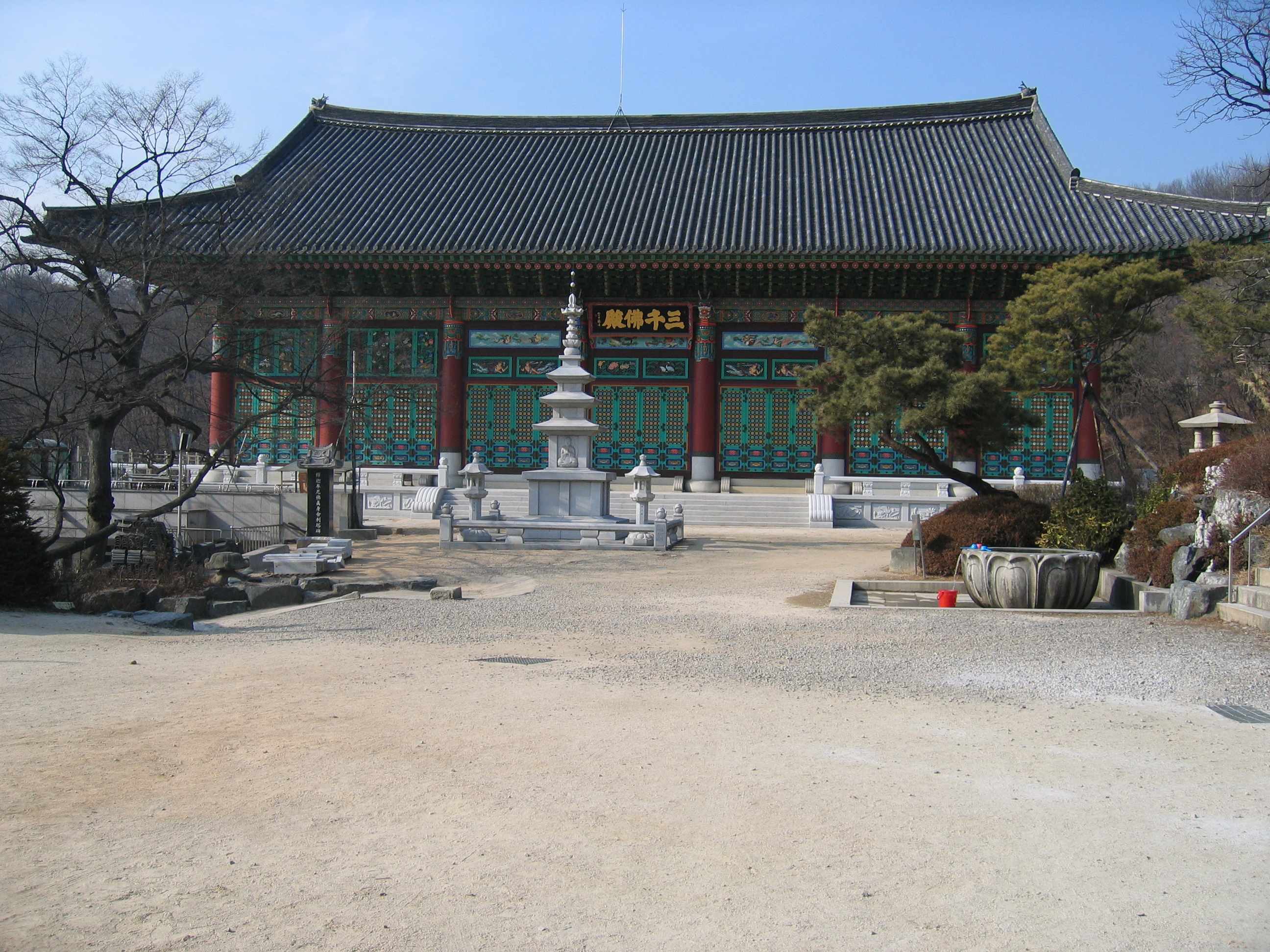
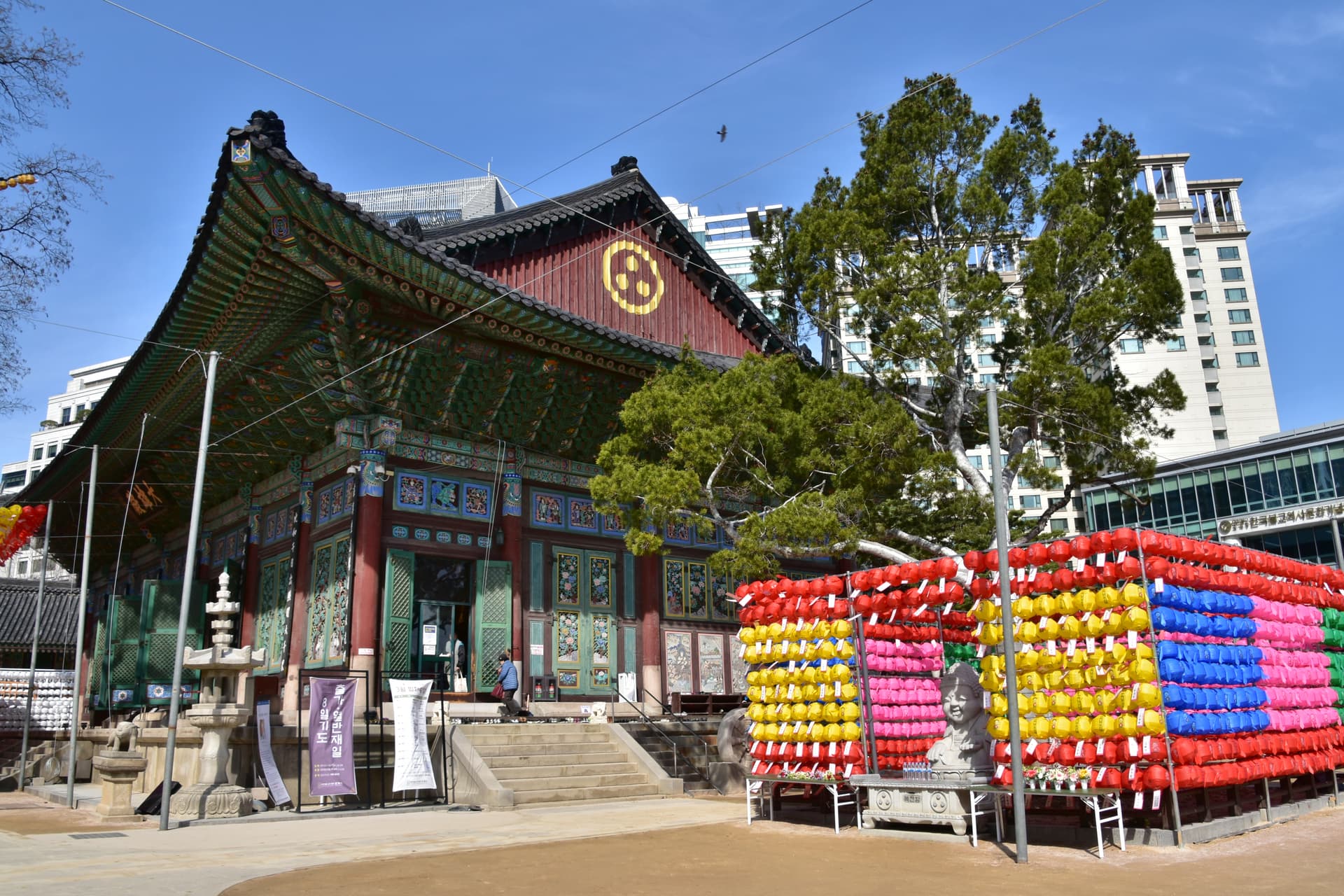
Bongwonsa Temple in Seoul, Seodaemun District, South Korea. Image source · CC BY-SA 3.0
Visit essentials
A quick read before you go
- Duration
- Allow about an hour on ordinary days; Yeongsanjae is extended and should be planned from the…
- Access
- KTO lists parking, website bongwonsa.or.kr, and telephone +82-2-392-3007.
Overview
A visitor outside the ritual calendar may find Bongwonsa comparatively quiet, but the precinct is shaped by practices designed for sound and movement. During Yeongsanjae, vocal specialists, instrumentalists, dancers, officiants, offerings, painted imagery, and assembled participants build a ceremonial world recalling the Buddha’s teaching at Vulture Peak. The rite also directs merit toward the dead and peace toward the wider community. Bongwonsa’s spiritual importance therefore cannot be conveyed by listing old buildings alone.
It lies in a trained tradition whose knowledge is embodied, rehearsed, and transmitted across generations within the Taego Buddhist community.
Why this place is sacred
Yeongsanjae is sometimes advertised as a colorful performance, but performance is only one dimension. Gesture, costume, music, recitation, food offering, and spatial arrangement work together to proclaim Buddhist teaching and transfer merit. An observer may appreciate the arts while remembering that participants are not staging folklore for a camera. The temple’s annual June 6 observance has also been framed as a prayer for peace and reunification. These public intentions give the rite contemporary reach without changing its religious center.
No invisible energy claim is needed; disciplined voices and bodies make transmission materially present.
Bongwonsa’s received history traces a temple founded by Doseon in 889, originally called Banyasa.
After destruction during the Imjin War, the temple was rebuilt and renamed in 1748; it later became a principal Taego institution and guardian of Yeongsanjae.
Experience and orientation
On an ordinary day, look for open ground, hall orientation, and spaces where musicians or officiants might assemble; the architecture gains another dimension when imagined through the documented rite. If attending Yeongsanjae, arrive early and accept the viewing area assigned by custodians. Follow the entire sequence as far as possible rather than chasing only dances or costumes. Beompae chant can feel unfamiliar to listeners accustomed to short services.
Let its duration teach that ritual knowledge is carried through sustained breath, memory, and coordinated attention.
Ask where visitors may stand during ceremonies and keep all central routes free for ritual movement.
Context and lineage
KTO gives a traditional foundation by Doseon in 889 at a site associated with Yeonhui Palace, under the name Banyasa. The temple was destroyed during the Japanese invasions and rebuilt in 1748 by Chanjeup and Jeungam, who gave it the present name. Today it is identified with the Taego Order. Yeongsanjae was inscribed by UNESCO in 2009 on the Representative List of the Intangible Cultural Heritage of Humanity, an acknowledgment of the ritual tradition and its bearers.
Bongwonsa is a major temple of the Korean Buddhist Taego Order and a center for Yeongsanjae transmission.
Traditions and practice
Yeongsanjae follows a complex order under trained ritual specialists. Its forms should be described as living Buddhist liturgy, not detached entertainment.
The annual public observance supports safeguarding and teaching while also articulating hopes for peace and reunification.
Listen to one complete passage of chant without recording it, attending to breath, repetition, and the response of the assembled space.
Korean Buddhism
ActiveTaego Buddhism preserves a major integrated rite of teaching, offering, chant, and dance at Bongwonsa.
Yeongsanjae, beompae chant, ceremonial dance, offerings, prayer, and doctrinal recitation.
Perspectives and open questions
Bongwonsa invites religious, musicological, dance, and heritage readings, provided the rite remains whole.
Scholarly perspective
Intangible-heritage study can document transmission and performance without reducing Yeongsanjae to an aesthetic artifact.
Living and traditional perspectives
The rite re-presents Buddhist teaching and directs merit through forms whose efficacy is understood within the practicing tradition.
Open questions
Religious claims about merit are presented as Taego Buddhist understanding, not independently testable outcomes.
Plan your visit
Access and arrival
KTO lists parking, website bongwonsa.or.kr, and telephone +82-2-392-3007. Opening hours were not stated in the checked record, so confirm before travel.
No overnight visitor program was verified for this page.
Respectful visit
Wear modest clothing suitable for sitting or standing through a long outdoor observance.
Follow event-specific rules and never obstruct officiants, musicians, dancers, or offerings.
Do not touch ceremonial foods or objects; make personal donations only through temple channels.
Ritual platforms, preparation rooms, instruments, costumes, and altars remain under custodian control.
Do not enter the ritual floor, copy mudras, sample offerings, or isolate performers for staged portraits.
Current practical details
Address
120 Bongwonsa-gil, Seodaemun-gu, Seoul, South Korea
Phone
Hours, fees, and access can change — verify on the official source before you travel. Practical details last checked Jul 2026.
Location
Map loads as you approach this section.
Pilgrim reflections
A portrait of encounter, not a score
Pilgrims describe what they felt, how present they could become, and whether the place would shape a journey. There are no stars and no ranking of traditions.
No reviewed reflections yet
The first pilgrims can help describe the character of being here.
Share a reflection
Available after an account-backed “Been there.” Every reflection is reviewed before publication.
Nearby sacred places
Explore other sacred places in the region. Proximity does not establish access or travel time; check each place’s guidance.
References
Sources consulted for this page. Source categories describe the publication, not a guarantee that every claim is verified. Traditional accounts and outside interpretations may differ.
- 01Bongwonsa Temple — Korea Tourism OrganizationofficialOfficial tourism record for Taego Order identity, foundation and rebuilding traditions, annual Yeongsanjae, address, website, and contact.
- 02Bongwonsa — Wikipedia — Wikipedia contributorsacademicCorroborates identity, location, and general historical context; key claims require higher-tier support.
- 03Bongwonsa — Wikidata — Wikidata contributorsSource contextCommunity-maintained structured identity and coordinate cross-check; not treated as scholarship or an official custodian record.
- 04Bongwonsa Temple — Google Maps place record — GoogleSource contextStrong identity match used only for current practical fields and coordinates.
Share a photo
Help visitors recognize Bongwonsa Temple. Every submission is reviewed before publication.