Wat Tham Khao Noi
Vietnamese Mahayana art rises beside a Thai Theravada neighbor
Understand sacred places, explore living traditions, and learn how to engage respectfully with Pilgrim Map.
Access has not been verified. Check current local guidance before planning a visit.
Tha Muang, Kanchanaburi, Thailand
Read the sources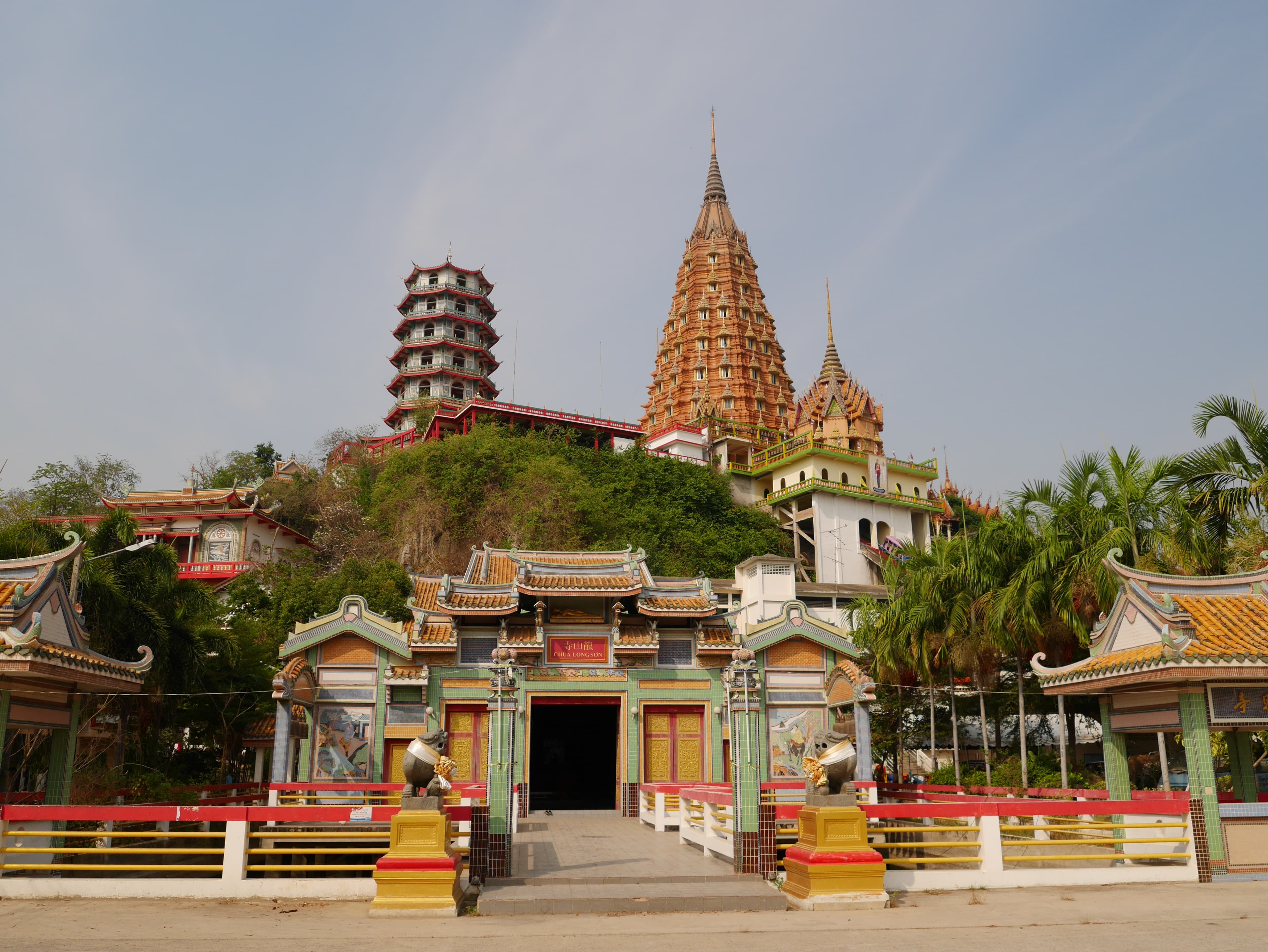
Wat Tham Khao Noi in Tha Muang, Kanchanaburi, Thailand. Image source · CC BY-SA 4.0
Visit essentials
A quick read before you go
- Etiquette
- Protect worshippers, historic fabric, and closed thresholds.
Overview
The site's religious identity is carried by Vietnamese Mahayana community history as much as by its highly visible pagoda. Maitreya at the lower level directs attention toward the future Buddha, while ascending levels gather images and the relic shrine into a vertical sequence. The adjacent Thai temple creates a striking skyline, but proximity does not erase denominational difference.
A responsible guide names the Vietnamese lineage, allows the architecture its own vocabulary, and resists using every ornate surface as evidence of a generalized Chinese theme park.
Why this place is sacred
Moving through an octagonal tower can feel symbolically ordered, and the upper view makes the neighboring temples appear joined. Physical adjacency is not proof that their rituals, sanghas, or histories are interchangeable. Relics at the top are described by government sources within Buddhist tradition; no scientific authentication or supernatural efficacy is claimed. The temple's age and minority-community continuity offer enough spiritual depth without adding energy language. No prevalent exact-site miracle claim emerged from the official evidence.
Experience and orientation
Enter through Wat Tham Khao Noi's own threshold and read its signs before crossing between compounds. Remove shoes and follow the Mahayana temple's rules rather than copying behavior observed next door. Pagoda stairs may be narrow, so yield on landings and do not force an ascent. Strong Google Places data provides exact ordinary hours and contact, but ceremonies can close levels. The user-facing guide should name Maitreya carefully and avoid misidentifying the smiling figure as a generic luck deity.
Context and lineage
Muang Chum Municipality dates the temple to roughly 1883 and identifies it as one of three Vietnamese temples in the province. Thailand's government portal similarly describes more than 140 years of history, Mahayana faith among the Vietnamese community, and the pagoda's relic chamber. These sources support a nineteenth-century institutional history rather than an ancient cave legend. World Heritage status does not apply, and classification remains built and cultural rather than a natural cave attraction.
Traditions and practice
Visitors may bow before Maitreya, honor Buddha images, ascend toward the relic level when open, and observe the different iconographic program with patience. Do not rub figures for luck, leave money on statues, or treat tower completion as a merit score. No named recurrent pilgrimage was established, so the page does not manufacture one from a government faith-tour itinerary.
Respect for Vietnamese-Mahayana identity is itself a practice: use the temple's names, listen to custodians, and avoid merging it with Wat Tham Sua.
Vietnamese Mahayana Buddhism
ActiveDocumented tradition layer 1.
Vietnamese-Thai community heritage
ActiveDocumented tradition layer 2.
Perspectives and open questions
Religious, historical, and environmental evidence remain distinct.
Scholarly perspective
Mahayana interpretation foregrounds Maitreya, multiple Buddhas, relic devotion, and the Vietnamese community that sustained the temple. Migration history explains why this lineage appears in Kanchanaburi; architectural history reads the pagoda's Chinese-Vietnamese forms. Comparative tourism sees two temples on neighboring hills, but should not flatten them into one attraction. The source base is sufficient to correct classification and target of veneration, while finer ritual detail remains for future temple-controlled documentation. Local government dates the Vietnamese-Mahayana temple to about 1883.
Minority religious history is not an optional decorative note. Vietnamese Buddhists established and sustained a distinct Mahayana institution in a province usually introduced through Thai Theravada landmarks. The pagoda and Maitreya image materialize that community story. A careful visitor therefore notices language, iconography, and custodial boundaries before comparing silhouettes. This approach avoids celebrating architectural difference while making the people and lineage that produced it disappear from the account. Translation review should retain Vietnamese community agency and Maitreya's specific identity.
Plan your visit
Day-of authority overrides routine listing data.
Respectful visit
Protect worshippers, historic fabric, and closed thresholds.
Current practical details
Address
18, 1, Tambon Muang Chum, Amphoe Tha Muang, Chang Wat Kanchanaburi 71110, Thailand
Phone
Hours
Hours, fees, and access can change — verify on the official source before you travel. Practical details last checked Jul 2026.
Location
Map loads as you approach this section.
Pilgrim reflections
A portrait of encounter, not a score
Pilgrims describe what they felt, how present they could become, and whether the place would shape a journey. There are no stars and no ranking of traditions.
No reviewed reflections yet
The first pilgrims can help describe the character of being here.
Share a reflection
Available after an account-backed “Been there.” Every reflection is reviewed before publication.
Nearby sacred places
Explore other sacred places in the region. Proximity does not establish access or travel time; check each place’s guidance.

References
Sources consulted for this page. Source categories describe the publication, not a guarantee that every claim is verified. Traditional accounts and outside interpretations may differ.
- 01Wat Tham Khao Noi — Google PlacesofficialExact practical metadata accepted after strong name, country, locality, and coordinate review.
- 02Nine temples in Kanchanaburi — Royal Thai GovernmentofficialExact age, Vietnamese Mahayana identity, Maitreya, pagoda, and relic chamber.
- 03Wat Tham Khao Noi — Muang Chum MunicipalityofficialLocal-government exact identity, circa-1883 history, Vietnamese lineage, and architecture.
Share a photo
Help visitors recognize Wat Tham Khao Noi. Every submission is reviewed before publication.