Phra Pathom Chedi
A vast relic stupa marks Nakhon Pathom's Buddhist centre
Understand sacred places, explore living traditions, and learn how to engage respectfully with Pilgrim Map.
Access has not been verified. Check current local guidance before planning a visit.
Nakhon Pathom, Nakhon Pathom, Thailand
Read the sources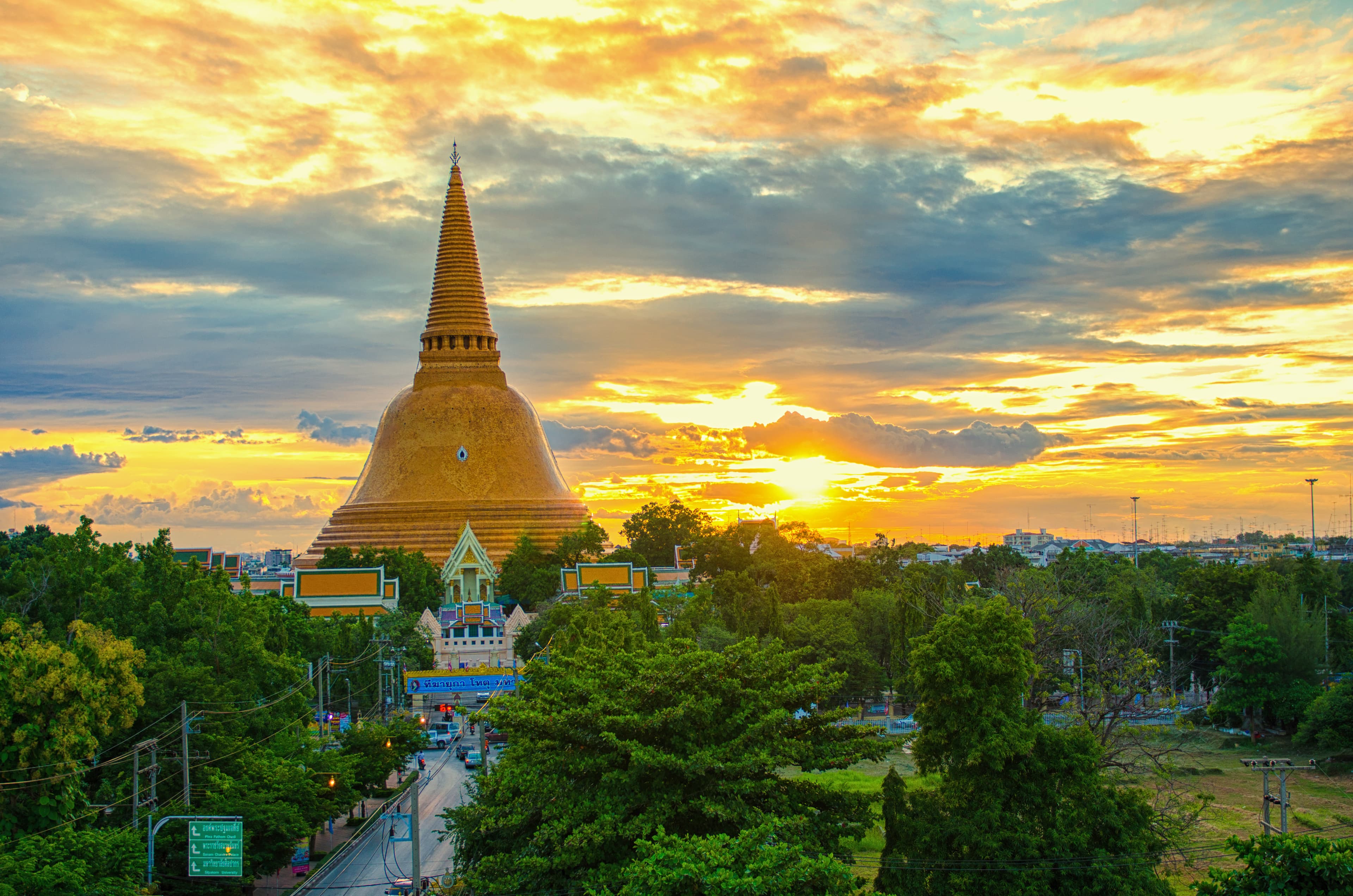
Phra Pathom Chedi in Nakhon Pathom, Nakhon Pathom, Thailand. Image source · CC BY-SA 4.0
Visit essentials
A quick read before you go
- Etiquette
- Follow processional direction, protect worship space, and use only designated flame and offering…
Overview
The orange-tiled dome dominates the city because a reliquary is meant to organize attention from far beyond its courtyard. Devotees circle the stupa, bow before Buddha images, make merit, and direct recollection toward relics held within an inaccessible centre. The name 'first stupa' supports a powerful national narrative about the arrival of Buddhism, though exact claims about the earliest foundation should remain distinct from what archaeology can securely date.
Sacredness rests not only on height or antiquity but on the Buddhist logic of presence: material relic memory makes the Buddha an object of continuing homage after his passing.
Why this place is sacred
The relic centre remains enclosed from ordinary public view. Its meaning is sustained through testimony, consecration, architectural enclosure, and repeated devotion. That distance is important: the stupa invites circumambulation around what remains unseen. Official tourism language calls the monument a sign of Buddhism's introduction into Thailand, while scholarship treats early regional history with more chronological caution. The page holds both scales without claiming that the monument is scientifically the first Buddhist structure in the country.
Nor does its size establish a measurable force, healing effect, or guaranteed merit independent of intention and practice.
Experience and orientation
Begin far enough away to see how the chedi changes the city skyline, then enter the cloister and identify the permitted direction of movement. Follow local worshippers without overtaking ceremonies, and keep feet and cameras away from Buddha images. The surrounding complex includes several chapels, images, and museum material, so do not reduce the visit to one wide-angle photograph. Surfaces can be hot and crowded during festivals.
Current opening hours from Places should be rechecked, and temporary barriers or ritual closures must take precedence over a planned circuit.
Context and lineage
Nakhon Pathom preserves remains associated with the Dvaravati world and long Buddhist settlement. Rama IV, who had encountered the older stupa while a monk, initiated the great reconstruction in 1853. The present bell-shaped mass encloses earlier fabric and was completed after his reign. Official sources identify Buddha relics within the monument and present it as the city's defining religious landmark. Later royal patronage and conservation maintained the temple as an active centre.
Phra Pathom Chedi is not inscribed on the UNESCO World Heritage List, despite its national importance.
Traditions and practice
Circumambulation, relic recollection, chanting, flower and incense offerings, and merit-making all belong to the living Buddhist setting. Visitors should use only designated flame areas and avoid touching decorated surfaces. Festivals may include dense processions and market activity; observe boundaries between commerce and worship. A simple visit can consist of a quiet circuit and attention to the refuge represented by the relic stupa.
Claims that completing a certain number of rounds guarantees healing, prosperity, or karmic reward are not established by the reviewed official sources.
Theravada Buddhism
ActiveTheravada worship centers Buddha relic memory, circumambulation, chanting, and merit-making.
Perspectives and open questions
Theravada relic devotion, national origin narrative, archaeology, architecture, and local identity qualify one another.
Scholarly perspective
Theravada devotion interprets the chedi as a reliquary and field of merit. National history emphasizes its place in stories of Buddhism's early presence in Thailand. Archaeology asks what survives from Dvaravati and later phases beneath the nineteenth-century envelope. Architectural history studies Rama IV's vision and the scale of the reconstruction. Local identity treats the chedi as Nakhon Pathom's emblem. Those lenses support a spiritually significant account while requiring caution around superlatives and origin claims.
Devotional belief in relic blessing is respected but not converted into a measurable promise.
Plan your visit
Unverified day-of details include festival closures and ceremonies; Places reports the exact identity and ordinary hours.
Respectful visit
Follow processional direction, protect worship space, and use only designated flame and offering points.
Current practical details
Address
27 Thanon Tesa, Tambon Phra Prathom Chedi, Amphoe Mueang Nakhon Pathom, Chang Wat Nakhon Pathom 73000, Thailand
Hours
Hours, fees, and access can change — verify on the official source before you travel. Practical details last checked Jul 2026.
Location
Map loads as you approach this section.
Pilgrim reflections
A portrait of encounter, not a score
Pilgrims describe what they felt, how present they could become, and whether the place would shape a journey. There are no stars and no ranking of traditions.
No reviewed reflections yet
The first pilgrims can help describe the character of being here.
Share a reflection
Available after an account-backed “Been there.” Every reflection is reviewed before publication.
Nearby sacred places
Explore other sacred places in the region. Proximity does not establish access or travel time; check each place’s guidance.


References
Sources consulted for this page. Source categories describe the publication, not a guarantee that every claim is verified. Traditional accounts and outside interpretations may differ.
- 01Nakhon Pathom — Tourism Authority of ThailandofficialOfficial identification, Buddhist significance, royal temple status, and city context.
- 0210 Things to Do in Nakhon Pathom — Tourism Authority of ThailandofficialExact-site relic claim and Rama IV construction date.
- 03Phra Pathom Chedi — Google Maps — Google PlacesSource contextStrong name, country, locality, and type match; used only for identity and practical visitor fields.
Pilgrim glossary
- Stupa
- A dome-shaped Buddhist monument that holds relics or marks a sacred place.
Share a photo
Help visitors recognize Phra Pathom Chedi. Every submission is reviewed before publication.