Wat Phumin
Four Buddhas face Nan while murals hold local memory close
Understand sacred places, explore living traditions, and learn how to engage respectfully with Pilgrim Map.
Access has not been verified. Check current local guidance before planning a visit.
Nan, Nan, Thailand
Read the sources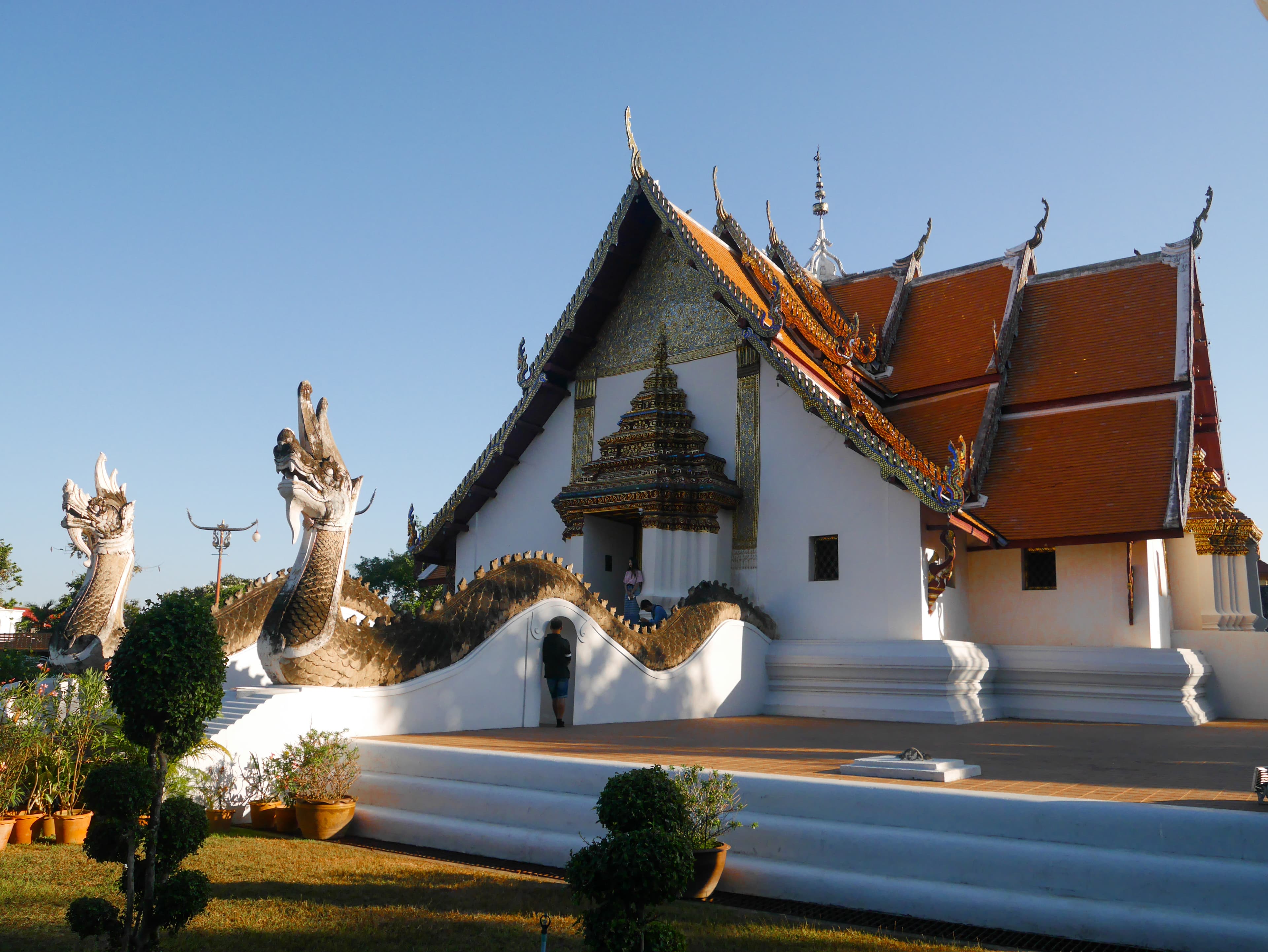
Wat Phumin in Nan, Nan, Thailand. Image source · CC BY-SA 4.0
Visit essentials
A quick read before you go
- Etiquette
- Protect prayer axes and mural surfaces, especially around the crowded whispering-couple scene.
Overview
Wat Phumin is entered through more than one visual axis, but each route leads toward the four seated Buddhas sharing a central core. The arrangement prevents one privileged façade from containing the whole temple. Devotees approach from different directions and still meet the same field of recollection. Around them, murals shift the scale from monumental calm to crowded narrative detail.
Fine Arts Department material identifies episodes from the Khatthana Kumara and Nemi Jatakas, the Buddha's life, and social scenes painted during the nineteenth-century renovation. The famous Pu Man Ya Man pair—often called the whispering lovers—belongs to this larger moral and historical program rather than standing alone as a romantic icon. Wat Phumin remains sacred because worship, teaching, regional memory, and preservation continue to occupy the same room.
Why this place is sacred
The temple's unusual power is architectural and relational, not evidence of a measurable energy. Four Buddha images establish cardinal orientation without dividing devotion into four competing objects. Murals then place Buddhist narratives beside clothing, gesture, courtship, travel, and ordinary community life. That adjacency makes doctrine visible within a particular northern world. The paintings are historically vulnerable surfaces, so contemplation depends on restraint: distance, low light, and the absence of touch preserve what future worshippers and students may encounter.
Popular fascination with the whispering couple can open attention to Nan culture, but it can also reduce the hall to a single photographic motif. A fuller reading returns from that intimate exchange to Jataka teaching and the central Buddhas.
Experience and orientation
Pause at the threshold until your eyes adjust, then locate the four principal images before scanning the murals. Move around the central core only along permitted routes and avoid crossing directly in front of someone bowing. The paintings reward close looking from a respectful distance: narrative registers, faces, textiles, architecture, and small social exchanges emerge gradually. Do not point, lean, use flash, or press near a wall for a portrait.
The whispering pair often attracts a concentrated crowd; wait rather than blocking circulation. A useful contemplative sequence is to face one Buddha, notice how the same central mass serves another direction, and then study one mural episode without trying to photograph the entire room.
Context and lineage
Official Fine Arts and Tourism Authority accounts place Wat Phumin's foundation in 1606. Its current artistic identity owes much to a major nineteenth-century renovation, when the mural cycle was produced. These dates separate an early Nan foundation from later surfaces instead of presenting the building as untouched. The murals are attributed within the regional history of Nan and Tai Lü culture, and their subjects combine Buddhist narratives with observations of contemporary life.
Subsequent conservation has addressed architecture and paint layers while preserving the hall's continuing religious use. UNESCO World Heritage status does not apply to Wat Phumin. Its protection and significance come through Thai heritage stewardship, monastic custody, and the care required for a living temple containing fragile historical paintings.
Traditions and practice
Theravada practice includes bowing, prayer, chanting, offerings, merit-making, and recollection before the principal Buddha images. Guests should use only established offering areas, keep their feet directed away from images, and allow ceremonies to reorder the normal visitor route. Murals are not ritual props and should never be touched. No named recurrent pilgrimage met the direct-source threshold for this page, so Wat Phumin is classified as active worship rather than a pilgrimage destination.
Quiet study can still be devotional: Jataka scenes traditionally support reflection on ethical conduct and the long cultivation associated with Buddhahood. Visitors unfamiliar with a scene should avoid inventing an interpretation and consult the museum or custodial material where available.
Theravada Buddhism
ActiveTheravada worship is focused through four Buddhas, merit, prayer, and painted narratives.
Perspectives and open questions
Buddhist teaching, Nan social history, mural scholarship, and conservation meet without romantic guarantees.
Scholarly perspective
Buddhist interpretation centers the four principal images and the narrative function of Jataka and life-of-the-Buddha paintings. Art history examines the cruciform plan, nineteenth-century mural campaign, technique, dress, and links to Nan's regional culture. Social historians value details of people and daily life without assuming that every painted figure is a literal documentary portrait. Conservation treats the hall as an environment in which humidity, light, crowds, and contact affect vulnerable surfaces. These perspectives converge on careful attention.
The reviewed sources do not establish a prevalent metaphysical claim about energy, healing, or guaranteed romantic fortune. The whispering couple's popularity is cultural reception; the temple's documented sacred center remains Buddhist worship and teaching.
Plan your visit
Strong Places supports routing; opening, ceremony, photography, and conservation limits need current confirmation.
Respectful visit
Protect prayer axes and mural surfaces, especially around the crowded whispering-couple scene.
Current practical details
Address
QQFC+RMC ผากอง Phakong, Tambon Nai Wiang, Amphoe Mueang Nan, Chang Wat Nan 55000, Thailand
Hours
Hours, fees, and access can change — verify on the official source before you travel. Practical details last checked Jul 2026.
Location
Map loads as you approach this section.
Pilgrim reflections
A portrait of encounter, not a score
Pilgrims describe what they felt, how present they could become, and whether the place would shape a journey. There are no stars and no ranking of traditions.
No reviewed reflections yet
The first pilgrims can help describe the character of being here.
Share a reflection
Available after an account-backed “Been there.” Every reflection is reviewed before publication.
Nearby sacred places
Explore other sacred places in the region. Proximity does not establish access or travel time; check each place’s guidance.

References
Sources consulted for this page. Source categories describe the publication, not a guarantee that every claim is verified. Traditional accounts and outside interpretations may differ.
- 01Wat Phumin — Fine Arts Department, Nan National MuseumofficialExact-site support for the four-direction principal Buddha images and current worship.
- 02Murals inside Wat Phumin — Fine Arts DepartmentofficialOfficial account of the mural chronology, Jatakas, Buddha biography, and Pu Man Ya Man scene.
- 03ASEAN Heritage Trail: Nan — Tourism Authority of ThailandofficialOfficial tourism corroboration for the 1606 foundation and nineteenth-century mural renovation.
- 04Wat Phumin — Wikipedia — Wikipedia contributorsacademicCorroborates identity, location, and basic historical context; key claims require higher-tier corroboration.
- 05Q588172 — Wikidata — Wikidata contributorsacademicStructured identity and coordinate corroboration; not used alone for spiritual or historical claims.
- 06Wat Phumin — Google Maps — Google PlacesSource contextStrong name, country, locality, and coordinate match; used only for practical visitor data and identity corroboration.
Share a photo
Help visitors recognize Wat Phumin. Every submission is reviewed before publication.