Wat Chang Rop
Sixty-eight elephants support a forest-zone Buddhist cosmos
Understand sacred places, explore living traditions, and learn how to engage respectfully with Pilgrim Map.
Access has not been verified. Check current local guidance before planning a visit.
Kamphaeng Phet, Kamphaeng Phet, Thailand
Read the sources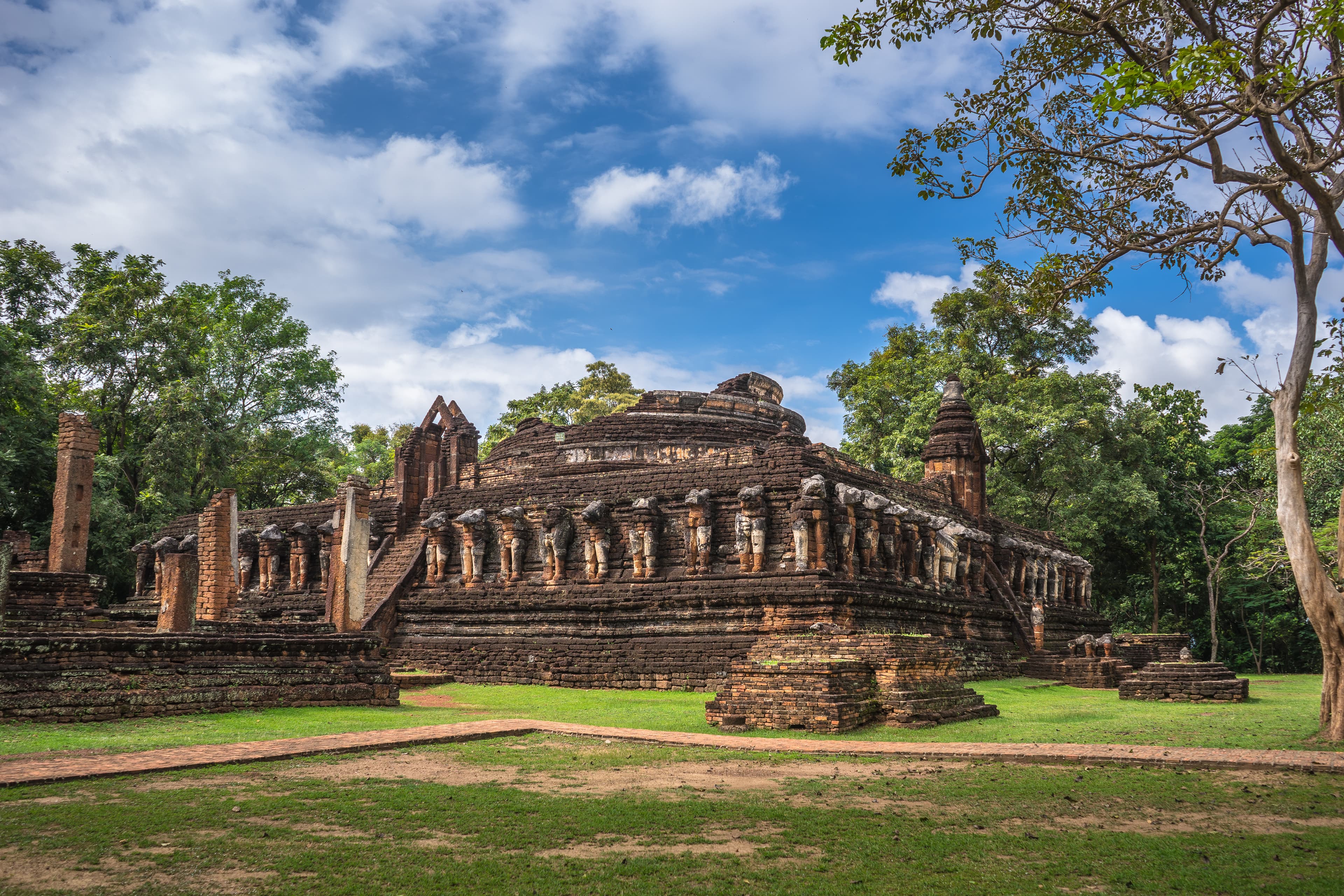
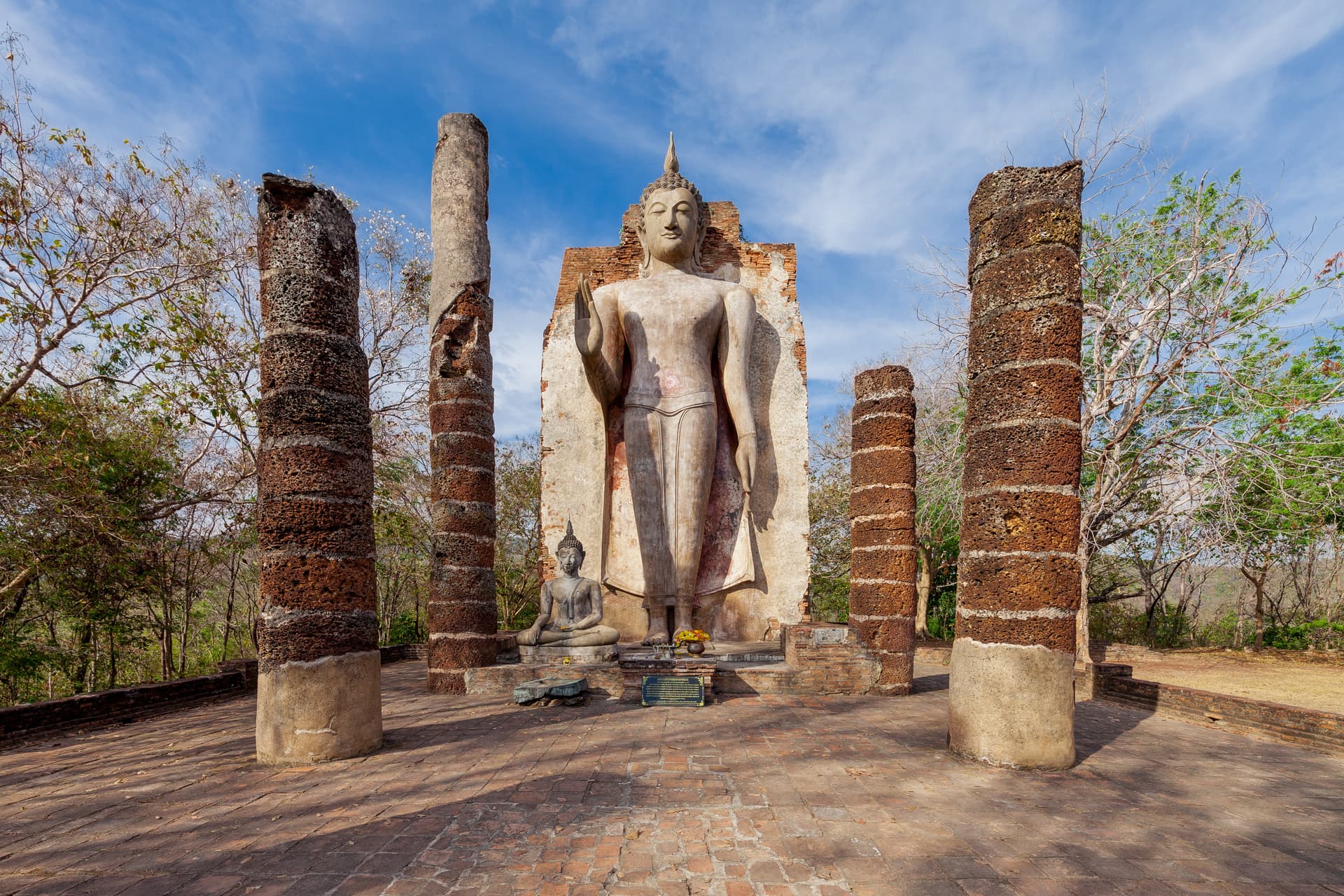
Wat Chang Rop in Kamphaeng Phet, Kamphaeng Phet, Thailand. Image source · CC BY-SA 4.0
Visit essentials
A quick read before you go
- Etiquette
- Protect every stucco elephant, relief fragment, barrier, forest path, and unstable edge.
Overview
The ascent reaches a monument built to look supported by living force. Sixty-eight elephants project head and forelegs from the stupa base; guardians and lions mark stairways, while traces of vegetation, heavenly beings, swans, kinnari, and episodes from the Buddha's life once animated higher registers. Fine Arts interprets the central bell stupa as Mount Meru and the surrounding figures as parts of a Buddhist cosmos.
East of it stood a hall with a principal Buddha image and monastic seating; an ordination hall lay to the northeast. The ensemble joined reliquary architecture, teaching narrative, ritual movement, and forest-monastery seclusion rather than elephant spectacle alone.
Why this place is sacred
Cosmology here is architectural language, not a claim that the laterite hill physically became Mount Meru. Builders used vertical order, cardinal stairs, guardians, elephants, and narrative zones to make Buddhist conceptions spatially intelligible. Walking around the base would have brought changing figures into sequence, while the forest location separated monastic practice from the walled city. Today much of the upper stupa is lost, so interpretation depends on fragments and expert comparison.
Touching elephants cannot recover that world and may damage the stucco. No credible source reports guaranteed strength or luck from contact; sacred understanding comes through form, context, and care.
Experience and orientation
Approach the principal stupa from enough distance to see how the hill and eastern hall relate. At the base, inspect ornament without crossing barriers or leaning into the elephant figures. Each animal differs in surviving headdress and jewelry, and the spaces between preserve other motifs that are easy to miss. Follow only open stairs; the upper processional terrace may be restricted or unstable. Fine Arts conservation reports make surface fragility explicit.
Compare the former Buddha hall, ordination area, water-cut laterite pit, and central monument rather than treating the site as one photo stop. Forest shade can conceal uneven ground, insects, and loose stone.
Context and lineage
Fine Arts places Wat Chang Rop on the highest laterite rise in Kamphaeng Phet's northern aranyik. Comparative dating associates the principal stupa with roughly the fifteenth or sixteenth century, while details show interaction between Sukhothai Buddhist forms and early-to-middle Ayutthaya art. Excavation found terracotta dancers, giants, swans, divine faces, human heads, and architectural pieces, some now held by the Kamphaeng Phet National Museum. Conservation continues because microorganisms and weather threaten stucco.
UNESCO property 574 includes the historic town as one of three associated centres, recognizing a shared cultural achievement rather than a separate inscription for this single temple.
Traditions and practice
Historical practice involved a principal Buddha hall, an ordination space, circumambulation, narrative contemplation, and monastic life in a forest district. The archaeological site does not authorize visitors to climb the stupa, circle on closed terraces, or place offerings among damaged elephants. Keep all food and incense away from conserved stucco. Quiet reflection from public paths is appropriate, and Buddhist visitors may bow without implying that the original rite survives unchanged.
No resident sangha, named present pilgrimage, or current festival is established by the source bundle. Conservation is therefore the active discipline through which the sacred record remains accessible.
Theravada Buddhism
HistoricalHistoric Theravada practice joined stupa reverence, Buddha narrative, monastic discipline, and sacred landscape.
Heritage stewardship
ActiveMicrobial cleaning and fragile-stucco treatment protect elephant forequarters, plant motifs, and surviving narrative fragments.
Perspectives and open questions
Cosmology, archaeology, art exchange, forest history, and conservation science share authority.
Scholarly perspective
Buddhist cosmology explains Mount Meru symbolism and the supportive role assigned to elephants, guardians, and celestial figures. Archaeology reconstructs the vanished upper monument from fragments, layout, and comparisons. Art history traces exchanges among Sukhothai, Sri Lankan, Nakhon Si Thammarat, Khmer, and Ayutthaya forms without reducing the site to imitation. Forest-monastery history considers why the compound stood outside the walls. Conservation science addresses biological growth and vulnerable plaster. Together these views make Wat Chang Rop highly specific.
None provides evidence for a transferable energy, supernatural animal power, or a visitor entitlement to touch the monument.
Plan your visit
Strong Places supports the exact hill monument; hours, weather, and conservation closures require checks.
Respectful visit
Protect every stucco elephant, relief fragment, barrier, forest path, and unstable edge.
Current practical details
Address
GG35+5VP, Nong Pling, Mueang Kamphaeng Phet District, Kamphaeng Phet 62000, Thailand
Phone
Hours
Hours, fees, and access can change — verify on the official source before you travel. Practical details last checked Jul 2026.
Location
Map loads as you approach this section.
Pilgrim reflections
A portrait of encounter, not a score
Pilgrims describe what they felt, how present they could become, and whether the place would shape a journey. There are no stars and no ranking of traditions.
No reviewed reflections yet
The first pilgrims can help describe the character of being here.
Share a reflection
Available after an account-backed “Been there.” Every reflection is reviewed before publication.
Nearby sacred places
Explore other sacred places in the region. Proximity does not establish access or travel time; check each place’s guidance.
References
Sources consulted for this page. Source categories describe the publication, not a guarantee that every claim is verified. Traditional accounts and outside interpretations may differ.
- 01Wat Chang Rop — Fine Arts Department, Kamphaeng Phet Historical ParkofficialExact-site elephants, layout, sculpture finds, and dating.
- 02Conservation of Wat Chang Rop stucco — Fine Arts Department, Kamphaeng Phet Historical ParkofficialCurrent official conservation and exact architectural evidence.
- 03Wat Chang Rop, ancient Kamphaeng Phet — Fine Arts DepartmentofficialDetailed official account of Buddha-life reliefs and Mount Meru symbolism.
- 04Historic Town of Sukhothai and Associated Historic Towns — UNESCO World Heritage CentreofficialAuthoritative inscription, property scope, criteria, and management context.
- 05Wat Chang Rop — Google Maps — Google PlacesSource contextStrong name, country, locality, and coordinate match; used only for practical visitor data and identity corroboration.
Pilgrim glossary
- Stupa
- A dome-shaped Buddhist monument that holds relics or marks a sacred place.
- Sangha
- The community of Buddhist practitioners, traditionally monks and nuns.
Share a photo
Help visitors recognize Wat Chang Rop. Every submission is reviewed before publication.