Wat Si Sawai
Three prangs preserve a Hindu sanctuary later remade for Buddhism
Understand sacred places, explore living traditions, and learn how to engage respectfully with Pilgrim Map.
Access has not been verified. Check current local guidance before planning a visit.
Mueang Kao, Sukhothai, Thailand
Read the sources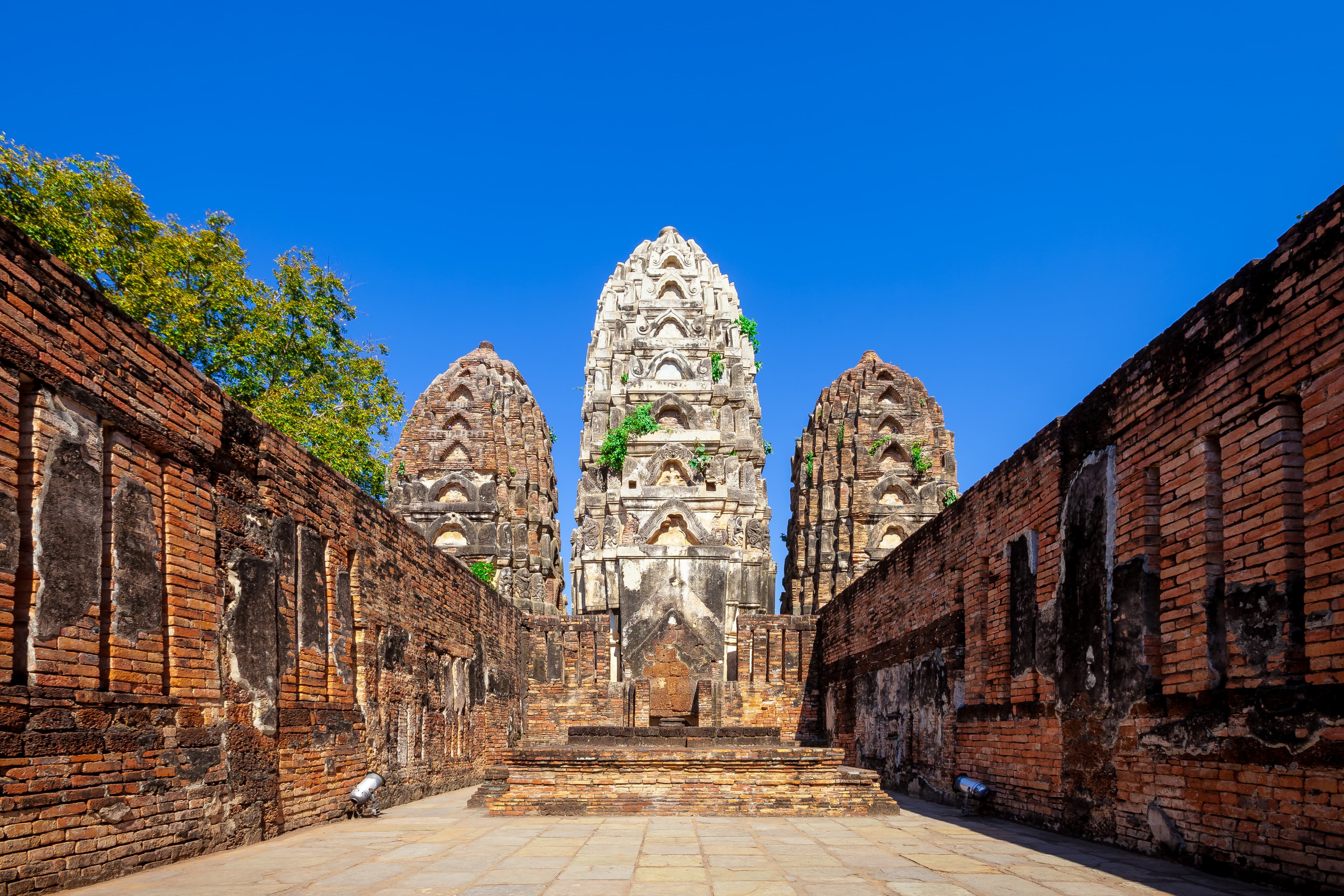
Wat Si Sawai in Mueang Kao, Sukhothai, Thailand. Image source · CC BY 4.0
Visit essentials
A quick read before you go
- Etiquette
- Do not climb, touch stucco, enter unstable towers, or use the pond as a ritual prop.
Overview
Three slender prangs dominate the enclosure, but objects recovered around them determine how the site is read. Fine Arts cites a lintel of Vishnu reclining on the cosmic ocean, deity fragments, and a Shiva lingam as evidence for Hindu worship. Two halls were subsequently added in front, marking reuse as a Buddhist temple. The sequence is not a story of one faith simply erasing another. Builders retained a charged architectural core while redirecting access and ritual purpose.
Today the ruined fabric asks visitors to hold both histories: Brahmanical devotion associated with Vishnu and Shiva, then Buddhist occupation within the Sukhothai sacred city.
Why this place is sacred
Religious change becomes visible here through joins, additions, and displaced sculpture. The prangs carry Khmer-influenced form; later halls alter the route without making the earlier sanctuary disappear. Fine Arts also records a historical proposal that the name may relate to Shiva and a nearby pond may have served a Brahmanical purification rite, but these remain interpretations rather than direct observation of a surviving ceremony.
No evidence supports claims that the towers generate power or that visitors can reenact purification by using the pond. The site's force is evidentiary: architecture and finds preserve the negotiation of traditions across time.
Experience and orientation
Walk the perimeter before approaching the three towers so their shared platform and enclosure remain legible. From the front, identify where later halls changed the original Hindu approach. Do not enter unstable openings, climb the base, or touch stucco and stone. Official signs can help distinguish Vishnu, Shiva-lingam evidence, and later Buddhist adaptation; generic 'Khmer temple' labels are not enough. The prangs are visually dramatic at oblique angles, but photography should stay on permitted surfaces.
A careful visit compares phases rather than searching for one timeless rite. Where the evidence is interpretive, use conditional language and let uncertainty remain visible.
Context and lineage
Fine Arts dates the sanctuary's earliest form to roughly the thirteenth century and describes Lopburi architecture influenced by Khmer art. Hindu objects establish a Brahmanical phase, while paired halls in front demonstrate later Buddhist conversion. Further work and restoration occurred in subsequent periods, including Ayutthaya-era changes. Wat Si Sawai now forms part of Sukhothai Historical Park and UNESCO property 574, inscribed in 1991. UNESCO status applies to the broader serial historic towns and their testimony to Sukhothai culture.
It should not be used to declare one theology superior or to resolve every scholarly question about naming, ritual, and sequence.
Traditions and practice
No continuous priesthood or monastic community is documented at the ruin, so visitors should not invent Hindu offerings or Buddhist ceremonies. Preservation-led conduct is the appropriate present practice: remain on paths, leave no incense or food, and do not use water features for symbolic cleansing. Quiet acknowledgment of the site's religious history is possible without copying gestures detached from their communities. Explain Vishnu and Shiva as evidence from the earlier phase and the Buddha as the focus of later reuse.
This precision avoids collapsing several traditions into a vague 'mystical' identity. No current pilgrimage or calendar observance is asserted.
Historic Hindu practice
HistoricalVishnu and Shiva evidence identifies the enclosure's earlier Hindu sanctuary and Brahmanical use.
Theravada Buddhism
HistoricalAdded halls document the sanctuary's later conversion for Buddhist worship within Sukhothai.
Heritage stewardship
ActiveCustodians preserve the physical junction between three Hindu prangs and the Buddhist halls added before them.
Perspectives and open questions
Hindu studies, Buddhist history, archaeology, naming tradition, and art history remain distinct.
Scholarly perspective
Hindu studies interprets the Vishnu lintel, lingam, prang form, and possible Brahmanical ritual setting. Buddhist history examines how new halls reoriented a pre-existing sanctuary. Archaeology sequences foundations, finds, and later modifications, while art history compares Lopburi, Khmer, Yuan-era decorative echoes, and Sukhothai adaptation. Heritage management keeps these layers available without rebuilding a hypothetical complete temple. Local naming traditions add another line of inquiry but do not override material evidence.
The page therefore uses plural, time-specific language and rejects unsupported energy claims. Sacred significance is strongest where the record shows actual religious transformation.
Plan your visit
Strong Places supports the exact monument; current park controls and weather conditions require checks.
Respectful visit
Do not climb, touch stucco, enter unstable towers, or use the pond as a ritual prop.
Current practical details
Address
2P72+GWC, Mueang Kao, Mueang Sukhothai District, Sukhothai 64210, Thailand
Hours, fees, and access can change — verify on the official source before you travel. Practical details last checked Jul 2026.
Location
Map loads as you approach this section.
Pilgrim reflections
A portrait of encounter, not a score
Pilgrims describe what they felt, how present they could become, and whether the place would shape a journey. There are no stars and no ranking of traditions.
No reviewed reflections yet
The first pilgrims can help describe the character of being here.
Share a reflection
Available after an account-backed “Been there.” Every reflection is reviewed before publication.
Nearby sacred places
Explore other sacred places in the region. Proximity does not establish access or travel time; check each place’s guidance.


References
Sources consulted for this page. Source categories describe the publication, not a guarantee that every claim is verified. Traditional accounts and outside interpretations may differ.
- 01Wat Si Sawai — Fine Arts Department, Sukhothai Historical ParkofficialExact-site Hindu finds, three prangs, and later Buddhist conversion.
- 02Wat Si Sawai, Sukhothai — Fine Arts DepartmentofficialDetailed official corroboration for religious phases, dating, and interpretation.
- 03Historic Town of Sukhothai and Associated Historic Towns — UNESCO World Heritage CentreofficialAuthoritative inscription, property scope, criteria, and management context.
- 04Wat Si Sawai — Google Maps — Google PlacesSource contextStrong name, country, locality, and coordinate match; used only for practical visitor data and identity corroboration.
Share a photo
Help visitors recognize Wat Si Sawai. Every submission is reviewed before publication.