Wat Benchamabophit
Carrara marble frames royal remembrance and a living Buddha-image collection
Understand sacred places, explore living traditions, and learn how to engage respectfully with Pilgrim Map.
Access has not been verified. Check current local guidance before planning a visit.
Bangkok, Bangkok, Thailand
Read the sources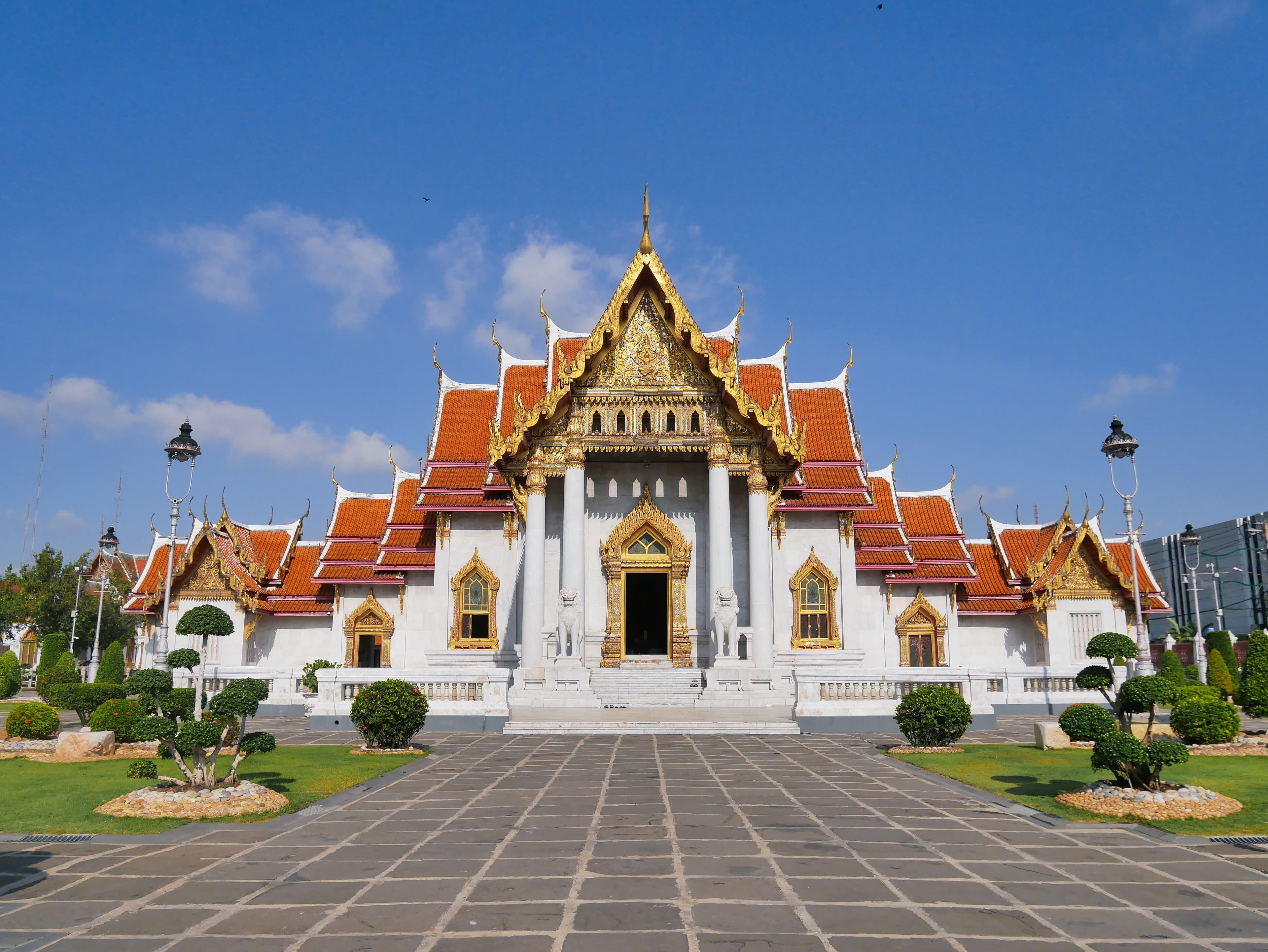
Wat Benchamabophit in Bangkok, Bangkok, Thailand. Image source · CC BY-SA 4.0
Visit essentials
A quick read before you go
- Etiquette
- Marble surfaces amplify footsteps and camera activity, making restraint especially important…
Overview
White Carrara marble catches Bangkok light with an almost civic formality, but the ubosot remains consecrated space. King Chulalongkorn commissioned the temple during the development of Dusit, and Prince Narisara Nuwattiwong shaped a design that joins Thai sacred architecture with selected European materials and techniques. The principal image, Phra Phuttha Chinnarat, is a Bangkok casting modeled on the revered Phitsanulok Buddha. Ashes of Rama V are enshrined beneath it, binding royal remembrance to Buddhist worship.
In the cloister, Buddha images representing different periods and regional styles create an educational sequence. The collection is not a sculpture market: images gathered for study are also treated as objects of respect.
Why this place is sacred
The temple's sacred quality emerges through the meeting of surface and lineage. Marble suggests permanence, cleanliness, and modern statecraft, while Buddhist practice insists on impermanence and disciplined attention. The apparent tension is productive. Rama V's temple did not abandon Thai ritual grammar when it adopted European stone; the imported material was made to serve an ubosot, Buddha image, ordination, and merit. The cloister likewise joins classification with reverence.
A visitor may compare styles while remembering that a Buddha image is not merely evidence for an art-historical timeline. Royal ashes beneath the principal image add a further layer: national memory is placed under, not above, the Buddha's teaching.
Experience and orientation
Cross the marble court without letting its symmetry turn the visit into a façade hunt. At the ubosot, remove shoes and wait until worshippers have completed bows before moving along the threshold. Let your eyes adjust from bright stone to the darker interior before approaching Phra Phuttha Chinnarat. In the cloister, follow the sequence of images patiently and avoid ranking them by decorative appeal. Each posture and style reflects a different historical setting.
Photography rules may differ between courtyard, cloister, and active hall; ask rather than infer. Early light reveals the material clearly, but ceremonies and monastic use decide the pace.
Context and lineage
Wat Benchamabophit took its present form under King Chulalongkorn around the turn of the twentieth century, when the Dusit district was being developed. Prince Naris, a major royal artist and architect, designed the principal complex. Italian marble became the feature by which outsiders remember the temple, while Thai roof forms, gables, guardian figures, and ritual planning maintained the building's religious identity. The principal Buddha image was cast after the celebrated Phra Phuttha Chinnarat in Phitsanulok.
Rama V's ashes were later placed beneath it. The cloister collection of Buddha images was assembled for public worship and historical understanding. Continued monastic use prevents this carefully composed royal project from becoming only a monument to modernization.
Traditions and practice
Wat Benchamabophit supports prayer, chanting, offerings, ordination, teaching, and resident monastic life. Bowing before the principal image or sitting in silence may be appropriate when space is open, but the central approach should remain available for practitioners. Do not touch cloister images, even when their display resembles a museum. Food, incense, flowers, and donations belong only at designated points. If monks receive alms or conduct a service, remain outside the working line.
A thoughtful visit can compare one cloister image with Phra Phuttha Chinnarat, asking how posture and setting change attention without claiming that one style is spiritually superior.
Theravada Buddhism
ActiveTheravada Buddhist worship anchors the royal temple, its principal image, cloister, monastic routine, and merit-making.
Perspectives and open questions
Material history can trace imported marble and royal design without reducing Phra Phuttha Chinnarat to interior decoration.
Scholarly perspective
Architectural history emphasizes the synthesis of Thai planning and European material during Rama V's reign. Royal history reads the temple through patronage and commemoration. Buddhist practice centers the principal image, ordination space, and sangha. Museum history studies the cloister as a purposeful collection of regional and period forms. These readings reinforce one another when their boundaries remain clear.
Marble does not make the temple more sacred than a wooden monastery, and the presence of royal ashes does not displace the Buddha as devotional focus. No reviewed source supports a prevalent claim that the stone radiates healing energy. Its verifiable power is cultural: skilled design turned imported material into a durable setting for Thai Buddhist worship and memory.
Plan your visit
Morning alms activity, hall access, and dress enforcement can differ from the quieter cloister circuit later in the day.
Respectful visit
Marble surfaces amplify footsteps and camera activity, making restraint especially important near prayer and ordination space.
Current practical details
Address
69 Thanon Rama V, Khwaeng Dusit, Khet Dusit, Krung Thep Maha Nakhon 10300, Thailand
Phone
Hours
Hours, fees, and access can change — verify on the official source before you travel. Practical details last checked Jul 2026.
Location
Map loads as you approach this section.
Pilgrim reflections
A portrait of encounter, not a score
Pilgrims describe what they felt, how present they could become, and whether the place would shape a journey. There are no stars and no ranking of traditions.
No reviewed reflections yet
The first pilgrims can help describe the character of being here.
Share a reflection
Available after an account-backed “Been there.” Every reflection is reviewed before publication.
Nearby sacred places
Explore other sacred places in the region. Proximity does not establish access or travel time; check each place’s guidance.


References
Sources consulted for this page. Source categories describe the publication, not a guarantee that every claim is verified. Traditional accounts and outside interpretations may differ.
- 01Bangkok — official destination overview — Tourism Authority of ThailandofficialOfficial overview identifying Bangkok's principal religious and historical sites.
- 02Wat Benchamabophit, the Marble Temple — Thailand 2026 Annual Meetings TeamofficialGovernment-hosted account of Rama V patronage, Italian marble, architectural synthesis, and religious significance.
- 03Wat Benchamabophit — Wikipedia — Wikipedia contributorsacademicCorroborates identity, location, and basic historical context; key claims require higher-tier corroboration.
- 04Q2165719 — Wikidata — Wikidata contributorsacademicStructured identity and coordinate corroboration; not used alone for spiritual or historical claims.
- 05Wat Benchamabophit Dusitwanaram — Google Maps — Google PlacesSource contextStrong name, country, locality, and coordinate match; used only for practical visitor data and identity corroboration.
Pilgrim glossary
- Sangha
- The community of Buddhist practitioners, traditionally monks and nuns.
Share a photo
Help visitors recognize Wat Benchamabophit. Every submission is reviewed before publication.