Wat Ratchanatdaram
Thirty-seven spires turn Buddhist discipline into ordered architecture
Understand sacred places, explore living traditions, and learn how to engage respectfully with Pilgrim Map.
Access has not been verified. Check current local guidance before planning a visit.
Bangkok, Bangkok, Thailand
Read the sources
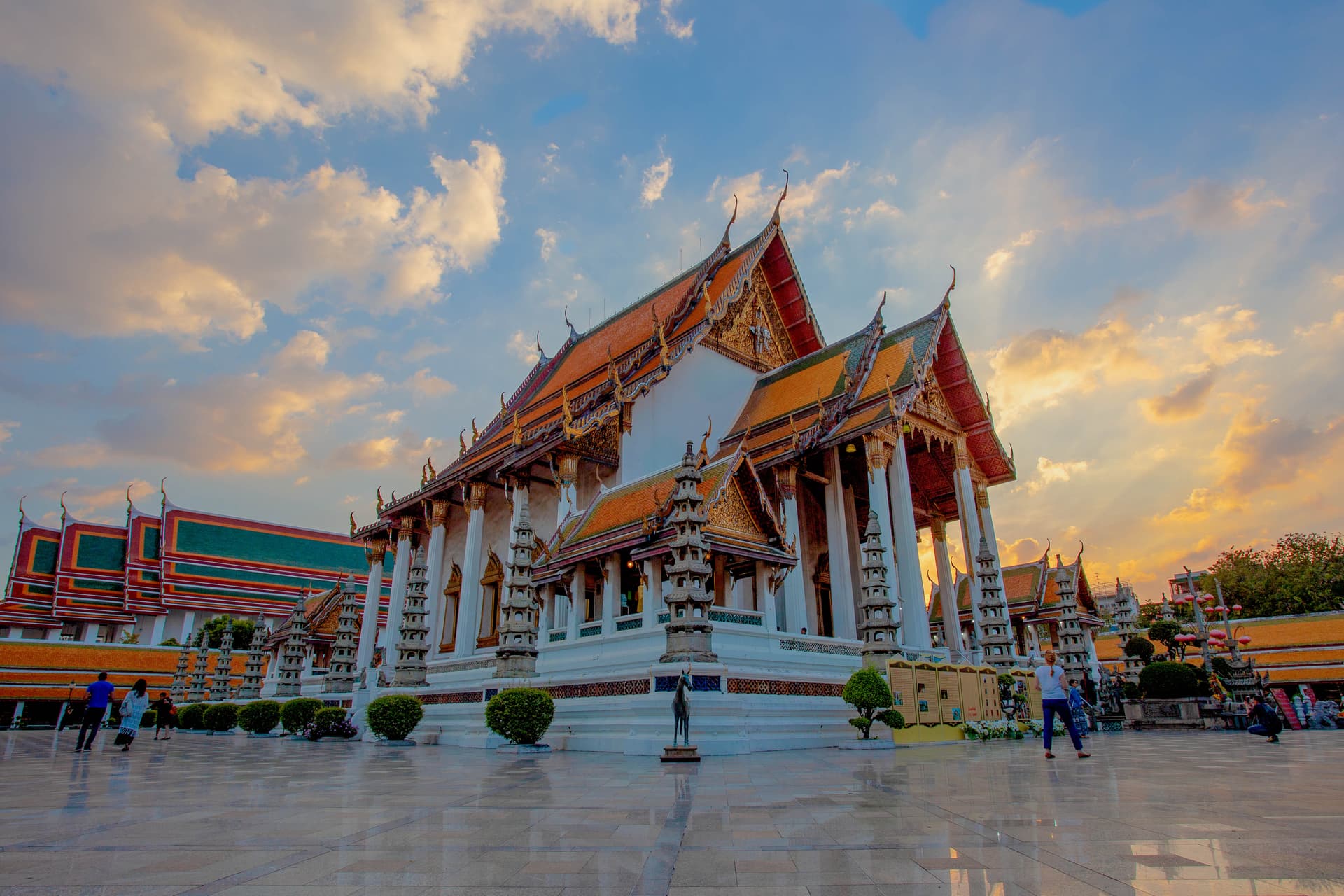
Wat Ratchanatdaram in Bangkok, Bangkok, Thailand. Image source · CC BY-SA 4.0
Visit essentials
A quick read before you go
- Duration
- Allow an exterior circuit and measured interior ascent rather than a single façade stop.
- Access
- The strong Places match gives 2 Maha Chai Road beside Ratchadamnoen; use the temple entrance.
Overview
Begin outside, where the tiers can be read as a whole, then allow interior corridors and stairs to change the pattern. Light, alignment, and repeated openings create an experience of ordered movement without requiring a supernatural explanation. Interpretive material about the factors conducive to awakening can be read as a map of ethical and mental training, not a promise delivered by the building itself.
Because Loha Prasat belongs to an active temple, upper-level curiosity should never override a closure, a worshipper's space, or monastic use. Its force comes from disciplined multiplicity made visible. Notice how each viewpoint withholds part of the structure until movement reveals another ordered layer.
Why this place is sacred
Loha Prasat's thirty-seven spires are interpreted in relation to the thirty-seven factors conducive to awakening. That association turns repetition into a teaching device: many elements form a disciplined whole, just as Buddhist cultivation is described through coordinated qualities rather than one dramatic revelation. The structure belongs to an active Theravada temple, so its symbolism should remain connected to practice, teaching, and monastic presence. It is not evidence of hidden technology or an esoteric energy system.
Loha Prasat joins Buddhist instruction, meditation, and royal temple patronage.
Rama III's foundation and later restoration produced the legible dark-spired structure encountered now.
Experience and orientation
Begin with the pattern of the spires, then notice how corridors, axes, and changing light make order perceptible from within. The contrast between metal, white walls, and surrounding Bangkok can encourage reflection on steadiness amid urban motion. The site's spiritual specificity lies in disciplined multiplicity: repeated architectural units point toward a coordinated path of ethical conduct, mental cultivation, and insight.
Circle Loha Prasat before entering so its concentric tiers remain intelligible from within.
Context and lineage
King Rama III founded Wat Ratchanatdaram in the nineteenth century for his granddaughter, Princess Somanass Waddhanawathy. Its defining structure, Loha Prasat, draws its name from the ancient idea of a metal-roofed or metal-spired monastery. Earlier structures described in Buddhist tradition did not survive, making Bangkok's example an unusual later interpretation rather than a direct ancient remnant.
The building's restoration history is part of its meaning: conservation has sought to recover the legibility of a complex geometric monument within a changing capital.
The doctrinal program belongs to Thai Theravada cultivation rather than an unspecified esoteric system.
Traditions and practice
Use the interior route quietly, yield at devotional spaces, and treat stairs and upper levels as parts of a religious monument. Where interpretive displays explain the thirty-seven factors, read them as a structured Buddhist framework rather than a checklist promising instant transformation. Offerings and meditation should follow temple guidance.
Meditation areas and interpretive displays share the structure with ordinary temple visitation.
Choose one of the thirty-seven factors from posted interpretation and observe its architectural grouping.
Theravada Buddhism
ActiveLoha Prasat gives a doctrinal path unusual architectural visibility within Bangkok Buddhism.
Quiet study, meditation where designated, offerings, and temple worship remain locally governed.
Perspectives and open questions
Doctrine, royal commemoration, architectural precedent, and restoration explain different aspects of Loha Prasat.
Scholarly perspective
The Bangkok building is a later interpretation of lost precedents, not an intact ancient metal monastery.
Living and traditional perspectives
The thirty-seven-part program refers to coordinated Buddhist cultivation within living Theravada teaching.
Alternative interpretations
Sources do not support numerological promises or an energy grid hidden beneath the spires.
Open questions
The reviewed records do not establish how every interior chamber is used in current practice.
Plan your visit
Access and arrival
The strong Places match gives 2 Maha Chai Road beside Ratchadamnoen; use the temple entrance.
Respectful visit
Wear modest clothing suited to a royal monastery and secure footwear for interior stairs.
Frame the spires from permitted floors without photographing meditators or obstructing narrow passages.
Place devotional items only at clearly established altars, never on geometric displays or ledges.
Upper chambers and circulation routes may close when maintenance or religious use requires privacy.
Do not turn stair climbing or axial alignment into claims of secret initiation.
Current practical details
Address
2 Maha Chai Rd, Khwaeng Wat Bowon Niwet, Khet Phra Nakhon, Krung Thep Maha Nakhon 10200, Thailand
Phone
Hours
Hours, fees, and access can change — verify on the official source before you travel. Practical details last checked Jul 2026.
Location
Map loads as you approach this section.
Pilgrim reflections
A portrait of encounter, not a score
Pilgrims describe what they felt, how present they could become, and whether the place would shape a journey. There are no stars and no ranking of traditions.
No reviewed reflections yet
The first pilgrims can help describe the character of being here.
Share a reflection
Available after an account-backed “Been there.” Every reflection is reviewed before publication.
Nearby sacred places
Explore other sacred places in the region. Proximity does not establish access or travel time; check each place’s guidance.



References
Sources consulted for this page. Source categories describe the publication, not a guarantee that every claim is verified. Traditional accounts and outside interpretations may differ.
- 01Bangkok — official destination overview — Tourism Authority of ThailandofficialOfficial overview identifying Bangkok's principal religious and historical sites.
- 02Wat Ratchanatdaram — Wikipedia — Wikipedia contributorsacademicCorroborates identity, location, and basic historical context; key claims require higher-tier corroboration.
- 03Q1554856 — Wikidata — Wikidata contributorsacademicStructured identity and coordinate corroboration; not used alone for spiritual or historical claims.
- 04Wat Ratchanatdaram Worawihan — Google Maps — Google PlacesSource contextStrong name, country, locality, and coordinate match; used only for practical visitor data and identity corroboration.
Share a photo
Help visitors recognize Wat Ratchanatdaram. Every submission is reviewed before publication.