Wat Saket
A relic hill shaped by collapse, rebuilding, memory, and ascent
Understand sacred places, explore living traditions, and learn how to engage respectfully with Pilgrim Map.
Access has not been verified. Check current local guidance before planning a visit.
Bangkok, Bangkok, Thailand
Read the sources
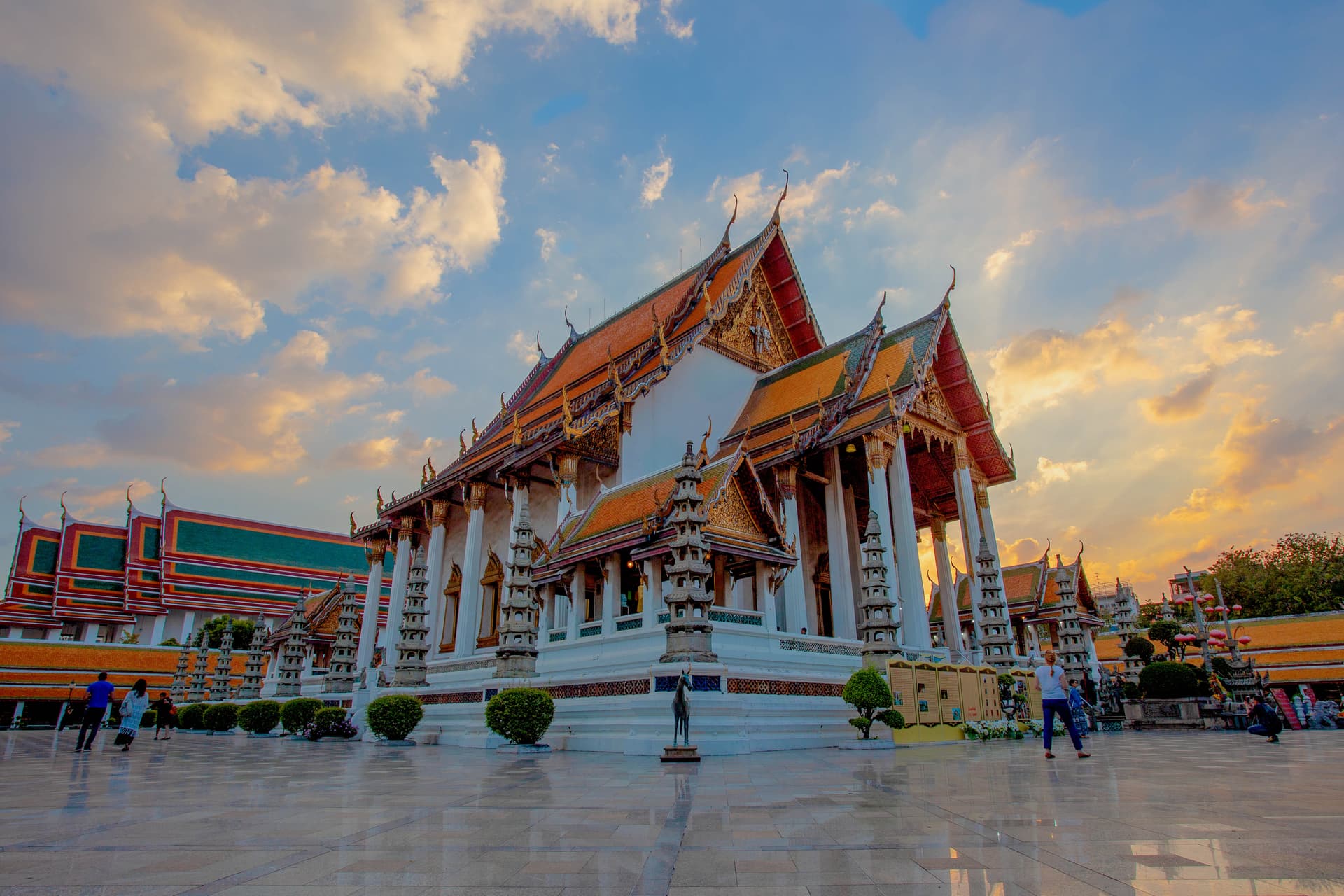
Wat Saket in Bangkok, Bangkok, Thailand. Image source · CC BY-SA 4.0
Visit essentials
A quick read before you go
- Duration
- Budget enough time to ascend slowly, circle respectfully, and revisit the lower monastery.
- Access
- The strong Places result identifies 344 Chakkraphatdi Phong Road; check which lower gate is…
Overview
Let the ascent establish a measured pace and give people carrying offerings room to pass. At the summit, identify the chedi as the religious center before turning toward the panorama. Circumambulation, where local signs or practice indicate it, deserves more care than a quick circuit for photographs. The annual fair can make Wat Saket especially lively, but dates and access are current facts to confirm, not permanent promises.
The strongest encounter holds repair and impermanence together: a failed foundation became a maintained shrine, and difficult urban memories remain beneath a celebrated golden landmark.
Why this place is sacred
The Golden Mount's sacred focus is the chedi and the Buddha relic tradition associated with it. Climbing is not automatically a pilgrimage, yet the measured ascent can mirror Buddhist practices of recollection and restraint when undertaken respectfully. Bells, prayer areas, Buddha images, and the summit circumambulation organize attention around veneration rather than the skyline alone. The annual temple-fair tradition reinforces the site's place in Bangkok's religious calendar, although dates and access arrangements must be confirmed each year.
The summit shrine focuses Buddha-relic veneration above a functioning Bangkok monastery.
Failed masonry became a stabilized mound, later ascent route, and maintained golden reliquary.
Experience and orientation
Wat Saket is best read through ascent, memory, and reconstruction. The hill changes the body's pace; the relic tradition changes the summit from viewpoint to shrine; the monastery below prevents the mound from standing alone as a tourist object. A careful account also remembers that landscapes celebrated today can contain histories of death and public health. Contemplation here can acknowledge impermanence without turning suffering into atmosphere.
Begin at the lower monastery before following the spiral path toward the summit chedi.
Context and lineage
Wat Saket predates modern Bangkok, but its most recognizable feature is the Golden Mount, an artificial hill crowned by a chedi. An earlier large stupa project failed in unstable ground; later reigns reshaped the mound and completed the summit structure. The resulting ascent is therefore a history of repair rather than an untouched ancient form. Wat Saket also carries difficult urban memory through accounts of epidemics and funerary use outside the old city wall.
Its present religious identity joins a working monastery, a relic shrine, and a landscape built gradually from failure, rebuilding, and care.
Thai Theravada practice connects the lower wat, relic tradition, circumambulation, and annual fair.
Traditions and practice
Move clockwise where posted practice indicates circumambulation, keep bells and devotional objects from becoming props, and leave the central approach open for people making offerings. During a fair or holy day, expect the route to serve worship, community gathering, and heritage visitation at the same time. Avoid claiming that the climb guarantees merit or a supernatural result.
Fair-period crowds combine offerings, community celebration, bells, and restricted movement on one route.
Pause below the final stairs and identify how the chedi, not the view, centers movement.
Theravada Buddhism
ActiveBuddha-relic memory and repeated summit worship define the Golden Mount within Bangkok Theravada life.
Circumambulation, offerings, prayer, and fair participation follow posted local sequences.
Perspectives and open questions
Relic devotion, engineered topography, funerary history, and modern city views should remain distinct.
Scholarly perspective
Historical evidence describes failed construction and later stabilization, not an ancient natural mountain.
Living and traditional perspectives
The golden chedi receives Buddhist reverence that gives the climb a devotional destination.
Alternative interpretations
No cited source establishes that ringing bells guarantees fortune, purification, or supernatural protection.
Open questions
Exact fair rituals and access arrangements vary annually and cannot be inferred from older travel accounts.
Plan your visit
Access and arrival
The strong Places result identifies 344 Chakkraphatdi Phong Road; check which lower gate is open.
Respectful visit
Choose temple-appropriate clothing that also handles exposed heat and many stairs safely.
Keep cameras away from active offering lines and from mournful history treated as scenery.
Use the summit and monastery stations established by custodians rather than leaving objects along the path.
Closed doors around the chedi and service areas mark religious boundaries, not missed viewpoints.
Do not promise merit merely for completing the climb or ringing every available bell.
Current practical details
Address
344 Thanon Chakkraphatdi Phong, Khwaeng Ban Bat, Khet Pom Prap Sattru Phai, Krung Thep Maha Nakhon 10100, Thailand
Hours
Hours, fees, and access can change — verify on the official source before you travel. Practical details last checked Jul 2026.
Location
Map loads as you approach this section.
Pilgrim reflections
A portrait of encounter, not a score
Pilgrims describe what they felt, how present they could become, and whether the place would shape a journey. There are no stars and no ranking of traditions.
No reviewed reflections yet
The first pilgrims can help describe the character of being here.
Share a reflection
Available after an account-backed “Been there.” Every reflection is reviewed before publication.
Nearby sacred places
Explore other sacred places in the region. Proximity does not establish access or travel time; check each place’s guidance.



References
Sources consulted for this page. Source categories describe the publication, not a guarantee that every claim is verified. Traditional accounts and outside interpretations may differ.
- 01Top five must-visit temples in Bangkok — Tourism Authority of ThailandofficialOfficial source identifying Wat Saket and the Golden Mount in Bangkok's temple landscape.
- 02Bangkok — official destination overview — Tourism Authority of ThailandofficialOfficial overview identifying Bangkok's principal religious and historical sites.
- 03Wat Saket — Wikipedia — Wikipedia contributorsacademicCorroborates identity, location, and basic historical context; key claims require higher-tier corroboration.
- 04Q2063818 — Wikidata — Wikidata contributorsacademicStructured identity and coordinate corroboration; not used alone for spiritual or historical claims.
- 05Wat Saket Ratchawora Mahawihan — Google Maps — Google PlacesSource contextStrong name, country, locality, and coordinate match; used only for practical visitor data and identity corroboration.
Pilgrim glossary
- Stupa
- A dome-shaped Buddhist monument that holds relics or marks a sacred place.
Share a photo
Help visitors recognize Wat Saket. Every submission is reviewed before publication.