Wat Suthat
A Sukhothai Buddha anchors a royal temple beside Bangkok's Giant Swing
Understand sacred places, explore living traditions, and learn how to engage respectfully with Pilgrim Map.
Access has not been verified. Check current local guidance before planning a visit.
Bangkok, Bangkok, Thailand
Read the sources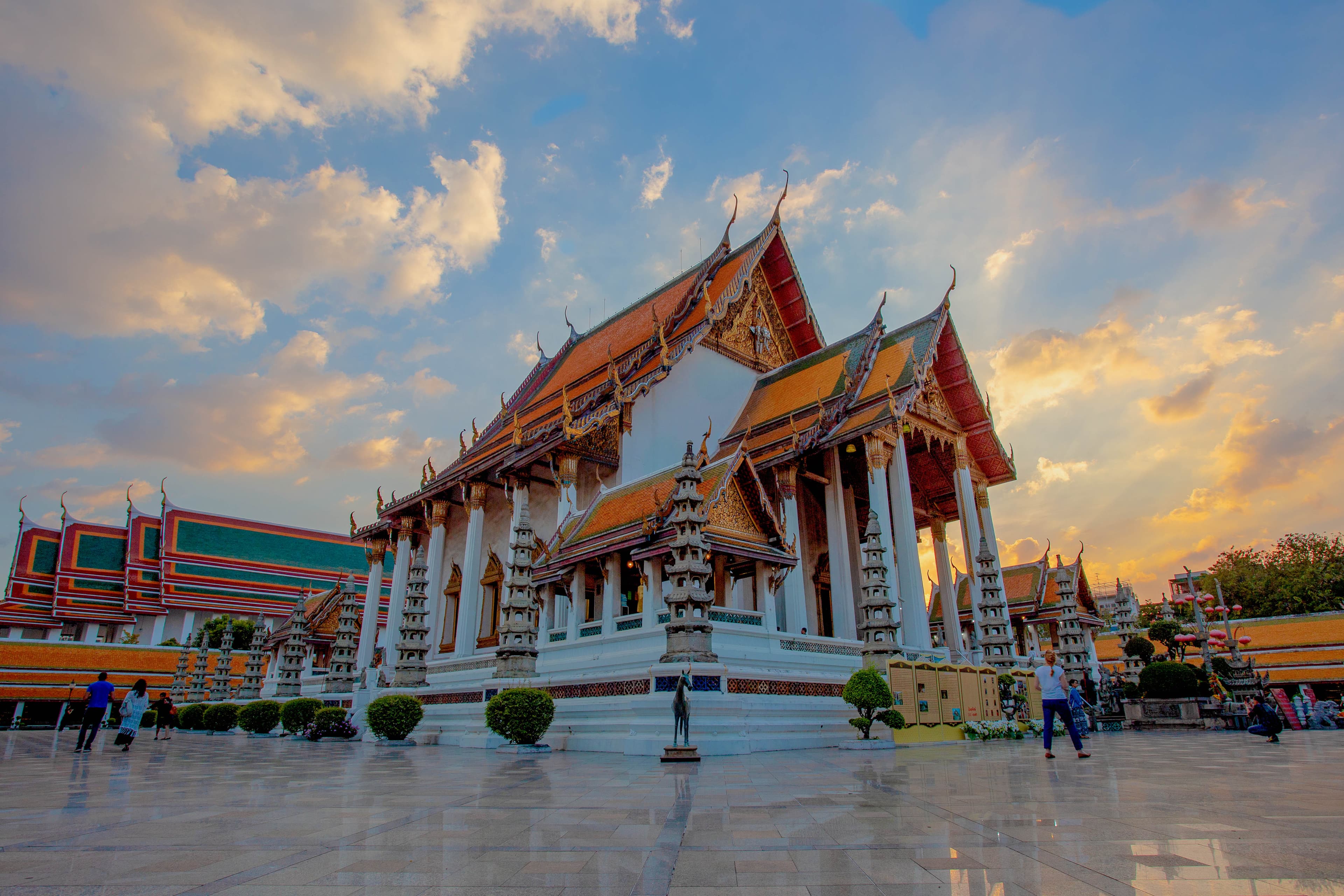
Wat Suthat in Bangkok, Bangkok, Thailand. Image source · CC BY-SA 4.0
Visit essentials
A quick read before you go
- Etiquette
- Do not let the adjacent Giant Swing collapse the Buddhist sanctuary and Bangkok's Brahmanical…
Overview
The great wihan establishes Wat Suthat's scale, but the principal Buddha gives that scale direction. Phra Sri Sakyamuni was brought from Wat Mahathat in Sukhothai and installed in Bangkok as the devotional center of a royal project that outlived its first patron. The temple's spacious court, surrounding images, murals, and carved surfaces unfold slowly around that focus. Unlike many Thai temples, Wat Suthat is not organized around a dominant chedi.
Official Tourism Authority material instead points to seven important trees associated with places in the Buddha's life, functioning as commemorative references. That difference matters. The site expresses Buddhist memory through image, vegetation, enclosure, and repeated movement, not through one expected monument type.
Why this place is sacred
Wat Suthat's spiritual specificity lies in relocation and recollection. A revered Sukhothai image entered a new capital and became part of Bangkok's religious order, carrying an older artistic and devotional presence into a nineteenth-century royal monastery. The seven trees create another form of movement across distance: they evoke sacred places without pretending to reproduce them. Murals and carved doors add teaching, cosmology, and craftsmanship, but they do not compete with worship.
The Giant Swing visible outside marks the importance of Brahmanical ritual in Bangkok's civic history; it is relational context rather than proof that the Buddhist temple is an undifferentiated Hindu-Buddhist sanctuary. Clear boundaries make the coexistence more respectful.
Experience and orientation
Approach from the Giant Swing side, then allow the temple wall and gates to reset the frame. Inside the wihan, give the central line to devotees and look at Phra Sri Sakyamuni before following painted narratives around the walls. Details emerge gradually in the lower light; flash or prolonged positioning can disturb both worship and conservation. In the grounds, search for the spatial role of the seven trees rather than assuming a missing chedi.
The broad court can feel empty between groups, but it remains active religious space. Keep voices low, avoid using door carvings as portrait backgrounds, and check whether ceremonies have changed access to the main hall.
Context and lineage
King Rama I began Wat Suthat as a major royal temple intended to house an important Buddha image brought from Sukhothai. The work was not complete at his death. Rama II continued the undertaking, including patronage associated with celebrated door carving, and Rama III brought the temple to completion. This multi-reign history explains why no single date or ruler contains the whole design.
It also situates Phra Sri Sakyamuni within the new capital's effort to gather religious authority, art, and memory. Later repair preserved a living monastery rather than returning the complex to one frozen phase. The finest original door panels are now protected in the National Museum, reminding visitors that conservation sometimes requires separating vulnerable fabric from its first setting.
Traditions and practice
Devotees bow, chant, offer flowers or incense where provided, and sit before Phra Sri Sakyamuni. Guests should leave the altar axis open and sit with feet directed away from the image. Circumambulation or movement around the court should follow local patterns instead of an assumed universal rule. The seven trees can support quiet recollection of episodes in the Buddha's life, but visitors should not attach objects or invent offerings around them.
When monks or lay groups are chanting, remain at the edge until the sequence finishes. Formal participation belongs under temple guidance; attentive observation is already a respectful form of presence.
Theravada Buddhism
ActiveTheravada Buddhism situates Phra Sri Sakyamuni within worship, teaching, merit-making, and the temple's living sangha.
Perspectives and open questions
Art historians emphasize murals and carving; devotees begin with Phra Sri Sakyamuni as a focus of recollection.
Scholarly perspective
A Buddhist reading centers Phra Sri Sakyamuni, recollection of the Buddha's life, and the community that maintains worship. Architectural history emphasizes royal patronage across three reigns and the relationship among wihan, court, images, murals, and trees. Urban history adds the Giant Swing and nearby Brahmanical institutions, revealing a capital whose ritual geography was plural without making every practice interchangeable. Popular blessing language may describe hoped-for outcomes from prayer, but the reviewed sources do not establish supernatural guarantees.
Wat Suthat is significant without them. Its strongest theme is careful transmission: an image moved between capitals, artistic work protected through relocation, and a monastery completed by successive rulers continues to orient devotion in the present.
Plan your visit
The wihan's active status and occasional ceremonies matter more than a fixed sightseeing circuit around the Giant Swing square.
Respectful visit
Do not let the adjacent Giant Swing collapse the Buddhist sanctuary and Bangkok's Brahmanical civic history into one ritual.
Current practical details
Address
146 Thanon Bamrung Mueang, Khwaeng Wat Ratchabophit, Khet Phra Nakhon, Krung Thep Maha Nakhon 10200, Thailand
Phone
Hours
Hours, fees, and access can change — verify on the official source before you travel. Practical details last checked Jul 2026.
Location
Map loads as you approach this section.
Pilgrim reflections
A portrait of encounter, not a score
Pilgrims describe what they felt, how present they could become, and whether the place would shape a journey. There are no stars and no ranking of traditions.
No reviewed reflections yet
The first pilgrims can help describe the character of being here.
Share a reflection
Available after an account-backed “Been there.” Every reflection is reviewed before publication.
Nearby sacred places
Explore other sacred places in the region. Proximity does not establish access or travel time; check each place’s guidance.


References
Sources consulted for this page. Source categories describe the publication, not a guarantee that every claim is verified. Traditional accounts and outside interpretations may differ.
- 01Bangkok — official destination overview — Tourism Authority of ThailandofficialOfficial overview identifying Bangkok's principal religious and historical sites.
- 02Spiritual places to visit for blessing in 2025 — Tourism Authority of ThailandofficialOfficial source for royal construction, Phra Sri Sakyamuni, the seven commemorative trees, and current visitor information.
- 03Wat Suthat — Wikipedia — Wikipedia contributorsacademicCorroborates identity, location, and basic historical context; key claims require higher-tier corroboration.
- 04Q2166761 — Wikidata — Wikidata contributorsacademicStructured identity and coordinate corroboration; not used alone for spiritual or historical claims.
- 05Wat Suthat Thepwararam Ratchaworamahawihan — Google Maps — Google PlacesSource contextStrong name, country, locality, and coordinate match; used only for practical visitor data and identity corroboration.
Share a photo
Help visitors recognize Wat Suthat. Every submission is reviewed before publication.