Bà Thiên Hậu Temple, Chợ Lớn
Hội quán Tuệ Thành: hanging incense coils above a Chợ Lớn communal court
Understand sacred places, explore living traditions, and learn how to engage respectfully with Pilgrim Map.
Access has not been verified. Check current local guidance before planning a visit.
District 5, Ho Chi Minh City, Vietnam
Read the sources
Bà Thiên Hậu Temple, Chợ Lớn in District 5, Ho Chi Minh City, Vietnam. Image source · CC0
Visit essentials
A quick read before you go
- Duration
- Allow time to connect inscriptions and association history with present prayer rather than…
- Access
- The Nguyễn Trãi address and hours come from a strong Places match; its Facebook candidate is not…
Overview
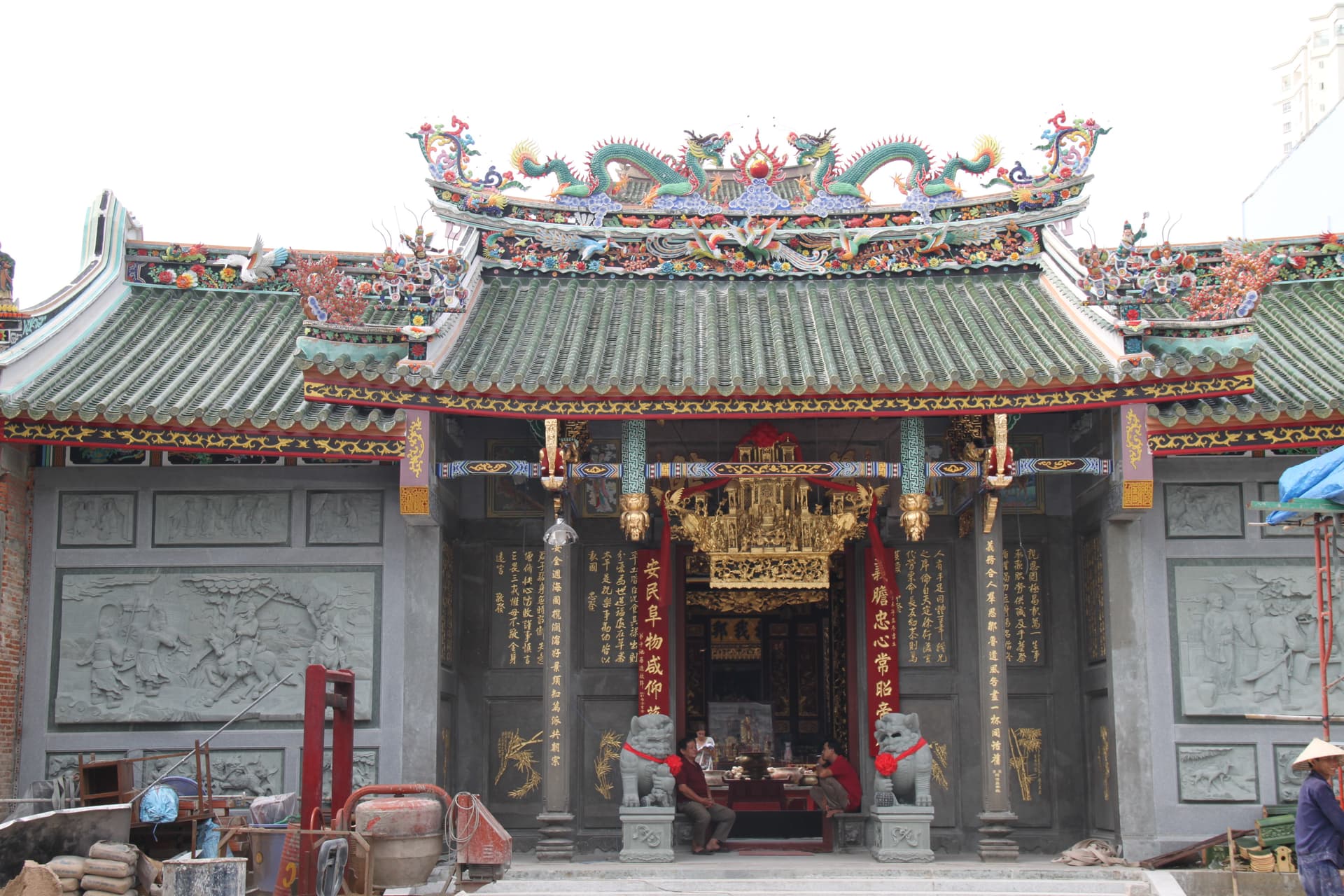
The courtyard opens upward beneath suspended incense coils, but the temple's centre is the relationship between Mazu and a Cantonese community. Bà Thiên Hậu is honoured as a protecting sea goddess whose care travelled with migrants far beyond coastal China. In Chợ Lớn, the Tuệ Thành Guildhall joined worship with association life, mutual responsibility, and the preservation of communal identity. Read plaques, roof figures, altar placement, and smoke as parts of that history.
A visitor enters a place still used for petitions and thanksgiving, not a preserved Chinatown set.
Why this place is sacred
Mazu devotion addresses protection across danger, distance, and uncertain journeys. Those maritime associations carried particular meaning for Cantonese families establishing themselves in southern Vietnam. The sanctuary remains sacred because Bà Thiên Hậu receives prayer and because the guildhall community assumes responsibilities for festival, maintenance, and remembrance. Devotional testimony can describe protection or gratitude, but the reviewed evidence does not promise that every petition receives a particular blessing.
The Tuệ Thành association joined worship of a protecting sea goddess with migrant organization and mutual responsibility.
Across generations, guildhall maintenance, festival observance, and communal memory kept the sanctuary religiously active.
Experience and orientation
Begin in the courtyard, looking up only after checking what is happening at ground level. Incense coils create a canopy, while worshippers move between open court and deeper altars. The changing light helps distinguish communal architecture from intimate devotional space. Notice names and inscriptions that point to patrons and associations. If a petition is being made, keep enough distance that neither smoke nor camera becomes an intrusion.
Check worship lines at ground level before looking upward at coils or architectural ornament.
Context and lineage
Cantonese migrants developed the Tuệ Thành Guildhall as a place where religion and community organization reinforced one another. Mazu worship connected the dangers of travel with protection in a new city, while the hall supported cultural memory across generations. Academic sources on Chinese temples in Saigon and Chợ Lớn establish this institutional frame.
The temple's authority rests in its Chinese Vietnamese community, not in a generic Chinatown aesthetic.
Mazu, honored as Bà Thiên Hậu
documented devotional focus
Traditions and practice
Devotees offer incense, make petitions, return thanks, and gather for lunar-calendar observances dedicated to Thiên Hậu. The hanging coils are managed devotional objects, not decorations to touch or swing. Stand clear of altar queues, use only the temple's accepted offerings, and allow community members to conduct rites without becoming background subjects.
The guildhall remains both a Mazu sanctuary and a vessel of Cantonese communal memory.
Notice how movement links courtyard and altar while keeping clear of people making petitions.
Cantonese Mazu devotion and Chinese Vietnamese communal religion
ActiveCantonese Mazu devotion links maritime protection with migration, association life, and intergenerational care in Chợ Lớn.
Incense, petitions, gratitude, festivals, and communal stewardship sustain the living guildhall sanctuary.
Perspectives and open questions
Migration, guildhall organization, material heritage, and continuing Mazu devotion each carry distinct evidence.
Scholarly perspective
Migration history explains the guildhall; traditional religion explains why Mazu protects and receives vows; material study explains carving, inscriptions, and spatial order. Together they show a community institution whose religious function remains active rather than merely nostalgic.
Living and traditional perspectives
The Tuệ Thành community determines how Bà Thiên Hậu's protection, festivals, petitions, and thanksgiving are understood.
Open questions
Neither incense density nor a visitor's feeling verifies a guaranteed blessing or measurable sacred force.
Plan your visit
Access and arrival
The Nguyễn Trãi address and hours come from a strong Places match; its Facebook candidate is not verified as official.
Choose District 5 lodging independently if proximity to the Chợ Lớn temple district matters.
Respectful visit
Choose modest clothing suitable for an active Chinese Vietnamese goddess temple.
Seek consent for worshippers, petitions, and interiors; leave workers tending incense ample space.
Ask guildhall custodians which incense, paper, or gifts are accepted before placing anything.
Stand clear of worship lines, ask before photographing devotees, and do not touch hanging coils or altar objects.
Do not treat hanging coils as props or assume their smoke confirms any promised spiritual outcome.
Current practical details
Address
710 Nguyễn Trãi, Chợ Lớn, Hồ Chí Minh 70000, Vietnam
Hours
Hours, fees, and access can change — verify on the official source before you travel. Practical details last checked Jul 2026.
Location
Map loads as you approach this section.
Pilgrim reflections
A portrait of encounter, not a score
Pilgrims describe what they felt, how present they could become, and whether the place would shape a journey. There are no stars and no ranking of traditions.
No reviewed reflections yet
The first pilgrims can help describe the character of being here.
Share a reflection
Available after an account-backed “Been there.” Every reflection is reviewed before publication.
Nearby sacred places
Explore other sacred places in the region. Proximity does not establish access or travel time; check each place’s guidance.

References
Sources consulted for this page. Source categories describe the publication, not a guarantee that every claim is verified. Traditional accounts and outside interpretations may differ.
- 01Cultural schemas and folk-belief in Mother Goddess worship — Humanities and Social Sciences CommunicationsacademicPeer-reviewed field research includes Thiên Hậu worship in District 5.
- 02Ethnic Chinese temples in Saigon and Chợ Lớn — University of Tokyo LibraryacademicUniversity source identifies the Mazu temple and its Cantonese communal role.
- 03Thiên Hậu Temple of Chợ Lớn — Wikipedia — Wikipedia contributorsacademicCorroborates the Tuệ Thành Guildhall identity, location, and Mazu dedication.
- 04Thiên Hậu Temple: spiritual heritage of Chợ Lớn — Vietnam AirlinesSource contextCarrier guide for current visitor context and Mazu devotion.
- 05Google Maps listing for Bà Thiên Hậu Temple, Chợ Lớn — Google MapsSource contextUsed only for strong-match coordinates and practical fields.
Photo gallery
3 curated photos
Share a photo
Help visitors recognize Bà Thiên Hậu Temple, Chợ Lớn. Every submission is reviewed before publication.