Quan Âm Pagoda, Chợ Lớn
Chợ Lớn Quan Âm: compassion within a migrant community's altar world
Understand sacred places, explore living traditions, and learn how to engage respectfully with Pilgrim Map.
Access has not been verified. Check current local guidance before planning a visit.
Chợ Lớn, Ho Chi Minh City, Vietnam
Read the sources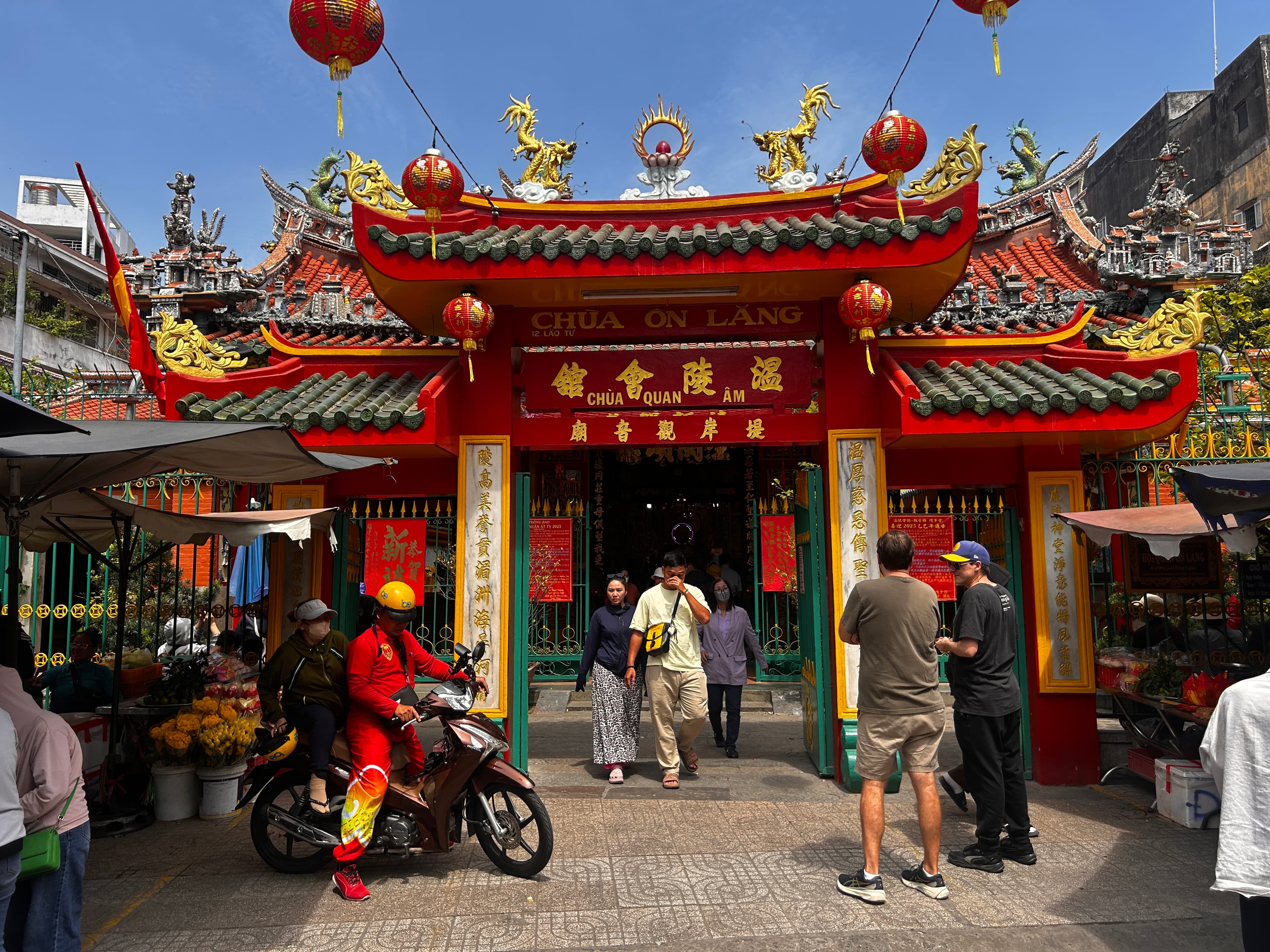
Quan Âm Pagoda, Chợ Lớn in District 5, Ho Chi Minh City, Vietnam. Image source · CC BY 4.0
Visit essentials
A quick read before you go
- Duration
- A short visit can be sufficient if it leaves room for prayer and avoids hurried altar…
- Access
- The strong Places match lists the temple at 12 Lão Tử in Chợ Lớn and includes a phone number.
Overview
Quan Âm provides the compassionate center, but the temple's sacred life extends through a layered congregation. Protective deities and ancestral remembrance place personal petitions within obligations to family and community. This combination is characteristic of a living Chinese Vietnamese religious environment where Buddhist and folk devotional categories can share one institution without needing to be flattened into a single doctrine. In the close interior, every movement affects someone else's access to an altar.
Visitors should first locate the principal Quan Âm focus, then notice how side figures and offerings create relationships around it. The research does not name every deity or ancestor represented, so visual resemblance is not enough for identification. The respectful response is to leave an image unnamed until a custodian or reliable label provides context.
Why this place is sacred
Chợ Lớn's urban movement narrows at the temple threshold. Incense, concentrated images, and repeated petitions can make the interior feel intense, but that intensity has a social structure. Quan Âm's compassion is joined to protective relationships and the memory of a congregation whose belonging was built across migration. The sacred quality is communal and devotional, not evidence of a free-floating energy.
Compassionate bodhisattva devotion anchors a Chợ Lớn congregation that also honors protective figures and forebears.
Active altars and assembly functions now share a dense urban heritage setting with visitors to Chợ Lớn.
Experience and orientation
The room may not offer a detached viewing position. Wait near the edge until a worshipper completes a petition, and avoid stepping backward into incense or offerings. Once the central compassionate figure is clear, scan side spaces for differences in use rather than assuming a hierarchy from size alone. Sound and smoke vary with the day's activity; leaving briefly can be more considerate than forcing a complete circuit.
From the public entrance, identify the Quan Âm altar, secondary devotional spaces, ancestor-related areas, assembly functions, and custodian routes.
Context and lineage
Research supports this exact Lão Tử Street institution as a temple and assembly hall centered on Quan Âm, protective deities, and migrant ancestral memory. It does not provide secure names for every altar or a complete foundation chronology. The page therefore avoids borrowing details from similarly named Quan Âm temples and claims no UNESCO World Heritage inscription.
Chinese Vietnamese folk religion and Buddhism coexist as the source-supported tradition of this communal sanctuary.
Avalokiteśvara (Quan Âm)
compassionate bodhisattva and principal devotional focus
Protective deities and remembered ancestors
supporting figures within the congregation's layered altar world
Traditions and practice
Devotees may offer incense, bow, pray to Quan Âm, address protective figures, or remember ancestors according to local custom. These actions are not interchangeable. Visitors should not move from altar to altar repeating the same improvised gesture or presume that every offering seeks personal fortune.
Living worship, congregation care, ancestral belonging, and assembly-hall functions continue within the neighborhood.
Observe how one person approaches an altar without copying them, then consider what privacy means in such a compact room.
Chinese Vietnamese folk religion and Buddhism
ActiveThe Chợ Lớn temple centers Quan Âm while holding protective deities and ancestral belonging within a migrant congregation.
Incense, bows, petitions, offerings, protection rites, and ancestor remembrance follow the temple's inherited altar distinctions.
Perspectives and open questions
Bodhisattva devotion, folk protection, migration, ancestor memory, and communal association remain distinct strands of one institution.
Scholarly perspective
The temple complicates rigid boundaries between Buddhism, folk religion, and migrant association. Rather than calling the mix inconsistent, analysis can ask how different altars answer different obligations. Accurate interpretation also depends on resisting confident identification without site-specific evidence.
Living and traditional perspectives
Quan Âm is approached through compassion, while protective and ancestral relationships locate the devotee within family and community.
Open questions
No petition, incense offering, or altar circuit is documented as guaranteeing protection, fortune, or healing.
Plan your visit
Access and arrival
The strong Places match lists the temple at 12 Lão Tử in Chợ Lớn and includes a phone number. Recheck hours and ceremony access before travel.
Use licensed Ho Chi Minh City lodging; no temple accommodation is claimed.
Respectful visit
Choose modest clothing suitable for a living urban temple and assembly hall.
Ask before including worshippers, avoid flash at altars, and never stage portraits in an active petition line.
Use only materials and locations accepted by temple custodians.
Altar platforms, ancestor areas, closed assembly rooms, and ritual workspaces are not public shortcuts.
Do not assign a deity from appearance alone, promise protection, or treat incense density as proof of spiritual power.
Current practical details
Address
12 Đ. Lão Tử, Chợ Lớn, Hồ Chí Minh, Vietnam
Phone
Hours
Hours, fees, and access can change — verify on the official source before you travel. Practical details last checked Jul 2026.
Location
Map loads as you approach this section.
Pilgrim reflections
A portrait of encounter, not a score
Pilgrims describe what they felt, how present they could become, and whether the place would shape a journey. There are no stars and no ranking of traditions.
No reviewed reflections yet
The first pilgrims can help describe the character of being here.
Share a reflection
Available after an account-backed “Been there.” Every reflection is reviewed before publication.
Nearby sacred places
Explore other sacred places in the region. Proximity does not establish access or travel time; check each place’s guidance.


References
Sources consulted for this page. Source categories describe the publication, not a guarantee that every claim is verified. Traditional accounts and outside interpretations may differ.
- 01Giá trị di sản văn hóa của người Hoa - Hội quán Ôn Lăng — Ho Chi Minh City Department of Science and TechnologyofficialExact city-hosted heritage study for Ôn Lăng/Quan Âm Pagoda identity, Quan Âm and Thiên Hậu devotion, the wider pantheon, community role, and national monument status.
- 025 địa điểm ăn chơi ở Chợ Lớn — Government News, Ho Chi Minh City portalofficialExact government feature corroborating the Ôn Lăng/Quan Âm identity, location, active worship, Quan Âm and Thiên Hậu among the enshrined figures, and Chinese-Fujian architecture.
- 03National Assembly approves provincial-level administrative reorganization — Government of Viet NamofficialAuthoritative 2025 successor-province and municipality boundaries.
- 04Hội quán Ôn Lăng - Chùa quan âm — Google PlacesofficialStrong exact-entity practical metadata from the authoritative current preflight.
- 05Vietnamese-language reference search for Chùa Quan Âm — Vietnamese Wikipedia contributorsacademicDiscovery reference only; unsupported details were not promoted into factual prose.
Pilgrim glossary
- Kannon
- The bodhisattva of compassion, central to many East Asian pilgrimage routes.
- Bodhisattva
- An enlightened being who postpones full nirvana to help others toward awakening.
Share a photo
Help visitors recognize Quan Âm Pagoda, Chợ Lớn. Every submission is reviewed before publication.