Si Thep Ancient Town
A moated Dvaravati city preserves Buddhist and Hindu plurality without flattening it
Understand sacred places, explore living traditions, and learn how to engage respectfully with Pilgrim Map.
Access has not been verified. Check current local guidance before planning a visit.
Si Thep, Phetchabun, Thailand
Read the sources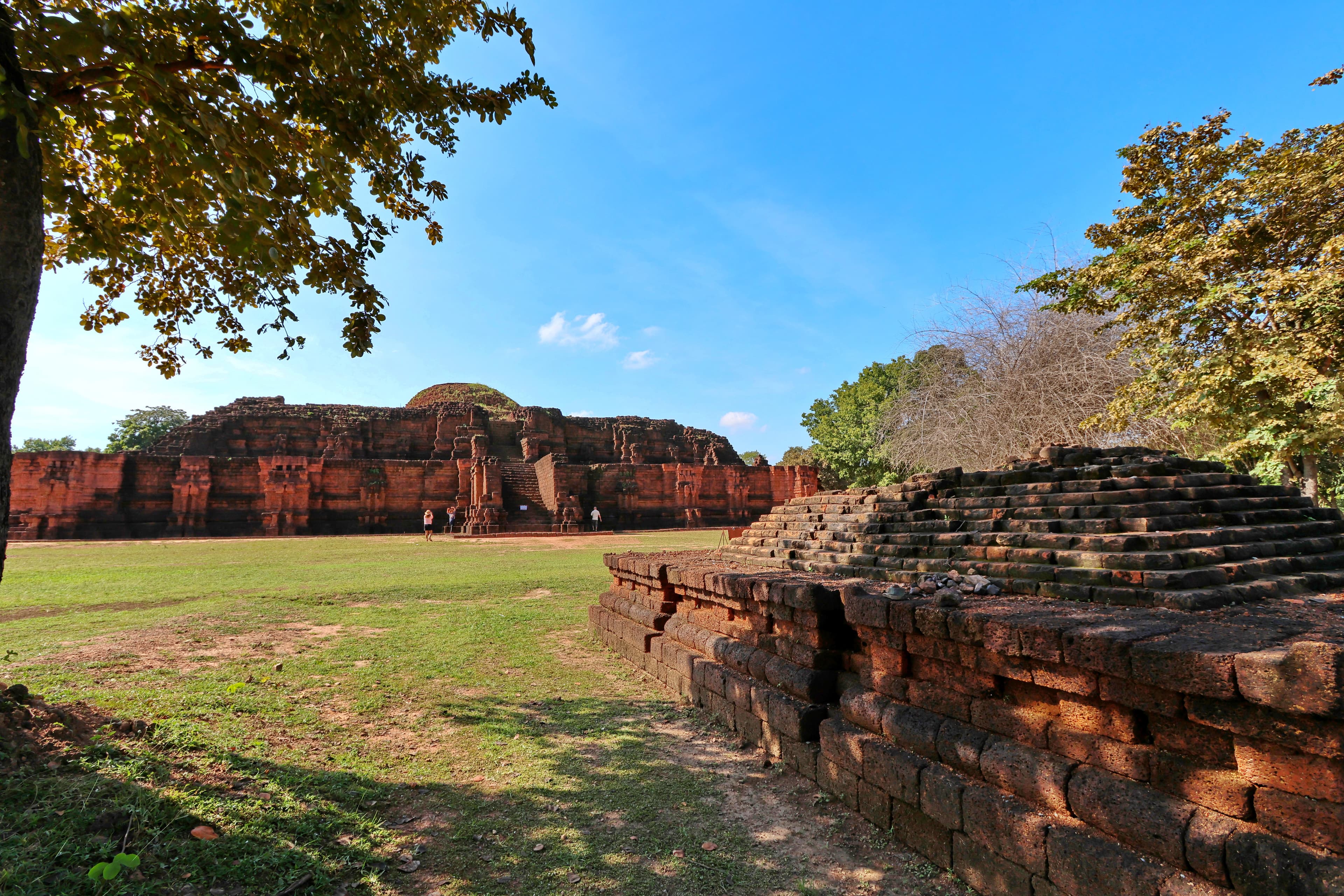
Si Thep Ancient Town in Si Thep, Phetchabun, Thailand. Image source · CC BY-SA 4.0
Visit essentials
A quick read before you go
- Etiquette
- Do not climb, touch, remove, offer, or assign certainty beyond official archaeological evidence.
Overview
The ancient town is read across distance. Muang Nai and Muang Nok form a distinctive inner-and-outer urban layout enclosed by moats; Khao Klang Nok stands outside as the largest surviving Dvaravati monument; Khao Thamorrat Cave preserves evidence of a Mahayana Buddhist cave monastery. UNESCO inscribed these three components together in 2023 because relationships among city, monuments, art, and religious exchange carry the outstanding value.
More than 112 monastery sites have been identified, while Hindu images and architectural forms show that Indian traditions were adapted rather than copied intact. No single deity or Buddha image can honestly stand for the whole property. The sacred landscape is the accumulated evidence of communities organizing urban life through several religious systems.
Why this place is sacred
Si Thep requires the discipline of keeping plurality visible. Archaeological remains associated with Theravada Buddhism, Mahayana Buddhism, and Hindu traditions do not prove that every practice occurred everywhere or simultaneously. Moats, roads, shrines, caves, sculptures, and large monuments reveal patterns, but many voices and ritual details are unrecoverable. The absence of a complete theology is not permission to fill gaps with mystery. UNESCO's criteria emphasize interchange, adaptation, and distinctive Dvaravati art, including the Si Thep School.
A contemplative encounter can attend to those relationships: built form and terrain, urban center and outlying monument, local invention and transregional influence. The page makes no claim that ruins retain measurable spiritual energy.
Experience and orientation
Begin with the mapped component boundaries rather than assuming every nearby ruin has the same World Heritage status. Within the ancient town, use established paths to compare inner and outer urban space, moats, foundations, and surviving monuments. Khao Klang Nok and Khao Thamorrat are separate components with different access and conservation needs; do not collapse them into a single quick stop. Never climb masonry, enter closed excavations, remove fragments, or touch sculpture.
Heat and distance can encourage rushing, but measured movement supports both safety and interpretation. Read signs before assigning a structure to Buddhism or Hinduism. Where an attribution is provisional, let uncertainty remain part of the site rather than inventing a ritual story.
Context and lineage
Archaeological evidence places earlier settlement in the Pa Sak basin before Si Thep developed into a major Dvaravati town. Between the sixth and tenth centuries, religious and artistic ideas arriving through wider networks were adapted locally. UNESCO identifies a twin-town plan, the monumental Khao Klang Nok, and Khao Thamorrat's Mahayana cave remains as the serial property's three components. The city later declined, leaving material layers rather than a continuously operating monastery.
Modern excavation, legal protection, community involvement, and Fine Arts Department management transformed the area into a historical park and then a World Heritage property in 2023. Conservation now includes groundwater, extreme weather, development pressure, buffer zones, and the wider symbolic relationship among components.
Traditions and practice
Si Thep is classified as archaeological rather than active pilgrimage. Visitors should not create offerings on ruins, light incense against ancient fabric, or imitate imagined rites. Appropriate practice is preservation-led attention: stay on routes, observe scale and alignment, compare official interpretations, and protect the context joining an object to where it was found. Communities around the property remain stakeholders, but archaeological evidence should not be assigned to present groups without authority.
The UNESCO inscription does not authorize unrestricted access or turn all land in the district into a sacred component. Current ceremonies, if any, require separate local confirmation. For most guests, careful observation and compliance with conservation boundaries are the responsible forms of respect.
Dvaravati Buddhist traditions
HistoricalHistoric Theravada, Mahayana, and Hindu evidence survives through protected archaeological context.
Hindu traditions
HistoricalHistoric Theravada, Mahayana, and Hindu evidence survives through protected archaeological context.
Archaeological and community stewardship
ActiveHistoric Theravada, Mahayana, and Hindu evidence survives through protected archaeological context.
Perspectives and open questions
UNESCO, archaeology, art history, religious history, and community stewardship illuminate different attributes.
Scholarly perspective
UNESCO interprets Si Thep through cultural interchange and testimony to Dvaravati civilization. Archaeologists study chronology, urban form, religious structures, sculpture, burials, and trade connections. Art historians examine the distinctive movement and form of Si Thep sculpture. Hindu and Buddhist histories trace different ideas without assuming an uncomplicated fusion. Local communities and managers add knowledge of stewardship, land use, and the pressures surrounding a protected landscape. These lenses sometimes produce different emphases, which is useful.
World Heritage status confirms outstanding universal value under criteria ii and iii; it does not prove spiritual superiority or settle every attribution. The site's strongest lesson is how selectively preserved material can document a religiously diverse urban world.
Plan your visit
Strong Places supports the historical park identity; component access and conservation closures require current checks.
Respectful visit
Do not climb, touch, remove, offer, or assign certainty beyond official archaeological evidence.
Current practical details
Address
208, Tambon Si Thep, Amphoe Si Thep, Chang Wat Phetchabun 67170, Thailand
Phone
Hours
Hours, fees, and access can change — verify on the official source before you travel. Practical details last checked Jul 2026.
Location
Map loads as you approach this section.
Pilgrim reflections
A portrait of encounter, not a score
Pilgrims describe what they felt, how present they could become, and whether the place would shape a journey. There are no stars and no ranking of traditions.
No reviewed reflections yet
The first pilgrims can help describe the character of being here.
Share a reflection
Available after an account-backed “Been there.” Every reflection is reviewed before publication.
Nearby sacred places
Explore other sacred places in the region. Proximity does not establish access or travel time; check each place’s guidance.

References
Sources consulted for this page. Source categories describe the publication, not a guarantee that every claim is verified. Traditional accounts and outside interpretations may differ.
- 01Summary history of the Ancient Town of Si Thep — Kingdom of Thailand / UNESCO World Heritage CentreofficialOfficial nomination appendix supporting the town's archaeological and religious history.
- 02The Ancient Town of Si Thep and its Associated Dvaravati Monuments — UNESCO World Heritage CentreofficialOfficial inscription, components, dates, traditions, and outstanding value.
- 03Decision 45 COM 8B.41 — UNESCO World Heritage CommitteeofficialOfficial 2023 inscription decision and management recommendations.
- 04ICOMOS evaluation: Si Thep — ICOMOSacademicEvaluation evidence for chronology, religious plurality, monastery count, and art.
- 05Si Thep Historical Park — Wikipedia — Wikipedia contributorsacademicCorroborates identity, location, and basic historical context; key claims require higher-tier corroboration.
- 06Q1517758 — Wikidata — Wikidata contributorsacademicStructured identity and coordinate corroboration; not used alone for spiritual or historical claims.
- 07Si Thep Historical Park — Google Maps — Google PlacesSource contextStrong name, country, locality, and coordinate match; used only for practical visitor data and identity corroboration.
Share a photo
Help visitors recognize Si Thep Ancient Town. Every submission is reviewed before publication.