Phra That Phanom
A Mekong relic stupa gathers legend, archaeology, rebuilding, and cross-river faith
Understand sacred places, explore living traditions, and learn how to engage respectfully with Pilgrim Map.
Access has not been verified. Check current local guidance before planning a visit.
That Phanom, Nakhon Phanom, Thailand
Read the sources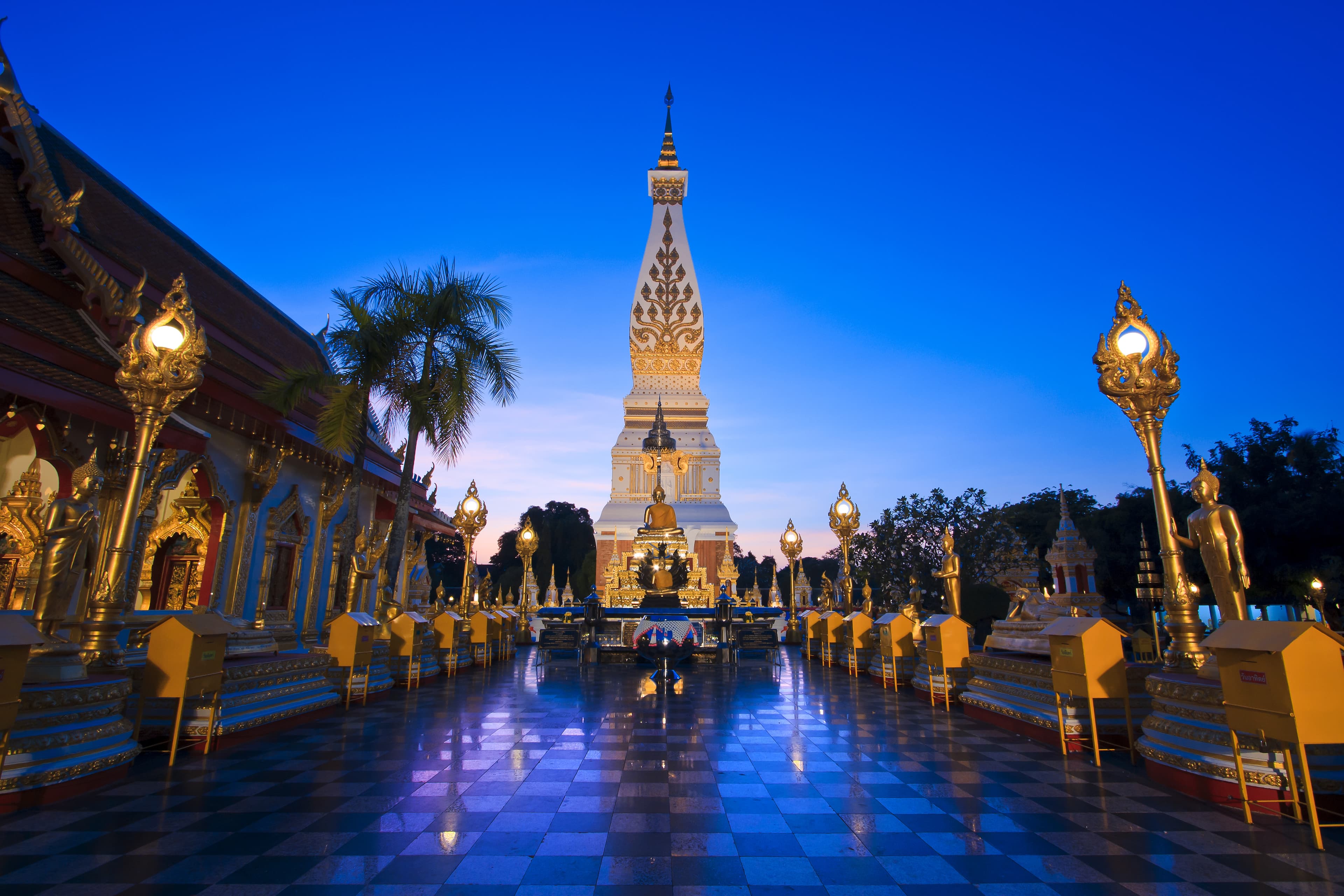
Phra That Phanom in That Phanom, Nakhon Phanom, Thailand. Image source · CC BY-SA 4.0
Visit essentials
A quick read before you go
- Etiquette
- Keep procession lanes clear and never attach objects or promote promised supernatural results.
Overview
The tall square-based reliquary is approached as the container of a Buddha relic, specifically the breastbone in the Urangadhatu tradition. That belief gives architecture a devotional center: people circumambulate, bow, offer, and travel because the stupa materializes recollection of the Buddha. Fine Arts archaeological interpretation dates the ancient fabric broadly to the seventh through ninth centuries and identifies a local synthesis of artistic forms. Tradition assigns a far earlier sacred foundation.
Both belong on the page, but not as interchangeable evidence. The present structure also carries the memory of collapse in 1975 and reconstruction. Continuity therefore resides not in untouched masonry but in relic tradition, recovered fragments, communal rebuilding, monastic practice, and renewed pilgrimage along the Mekong.
Why this place is sacred
Reliquary devotion joins presence and distance. Buddhists do not claim the living Buddha stands inside the stupa; the relic supports recollection, homage, and merit after his passing. Regional tradition extends that relationship across the Mekong, where communities have revered Phra That Phanom for generations. Tourism language sometimes promises dignity, fortune, or special benefit to people born on Sunday. Such hopes are reported as devotional belief, not guaranteed effect.
The stronger documented pattern is collective faith: people organize journeys, processions, offerings, and repairs around the monument. Architectural loss in 1975 did not end sacred meaning, yet reconstruction should not be described as archaeologically identical to every earlier phase. Faith and material history overlap without erasing one another.
Experience and orientation
Approach the stupa from the current public route and observe the established direction of circumambulation before joining. Keep procession lanes open, especially when groups carry offerings or prepare candlelight circuits. The reliquary's surface combines reconstructed structure with older decorative evidence; do not touch, attach objects, or cross barriers. During the annual festival, crowds and schedules extend from morning merit-making into evening rites. Government information for 2026 documents an Upakhut invitation procession, worship dance, age-based alms, offerings, candlelight circumambulation, and performances.
These details establish that year's program, not a permanent daily schedule. At quieter times, one complete attentive circuit can reveal more than repeated photography from the central axis.
Context and lineage
The Urangadhatu legend recounts enshrinement of the Buddha's breastbone relic by Mahakassapa and regional rulers. Fine Arts sources preserve this tradition while explicitly separating it from archaeological evidence. Surviving ancient brick reliefs support a broad seventh-to-ninth-century date for early fabric, followed by many alterations. The stupa became an artistic model across the northeast. After catastrophic collapse in 1975, reconstruction and restoration created the current form, incorporating recovered material and renewed engineering.
This history prevents two errors: dismissing a living relic tradition because it is not laboratory proof, and claiming every visible surface is ancient. Sacred continuity has been maintained through story, worship, custody, rebuilding, and the willingness of communities to return.
Traditions and practice
The named Phra That Phanom Worship Festival is an annual pilgrimage focus. The 2026 government calendar gives 26 January through 3 February and lists processions, offerings, candlelight circumambulation, and regional performance. Future dates require fresh confirmation. Ordinary practice includes bowing, prayer, flowers, candles where authorized, merit-making, and walking around the stupa in the locally directed manner. Visitors should not reproduce specialized rites without guidance or obstruct cross-river pilgrimage groups.
Claims of personal blessing or birth-day affinity belong to belief and testimony. The page does not promise supernatural outcomes. A respectful guest can join public movement when welcomed, remain outside restricted ritual areas, and allow the relic tradition to be explained in Buddhist terms.
Theravada Buddhism
ActiveTheravada relic devotion joins homage, merit, circumambulation, rebuilding, and cross-Mekong pilgrimage.
Perspectives and open questions
Buddhist, archaeological, manuscript, disaster, and regional histories converge without proving every legend.
Scholarly perspective
Buddhist tradition centers the relic and merit of homage. Archaeology studies brickwork, relief, chronological phases, and regional artistic exchange. Disaster history examines collapse, salvage, reconstruction, and the ethics of presenting a renewed monument. Folklore and manuscript studies trace versions of the Urangadhatu narrative. Regional history sees the shrine as a center shared by communities along both banks of the Mekong. These perspectives do not need one final chronology to establish importance.
Fine Arts evidence is appropriately cautious about foundation history, while government festival records demonstrate living scale. Metaphysical claims remain attributed to devotees; the independently supportable conclusion is that Phra That Phanom continues to organize religious time, travel, and collective responsibility.
Plan your visit
Strong Places supports identity and routing; current festival dates and shrine rules need direct confirmation.
Respectful visit
Keep procession lanes clear and never attach objects or promote promised supernatural results.
Current practical details
Address
183 13 หมู่ที่ 13 Chayangkun Rd, Tambon That Phanom, Amphoe That Phanom, Chang Wat Nakhon Phanom 48110, Thailand
Phone
Hours
Hours, fees, and access can change — verify on the official source before you travel. Practical details last checked Jul 2026.
Location
Map loads as you approach this section.
Pilgrim reflections
A portrait of encounter, not a score
Pilgrims describe what they felt, how present they could become, and whether the place would shape a journey. There are no stars and no ranking of traditions.
No reviewed reflections yet
The first pilgrims can help describe the character of being here.
Share a reflection
Available after an account-backed “Been there.” Every reflection is reviewed before publication.
Nearby sacred places
Explore other sacred places in the region. Proximity does not establish access or travel time; check each place’s guidance.

References
Sources consulted for this page. Source categories describe the publication, not a guarantee that every claim is verified. Traditional accounts and outside interpretations may differ.
- 01Wat Phra That Phanom — Fine Arts DepartmentofficialOfficial exact-site archaeology, relic tradition, architecture, registration, and restoration history.
- 02Phra That Phanom Worship Festival 2026 — Royal Thai GovernmentofficialExact current festival dates and documented rites for 2026.
- 03Wat Phra That Phanom — Wikipedia — Wikipedia contributorsacademicCorroborates identity, location, and basic historical context; key claims require higher-tier corroboration.
- 04Q1725518 — Wikidata — Wikidata contributorsacademicStructured identity and coordinate corroboration; not used alone for spiritual or historical claims.
- 05Wat Phrathat Phanom Woramahawihan — Google Maps — Google PlacesSource contextStrong name, country, locality, and coordinate match; used only for practical visitor data and identity corroboration.
- 06Power-up Your Life and Sightseeing: Phra That Phanom — Tourism Authority of ThailandofficialOfficial corroboration for regional sacred status, reconstruction, merit belief, and Sunday association; metaphysical language treated as belief.
Pilgrim glossary
- Stupa
- A dome-shaped Buddhist monument that holds relics or marks a sacred place.
Share a photo
Help visitors recognize Phra That Phanom. Every submission is reviewed before publication.