That Ing Hang
The golden stupa where the Buddha is said to have leaned and rested, holiest of southern Laos after Vat Phou
Understand sacred places, explore living traditions, and learn how to engage respectfully with Pilgrim Map.
Access has not been verified. Check current local guidance before planning a visit.
Savannakhet, Savannakhet, Laos
Read the sources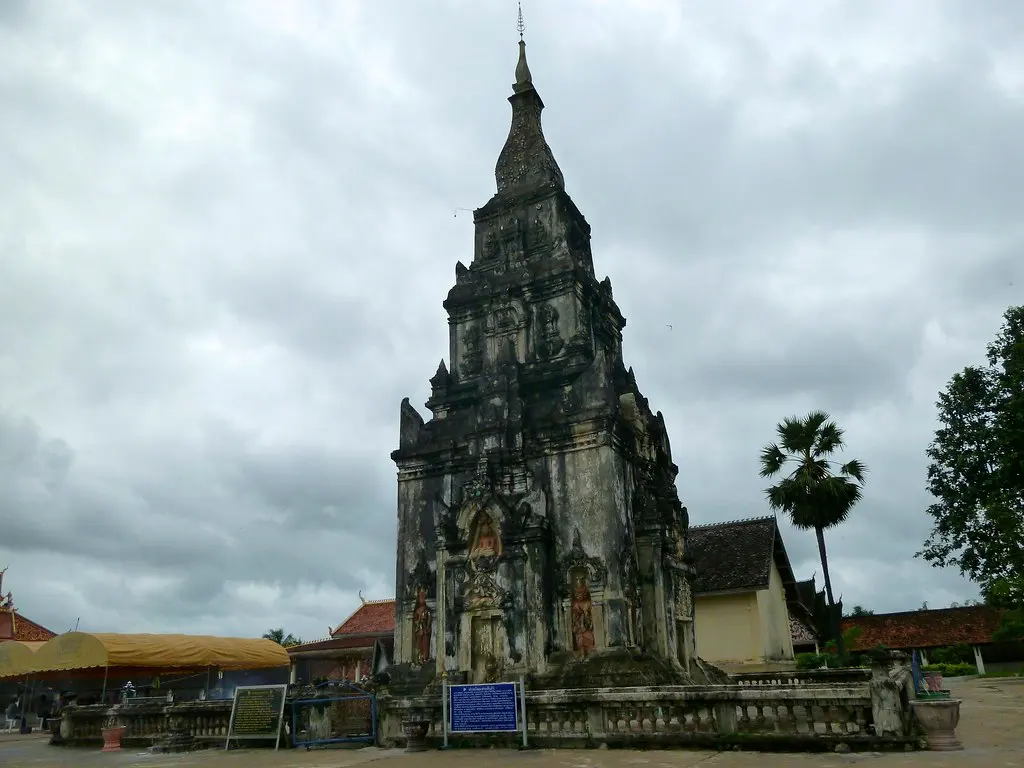
Image of That Ing Hang. Image source
Visit essentials
A quick read before you go
- Duration
- About 1 hour for the stupa and grounds; longer during the festival.
- Access
- About 12 km northeast of Savannakhet town, near Ban That on Route 9 toward Seno; reached by car,…
Overview
In a quiet rural setting northeast of Savannakhet rises That Ing Hang, a well-proportioned golden stupa of three terraced tiers, among the holiest Buddhist monuments of central and southern Laos and second in standing only to Vat Phou. Its name carries its founding legend: the Buddha, traveling and fallen ill in the ancient Kingdom of Sikhottabong, is said to have leaned (ing) to rest against a hang tree at this spot.
A relic of the Buddha, described in some accounts as his collarbone and in others as his spine, is believed to be enshrined within. By tradition a first stupa was raised here under King Soumitatham some two millennia ago, but that origin is legendary; the terraced stupa standing today was built or rebuilt in the mid-sixteenth century by King Setthathirath of Lan Xang, over an earlier Khmer temple. The stupa anchors a living devotion that crosses borders.
Lao and northern-Thai (Isan) Buddhists make merit here through the year, and at the annual festival around the December full moon the grounds fill with offering towers, music and pilgrims from both sides of the Mekong. A gender-specific custom persists at the monument: women are not permitted to enter the hollow lower chamber that holds the Buddha images, and women are asked to wear a traditional Lao pahsin on the temple grounds.
Away from festival days the stupa keeps a serene, uncrowded calm.
Why this place is sacred
That Ing Hang draws power from presence and proximity: its name preserves the traditional memory of the Buddha leaning here, while the enshrined relic gives the stupa a sacred core at a sacred site. Devotion crosses the Mekong, joining Lao and northern-Thai (Isan) Buddhists in a regional faith beyond one nation. Together, the leaning-place and relic sustain a quiet, durable holiness away from Vientiane's larger crowds.
Experience and orientation
Most of the year the visit is calm and uncrowded. The stupa stands in a quiet rural setting outside Savannakhet, well away from the larger monuments of Vientiane, and visitors most often describe a serene, well-proportioned golden form to be circled at an unhurried pace, with mornings the coolest and quietest time.
That stillness gives way at the annual festival, around the December full moon, when the grounds fill with pilgrims, offering towers, and music, and the strong local and Thai devotional atmosphere comes fully into the open. Visitors regularly note two things: the depth of cross-border devotion, with Isan Thai pilgrims crossing the Mekong to make merit here, and the gender custom at the inner chamber, where women do not enter the relic chamber holding the Buddha images.
The experience is one of quiet merit-making and reflection more than spectacle, a connection to the Buddha-resting legend and to the shared Buddhist life of the middle Mekong.
The stupa stands about 12 kilometers northeast of Savannakhet town, near Ban That on Route 9 toward Seno, reached by car, tuk-tuk or motorbike. Savannakhet sits on the Mekong opposite Mukdahan in Thailand, linked by the Second Thai-Lao Friendship Bridge, which feeds the cross-border pilgrimage. Women are asked to wear a pahsin on the grounds and do not enter the lower relic chamber.
Context and lineage
The defining legend tells that the Buddha, traveling and fallen ill in the ancient Kingdom of Sikhottabong, rested by leaning (ing) against a hang tree at this spot, giving the stupa its name, That Ing Hang. A relic was later enshrined and, by tradition, a stupa raised under King Soumitatham some two thousand years ago, though this earliest origin is legendary rather than documented.
The terraced stupa standing today was built or rebuilt in the mid-sixteenth century, with sources giving dates between 1548 and 1566, by King Setthathirath of Lan Xang, raised over a pre-existing Khmer temple. Accounts of the enshrined relic differ, naming it the Buddha's collarbone or his spine, and the stupa rises about nine meters, crowned by a gold umbrella.
It is not a UNESCO World Heritage Site, but it is nationally significant and is described as the second-holiest religious monument in southern Laos after Vat Phou in Champasak, which holds the World Heritage inscription.
That Ing Hang belongs to the Theravada Buddhism of the Lao and the neighboring Thai-Isan, shaped by the royal Buddhism of the Lan Xang kingdom under Setthathirath and rooted in an earlier Khmer temple on the site, with a legendary lineage reaching back to the Kingdom of Sikhottabong. It remains an active pilgrimage stupa today.
The Buddha (by legend)
Namesake of the site
King Soumitatham (by legend)
Legendary founder
King Setthathirath
Builder of the present stupa
Traditions and practice
The great annual observance is the That Ing Hang Festival, held over the full moon of the first lunar month, around December. Pilgrims place khanmakbeng, offering towers of banana leaf and flowers, around the stupa, receive wrist-string blessings tied by nuns, and bring offerings of forest products such as honey along with traditional food, amid prayers, processions and cultural performances.
Beyond the festival the stupa sees year-round prayer, offerings and circumambulation, with merit-making by both Lao and northern-Thai pilgrims who cross the Mekong region to worship here. The festival remains the devotional and cultural high point of the year.
Circle the stupa quietly and, if you wish, make a simple offering or receive a wrist-string blessing in the local manner; come in the cool morning for stillness, or during the December festival to witness the full cross-border devotion. Women should observe the inner-chamber custom and wear a pahsin where required.
Theravada Buddhism (Lao and Thai-Isan)
ActiveThat Ing Hang is among the most sacred stupas of central and southern Laos, believed to enshrine a relic of the Buddha and marking the spot where, by legend, the Buddha rested while ill; it draws Lao and northern-Thai pilgrims, especially at its annual festival.
Offerings of khanmakbeng (banana-leaf and flower towers); wrist-string blessings tied by nuns; offerings of forest products such as honey and traditional food; circumambulation, prayer and merit-making.
Lan Xang royal Buddhism
HistoricalThe present stupa was built or rebuilt in the mid-sixteenth century under King Setthathirath of Lan Xang over an earlier Khmer site, expressing royal patronage of Buddhism in the Mekong region.
Royal construction and dedication.
Perspectives and open questions
The stupa is read at once as a documented royal monument over a Khmer site and as a living relic-shrine of a Buddha-touched place.
Scholarly perspective
Scholars regard That Ing Hang as a major Theravada Buddhist stupa of central and southern Laos, rebuilt in its present three-terraced form under King Setthathirath in the mid-sixteenth century over an earlier Khmer site, and ranked second in sanctity in southern Laos after Vat Phou. Its earliest, roughly two-thousand-year origin is treated as legendary rather than documented.
Living and traditional perspectives
For Lao and northern-Thai (Isan) Buddhists the stupa marks where the Buddha rested and enshrines his relic; it is a focus of cross-border merit-making, with living customs that include the women's inner-chamber prohibition and the pahsin dress.
Alternative interpretations
Popular tradition stresses the 'miracle stupa' and the Buddha-visit legend, and the great antiquity of the site under the Kingdom of Sikhottabong.
Open questions
Whether an authentic relic of the Buddha is enshrined, and the historicity of the Buddha's visit and the two-thousand-year origin, remain matters of faith; the nature and date of the underlying Khmer temple, and the precise identity of the relic (collarbone or spine), are also uncertain.
Plan your visit
Access and arrival
About 12 km northeast of Savannakhet town, near Ban That on Route 9 toward Seno; reached by car, tuk-tuk or motorbike. Savannakhet sits on the Mekong opposite Mukdahan, Thailand, linked by the Second Thai-Lao Friendship Bridge.
Savannakhet town, about 12 km away on the Mekong, offers a range of hotels and guesthouses, with further lodging across the river in Mukdahan, Thailand.
Respectful visit
Modest dress with shoulders and knees covered; women are commonly asked to wear a traditional Lao pahsin (sarong) on the temple grounds, and shoes are removed where indicated.
Generally permitted in outdoor areas; be discreet around worshippers and within sacred spaces.
Khanmakbeng (banana-leaf and flower offering towers), flowers, incense, candles and food are customary, especially at the festival.
By religious custom women are not permitted to enter the hollow lower relic chamber containing the Buddha images; do not point your feet at sacred images, speak quietly, and behave respectfully.
By religious custom women do not enter the hollow lower relic chamber containing the Buddha images; respect this without judgment. Do not point your feet at sacred images, speak quietly, and behave respectfully throughout the grounds.
Location
Map loads as you approach this section.
Pilgrim reflections
A portrait of encounter, not a score
Pilgrims describe what they felt, how present they could become, and whether the place would shape a journey. There are no stars and no ranking of traditions.
No reviewed reflections yet
The first pilgrims can help describe the character of being here.
Share a reflection
Available after an account-backed “Been there.” Every reflection is reviewed before publication.
Nearby sacred places
Explore other sacred places in the region. Proximity does not establish access or travel time; check each place’s guidance.

References
Sources consulted for this page. Source categories describe the publication, not a guarantee that every claim is verified. Traditional accounts and outside interpretations may differ.
- 01That Ing Hang Festival in Savannakhet Province — Lao National Tourism / tourismlaos.orgofficialAnnual festival; offerings of khanmakbeng (banana-leaf/flower offering towers), wrist-string blessings from nuns, forest-product offerings; pilgrims from Laos and Thailand.
- 02That Ing Hang — Lonely PlanetguideRebuilt under Setthathirath (1548-71) over a Khmer site; three terraced bases; ~9 m; gold umbrella ~450 g; hollow lower chamber with Buddha images that women may not enter; second-holiest in southern Laos after Wat Phu.
- 03That Ing Hang - A Miracle Stupa in Savannakhet, Laos — Go Laos ToursguideLegend of Buddha resting/leaning (ing) on a hang tree while ill; relic enshrined; rebuilding history.
- 04That Ing Hang Stupa Attractions - Laos — Asia King TravelguideBuilt 1560 by Setthathirath on a Khmer site; King Soumitatham legend ~2000 years; Sikhottabong kingdom; importance to Thai Buddhists; festival on full moon of first lunar month.
- 05That Ing Hang Stupa — Laos Tourism (laostourism.org)guideSoumitatham legend; rebuilt 1548 by Sayasetthathilath; on Route 9 at Ban That, ~12 km from Savannakhet; pahsin requirement for women.
- 06Savannakhet's That Ing Hang Festival to Break Records — Travel And Tour WorldnewsDecember festival framing, scale and significance.
- 07Savannakhet - That Ing Hang — tri140.50webs.comblogField/visitor description and history summary.
Pilgrim glossary
- Stupa
- A dome-shaped Buddhist monument that holds relics or marks a sacred place.
Share a photo
Help visitors recognize That Ing Hang. Every submission is reviewed before publication.