Phanom Rung Sanctuary
An extinct volcano becomes Kailash through a Shaiva sanctuary's measured ascent
Understand sacred places, explore living traditions, and learn how to engage respectfully with Pilgrim Map.
Access has not been verified. Check current local guidance before planning a visit.
Chaloem Phra Kiat, Buri Ram, Thailand
Read the sources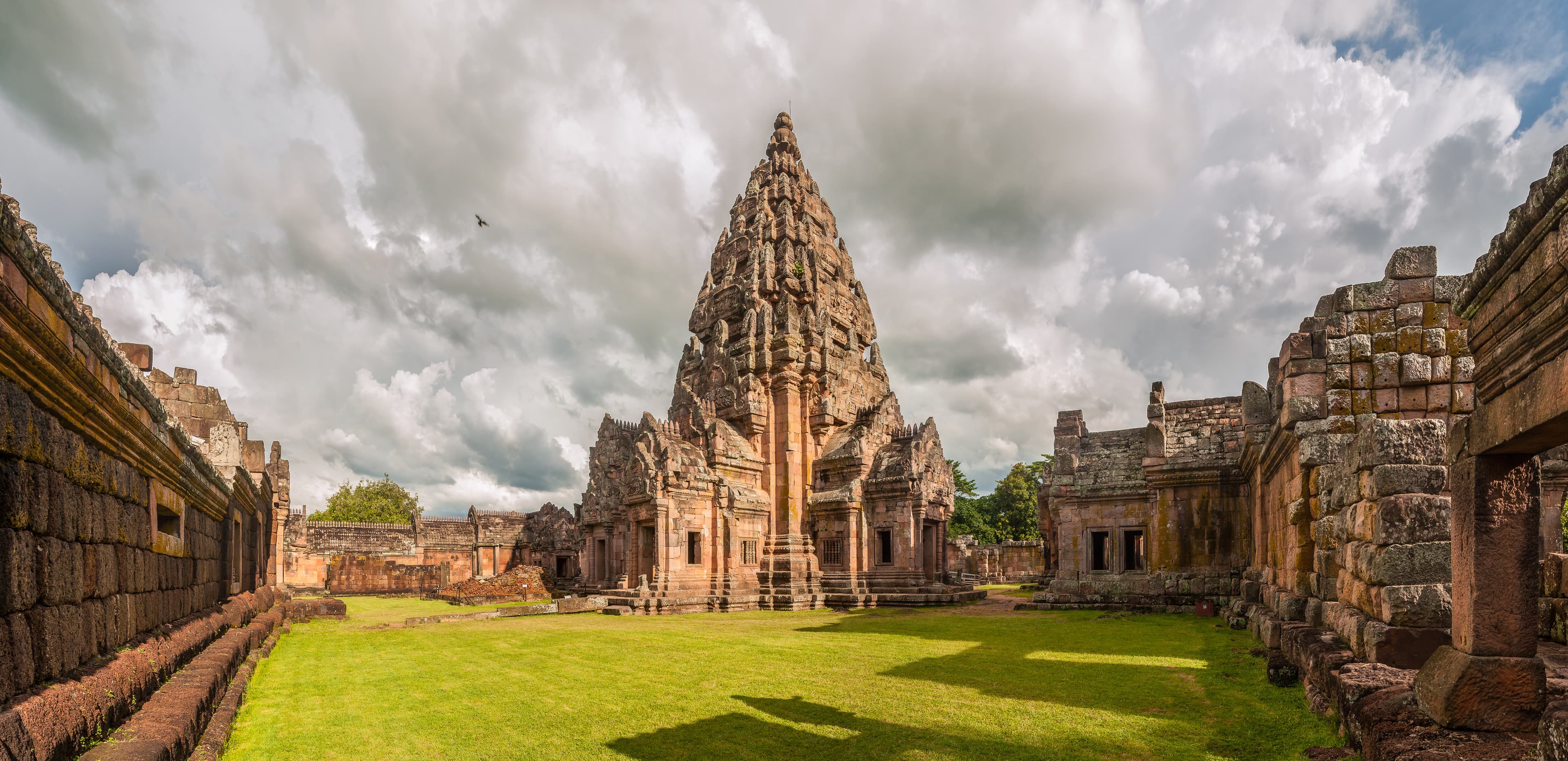
Phanom Rung Sanctuary in Chaloem Phra Kiat, Buriram, Thailand. Image source · CC BY-SA 2.0
Visit essentials
A quick read before you go
- Etiquette
- Stay off carved stone and do not convert solar photographs into unsupported ritual claims.
Overview
The approach is part of the sanctuary's theology. Causeway, stair, platforms, gateways, and central tower lead upward across an extinct volcanic summit interpreted as Kailash, the mountain dwelling of Shiva. Fine Arts Department evidence identifies Shaivism and specifically the Pasupata tradition, while inscriptions mention devotional poetry, a Shiva lingam, land, settlements, and ascetic life dedicated to the shrine. The monument therefore was not a decorative palace on a dramatic hill.
It was a religious center embedded in political authority and a supported landscape. Today it is archaeological rather than an active Shaiva monastery. Visitors encounter surviving and reconstructed stone, empty ritual locations, sculpture, and alignment. Sacred interpretation depends on holding architecture, inscription, topography, and historical absence together.
Why this place is sacred
Mountain symbolism here is documented, but the extinct volcano is not evidence that geological force generated religion. Builders and patrons selected and shaped the summit so that ascent and enclosure evoked Kailash. The distinction matters: nature contributed terrain, while religious communities created meaning through design, image, endowment, and practice. Modern interest in sunlight passing through aligned doorways can illuminate architectural orientation, yet a dramatic photograph should not automatically become proof of an ancient equinox rite.
Only claims supported by archaeological and custodial evidence belong on the page. The strongest spiritual reading follows the route itself—distance, repetition, narrowing thresholds, and arrival at the former focus of Shiva worship—without pretending the original rite can be fully reenacted.
Experience and orientation
Begin at the lower processional approach and preserve the sequence rather than entering only from the nearest upper access. The repeated thresholds clarify how the central sanctuary was set apart. Walk on designated surfaces, keep off lintels and collapsed blocks, and never use a doorway or sculpture as climbing support. Heat, rain, and exposed stone can make the ascent physically demanding; accessibility routes do not diminish the legitimacy of an encounter.
At the central tower, identify the historic place of the lingam from official interpretation rather than inventing an offering. Festival or sunrise crowds require additional patience, but current public events should not be confused with uninterrupted ancient ritual. Leave all objects and surfaces exactly where they are.
Context and lineage
Fine Arts Department history describes construction across several periods, with inscriptions tying the mountain sanctuary to Shaivism, regional elites, donated land, settlements, and ascetics. Narendraditya is associated with a major building phase and with the political world connected to Suryavarman II. The sanctuary declined as its original religious institution changed, and vegetation and structural displacement altered the complex.
Thai authorities registered the monument, studied it, and reconstructed major portions by anastylosis between 1971 and 1988, returning displaced original elements where evidence allowed. The historical park opened in 1988. Visible coherence is therefore partly the result of modern archaeological work. Conservation history belongs beside sacred history because it determines what visitors now perceive as a complete route.
Traditions and practice
Phanom Rung is classified as archaeological, not an active pilgrimage shrine. Visitors should not pour liquids, light incense against stone, leave improvised offerings, or claim to revive a Shaiva rite without living custodial authority. Responsible practice is processional observation: follow the designed approach, read inscriptions and iconography through official interpretation, and keep archaeological context intact. Present cultural events may honor regional heritage, but their schedules and meanings require current sources.
The sanctuary's historical target of veneration is Shiva; that does not authorize treating every figure as Shiva or every basin as a ritual device. Quiet attention to orientation, elevation, threshold, and the former lingam location can respect the site's religious design without fabricating continuity.
Hindu devotion
HistoricalHistoric Shaiva worship interpreted the volcanic summit as Kailash and centered the sanctuary on Shiva and the lingam.
Heritage stewardship
ActivePresent heritage stewardship protects inscriptions, carved stone, spatial sequence, and archaeological context without claiming to continue undocumented rites.
Perspectives and open questions
Shaiva theology, epigraphy, Khmer architecture, geology, and conservation explain different aspects.
Scholarly perspective
Shaiva interpretation reads Phanom Rung as a terrestrial Kailash and the central sanctuary as Shiva's domain. Epigraphy supplies names, devotion, endowments, and institutional relationships. Architectural history studies Khmer planning, carved lintels, axial movement, and construction phases. Archaeology and conservation explain anastylosis and the limits of reconstruction. Geology identifies the extinct volcano but does not by itself explain sacred selection. Public fascination with solar alignment should remain proportional to evidence and should not displace the sanctuary's well-documented Shaiva program.
No UNESCO World Heritage inscription currently applies to Phanom Rung itself. Its importance is secured through Thai national heritage protection, scholarship, and the surviving religious landscape documented by the Fine Arts Department.
Plan your visit
Strong Places and the Fine Arts park site support identity; access, weather, and events require fresh checks.
Respectful visit
Stay off carved stone and do not convert solar photographs into unsupported ritual claims.
Current practical details
Address
114, Tambon Ta Pek, Amphoe Chaloem Phra Kiat, Chang Wat Buri Ram 31110, Thailand
Phone
Hours
Hours, fees, and access can change — verify on the official source before you travel. Practical details last checked Jul 2026.
Location
Map loads as you approach this section.
Pilgrim reflections
A portrait of encounter, not a score
Pilgrims describe what they felt, how present they could become, and whether the place would shape a journey. There are no stars and no ranking of traditions.
No reviewed reflections yet
The first pilgrims can help describe the character of being here.
Share a reflection
Available after an account-backed “Been there.” Every reflection is reviewed before publication.
Nearby sacred places
Explore other sacred places in the region. Proximity does not establish access or travel time; check each place’s guidance.

References
Sources consulted for this page. Source categories describe the publication, not a guarantee that every claim is verified. Traditional accounts and outside interpretations may differ.
- 01Phanom Rung Historical Park — Fine Arts DepartmentofficialExact official source for Shiva dedication, Kailash symbolism, chronology, registration, and conservation.
- 02Phanom Rung historical background — Fine Arts DepartmentofficialOfficial inscription, Pasupata, lingam, patronage, endowment, and anastylosis evidence.
- 03Phanom Rung Historical Park — Google Maps — Google PlacesSource contextStrong name, country, locality, and coordinate match; used only for practical visitor data and identity corroboration.
Share a photo
Help visitors recognize Phanom Rung Sanctuary. Every submission is reviewed before publication.