Muang Tam Sanctuary
Five towers and four sacred ponds preserve a Khmer Shaiva temple
Understand sacred places, explore living traditions, and learn how to engage respectfully with Pilgrim Map.
Access has not been verified. Check current local guidance before planning a visit.
Prakhon Chai, Buri Ram, Thailand
Read the sources
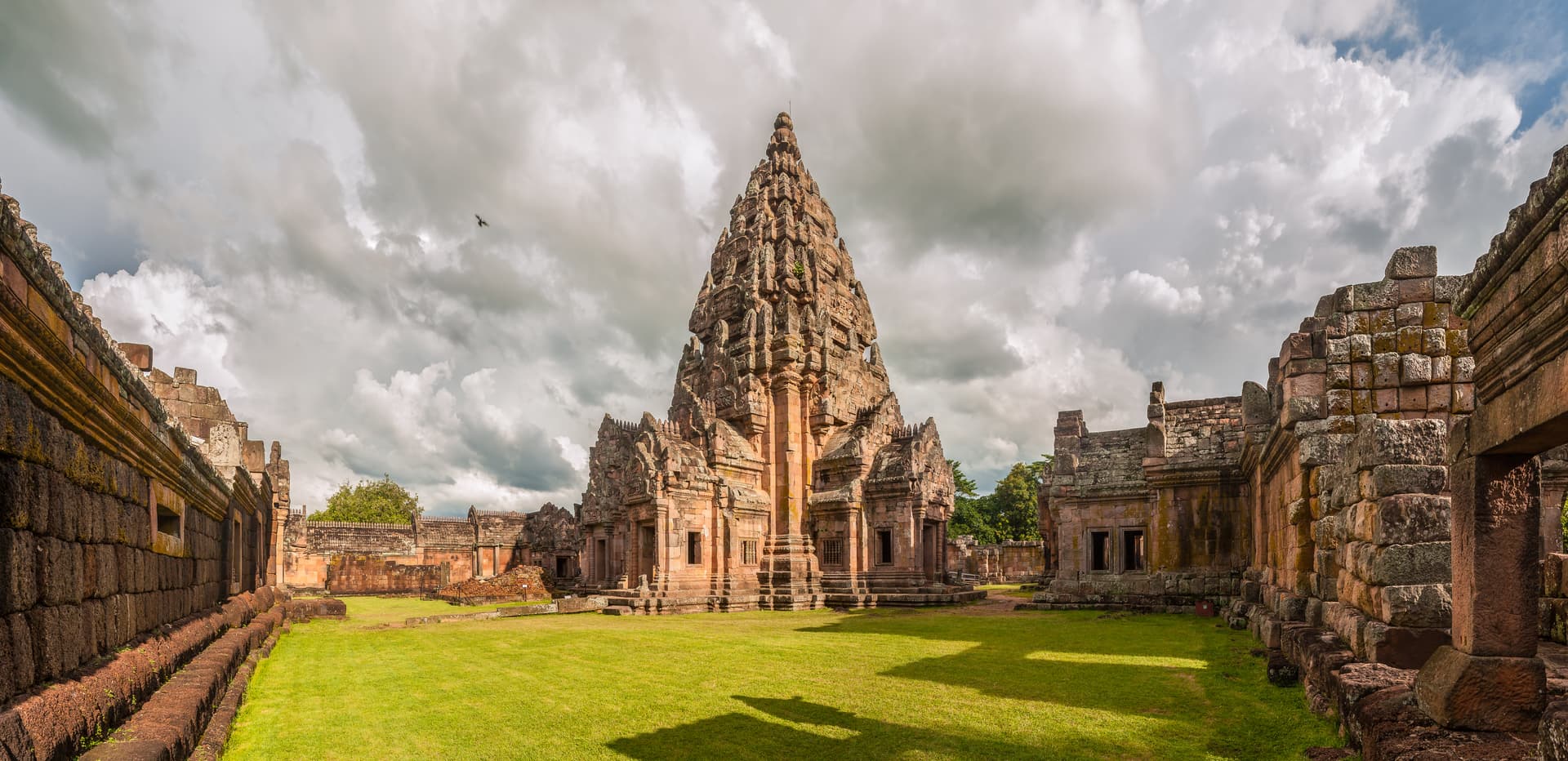
Muang Tam Sanctuary in Prakhon Chai, Buriram, Thailand. Image source · CC BY-SA 3.0
Visit essentials
A quick read before you go
- Etiquette
- Protect brick, sandstone, water edges, closed chambers, and every carved surface.
Overview
The monument's low profile makes water and enclosure as important as towers. Four ponds occupy the inner court, edged by Naga balustrades that bind water, fertility, protection, and transition. Five brick towers once focused worship; the central tower has collapsed, leaving absence at the compositional heart. Lintels and pediments draw from Hindu narratives, while the sanctuary's dedication to Shiva is grounded in archaeological interpretation.
Muang Tam belonged to a settled community on the Khmer route through the Dangrek region, not merely a scenic satellite of Phanom Rung.
Why this place is sacred
Still water, red brick, and repeated serpent forms can feel unusually composed, especially in quiet hours. Those sensations do not demonstrate ley lines, elemental portals, or a surviving water ritual. The ponds are real architectural evidence whose exact historical use must remain bounded. Shaiva identity is supported; a modern visitor's improvised linga offering is not. The strongest sacred reading joins deity, enclosure, water management, procession, and the absent central tower without pretending that every original rite can be recovered.
Experience and orientation
Walk the outer enclosure before entering so the moat and larger setting remain visible. Inside, compare each L-shaped pond and its Naga rails, then approach the tower group from the permitted axis. Do not climb brickwork, enter unstable chambers, or place flowers and oil on sandstone. Fine Arts lists official hours and fees, while Places reports a somewhat different opening time; confirm with the custodian. Shade is limited, and wet stone can be slippery.
Treat carved Hindu narratives as sacred evidence rather than costume scenery.
Context and lineage
Fine Arts dates Prasat Muang Tam through Klang and Baphuon artistic forms to roughly a thousand years ago. Archaeological evidence places it among communities along a Khmer cultural route connecting the Angkor region, the Dangrek passes, Phanom Rung, and Phimai. The temple served a local settlement and was dedicated to Shiva. Modern conservation stabilized towers, ponds, and carvings for public interpretation. It is included in Thailand's broader heritage planning but is not presently a UNESCO World Heritage inscription.
Traditions and practice
Historical Shaiva practice likely involved offerings, water, procession, and worship focused on the sanctuary's deity and linga tradition. The site lacks a verified continuous priesthood, so visitors should not pour liquids, leave food, touch carvings, or invent purification at the ponds. Quiet acknowledgment from the path is appropriate. Heritage stewardship is the active practice now: following routes, respecting barriers, and naming Hindu evidence precisely. No current named pilgrimage or guaranteed blessing is asserted.
Shaiva Hinduism
HistoricalHistoric Shaiva worship centered Shiva, linga symbolism, offerings, procession, and community.
Heritage stewardship
ActiveFine Arts management preserves tower masonry, carved stone, ponds, and enclosure as one system.
Perspectives and open questions
Shaiva theology, Khmer art, archaeology, water studies, and conservation qualify one another.
Scholarly perspective
Shaiva studies explains dedication to Shiva and the linga-centered sanctuary. Khmer art history reads tower forms, lintels, Nagas, and regional stylistic exchange. Archaeology reconstructs community and route connections from material remains. Hydraulic and landscape studies consider ponds without overstating ritual certainty. Conservation addresses brick, sandstone, and water together. Popular descriptions sometimes call the complex mystical; the page replaces that vagueness with documented religious architecture and openly stated gaps. The four ponds deserve comparable care.
Their symmetry and Naga-edged corners make them central to the visitor's understanding, yet water supply, architectural balance, purification, and cosmic symbolism are not interchangeable claims. Where the official account does not specify a rite, the page leaves it open. This restraint makes Shiva dedication and the temple's community role clearer, because documented religious identity no longer competes with invented ceremonial detail.
Plan your visit
Fine Arts and Places hours differ; verify current entry rules with the historical-park custodian.
Respectful visit
Protect brick, sandstone, water edges, closed chambers, and every carved surface.
Current practical details
Address
Chorakhe Mak, Prakhon Chai District, Buri Ram 31140, Thailand
Phone
Hours
Hours, fees, and access can change — verify on the official source before you travel. Practical details last checked Jul 2026.
Location
Map loads as you approach this section.
Pilgrim reflections
A portrait of encounter, not a score
Pilgrims describe what they felt, how present they could become, and whether the place would shape a journey. There are no stars and no ranking of traditions.
No reviewed reflections yet
The first pilgrims can help describe the character of being here.
Share a reflection
Available after an account-backed “Been there.” Every reflection is reviewed before publication.
Watch deeper
Films, episodes, and recorded talks for visitors who want more context before or after a visit. Speculative and alternative-history entries are labelled as perspectives, not as sources for established claims.
Nearby sacred places
Explore other sacred places in the region. Proximity does not establish access or travel time; check each place’s guidance.
References
Sources consulted for this page. Source categories describe the publication, not a guarantee that every claim is verified. Traditional accounts and outside interpretations may differ.
- 01Prasat Muang Tam Historical Park — Fine Arts DepartmentofficialExact-site Shaiva dedication, chronology, community, route, and architecture.
- 02Prasat Muang Tam visitor information — Fine Arts DepartmentofficialOfficial address, hours, fees, and access rules.
- 03Prasat Muang Tam — Google Maps — Google PlacesSource contextStrong name, country, locality, and coordinate match; used only for practical visitor data and identity corroboration.
Share a photo
Help visitors recognize Muang Tam Sanctuary. Every submission is reviewed before publication.