Myeongdong Cathedral
A cathedral where Korean Catholic origins open onto the city
Understand sacred places, explore living traditions, and learn how to engage respectfully with Pilgrim Map.
Access has not been verified. Check current local guidance before planning a visit.
Seoul, Seoul, South Korea
Read the sources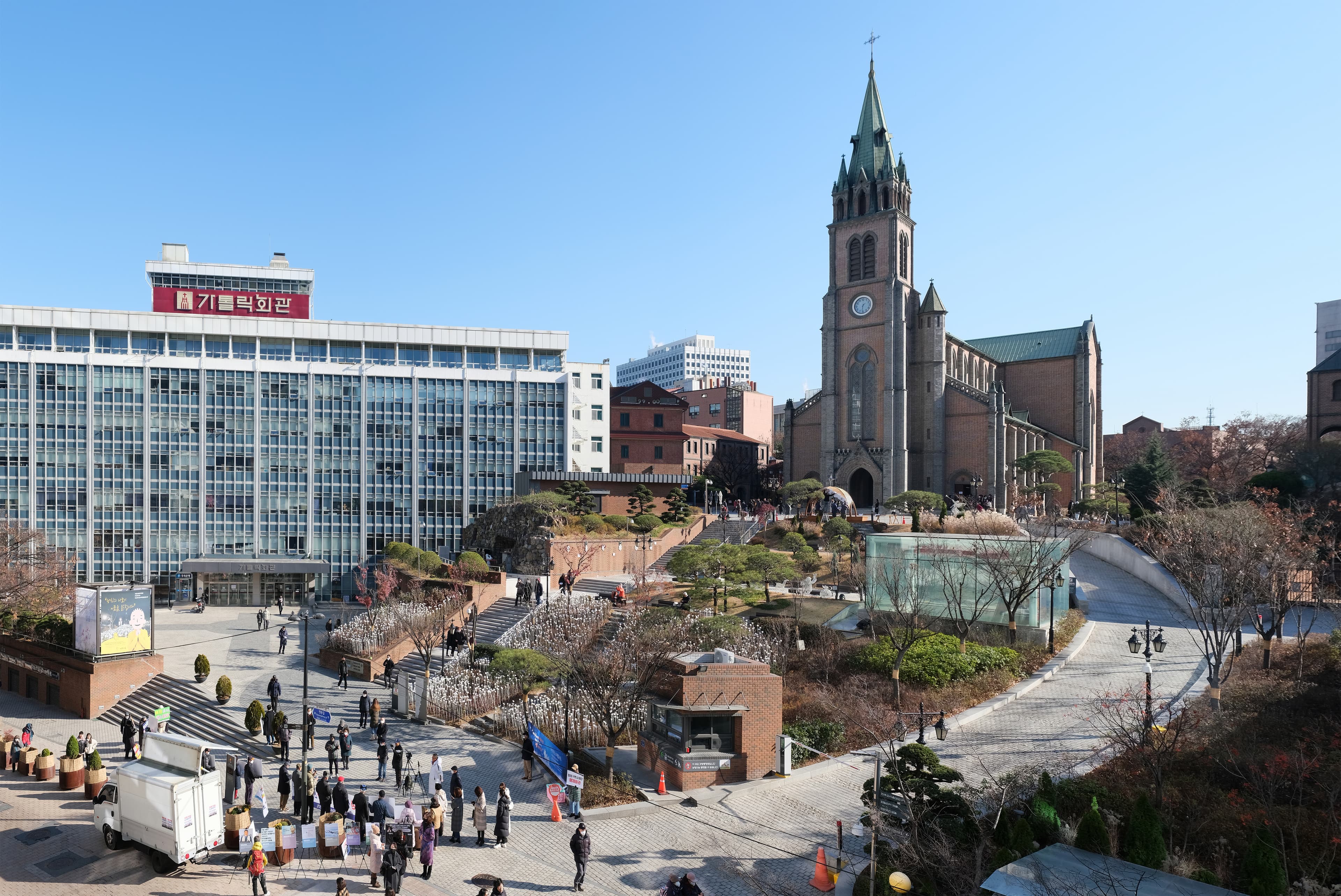
Myeongdong Cathedral in Seoul, Jung District, South Korea. Image source · CC BY-SA 4.0
Visit essentials
A quick read before you go
- Duration
- Allow one hour for the cathedral and crypt; the Seosomun route is a separate official 2.5-hour…
- Access
- Google’s strong exact record lists varying daily hours, while church services and tour access…
Overview
Red brick and pointed arches make the cathedral visible from crowded streets, but Catholic identity is established through altar, ambo, baptism, Eucharist, confession, crypt, and community. The patronal title refers to Mary’s Immaculate Conception; Catholics venerate Mary and worship God, a distinction the page must preserve. Relics transferred to the crypt in 1900 connect liturgy with persecution memory. During South Korea’s democratization struggles the cathedral also became a place where public conscience and sanctuary entered civic life.
That political history should be documented without treating every gathering as a religious rite.
Why this place is sacred
Cathedral height draws the eye upward while the crypt directs memory below ground. Between them, Mass gathers a living congregation at ordinary human scale. This vertical relation can support reflection on hope, death, and communion without implying that Gothic form emits sacred energy. Myeongdong’s location adds a horizontal movement: the Seosomun route begins here and continues toward sites of education, execution, and memorial. Pilgrimage is therefore named and walkable, not merely a metaphor for tourism.
The city’s noise does not cancel prayer; it clarifies the cathedral’s responsibility to a public world.
The present church was built as the principal Catholic church in Seoul and consecrated in 1898 under Marian patronage.
Martyr relic translation, archdiocesan growth, democratization memory, multilingual Mass, cultural facilities, and an official pilgrimage route expanded its roles.
Experience and orientation
Check the cathedral calendar first. If Mass is underway, attend respectfully or wait; sightseeing access is secondary. In the nave, look from brick structure and stained glass toward the liturgical center rather than circulating during prayer. Visit the crypt only at permitted hours and treat it as a reliquary and burial space. Outside, identify the start of the official Seosomun route and understand that completing the route requires separate time and booking conditions.
The 1898 cultural complex beneath the grounds has different purposes and hours from the church above.
Map main cathedral, sanctuary, crypt, pilgrimage meeting point, clergy areas, plaza, and 1898 cultural complex.
Context and lineage
The cathedral’s official site says the first Korean faith community gathered here in 1784. Father Coste began planning in 1894, and the building was consecrated on 29 May 1898 with the Immaculate Conception as patron. Martyr relics from the persecutions of 1839 and 1866 entered the crypt in 1900. Official Seoul tourism names Myeongdong Cathedral as the meeting point and first stop of the Seosomun Pilgrimage Route. These sources support active-pilgrimage classification under the project’s named-route rule.
Myeongdong is Roman Catholic, the cathedral church of the Archdiocese of Seoul, and a major institution in Korean Catholic history.
Traditions and practice
Catholics worship God in the Eucharist, honor Mary under the Immaculate Conception, and venerate martyrs without worshipping them as gods.
Korean and international congregations, the Seosomun route, and civic remembrance extend the cathedral’s public ministry.
Read one martyr biography before entering the crypt, then walk one city block without treating the route as a photo checklist.
Roman Catholic Christianity
ActiveMyeongdong anchors Korean Catholic origins, archdiocesan worship, martyr memory, and a named Seoul pilgrimage route.
Mass, sacrament, prayer, Marian devotion, relic veneration, pilgrimage, sacred music, and public witness.
Perspectives and open questions
Myeongdong requires architectural, liturgical, martyr, civic, and pilgrimage histories to be read together.
Scholarly perspective
The 1784 community, 1898 consecration, 1900 relic transfer, and later civic role are distinct historical layers.
Living and traditional perspectives
Mary’s patronage and the martyrs’ communion direct believers toward Christ rather than replacing divine worship.
Open questions
Reported favors through prayer remain testimony of faith and are not independently verified causal results.
Plan your visit
Access and arrival
Google’s strong exact record lists varying daily hours, while church services and tour access follow the cathedral calendar. Use mdsd.or.kr for current Mass, confession, language, and closure information.
No lodging is associated with ordinary cathedral or route access.
Respectful visit
Wear modest clothing suitable for an active cathedral and crypt.
Follow current rules for Mass, sanctuary, crypt, relics, clergy, choir, and individuals at prayer.
Use authorized candles, Mass intentions, donations, and devotional stations; leave nothing in the crypt.
Sanctuary steps, sacristy, confessionals in use, crypt barriers, relics, and clergy rooms are restricted.
Do not enter during restricted Mass periods, photograph worshippers without consent, or claim relics and Marian petitions guarantee favors.
Current practical details
Address
74 Myeongdong-gil, Jung District, Seoul, South Korea
Phone
Hours
Hours, fees, and access can change — verify on the official source before you travel. Practical details last checked Jul 2026.
Location
Map loads as you approach this section.
Pilgrim reflections
A portrait of encounter, not a score
Pilgrims describe what they felt, how present they could become, and whether the place would shape a journey. There are no stars and no ranking of traditions.
No reviewed reflections yet
The first pilgrims can help describe the character of being here.
Share a reflection
Available after an account-backed “Been there.” Every reflection is reviewed before publication.
Nearby sacred places
Explore other sacred places in the region. Proximity does not establish access or travel time; check each place’s guidance.

References
Sources consulted for this page. Source categories describe the publication, not a guarantee that every claim is verified. Traditional accounts and outside interpretations may differ.
- 01Myeongdong Cathedral official website — Myeongdong CathedralofficialDomain matches the site or its managing religious/heritage body.
- 02Seosomun Pilgrimage Route — Korea Tourism OrganizationofficialOfficial Seoul tourism route naming Myeongdong Cathedral as the meeting point and first stop on a recurrent bookable pilgrimage route connecting Korean Catholic origins and martyr sites.
- 03Myeongdong Cathedral — Wikipedia — Wikipedia contributorsacademicCorroborates identity, location, and general historical context; key claims require higher-tier support.
- 04Myeongdong Cathedral — Wikidata — Wikidata contributorsSource contextCommunity-maintained structured identity and coordinate cross-check; not treated as scholarship or an official custodian record.
- 05Myeongdong Cathedral — Google Maps place record — GoogleSource contextStrong identity match used only for current practical fields and coordinates.
Share a photo
Help visitors recognize Myeongdong Cathedral. Every submission is reviewed before publication.