Munmyo Shrine at Sungkyunkwan
Ritual learning before Confucius and the sages in Seoul
Understand sacred places, explore living traditions, and learn how to engage respectfully with Pilgrim Map.
Access has not been verified. Check current local guidance before planning a visit.
Seoul, Seoul, South Korea
Read the sources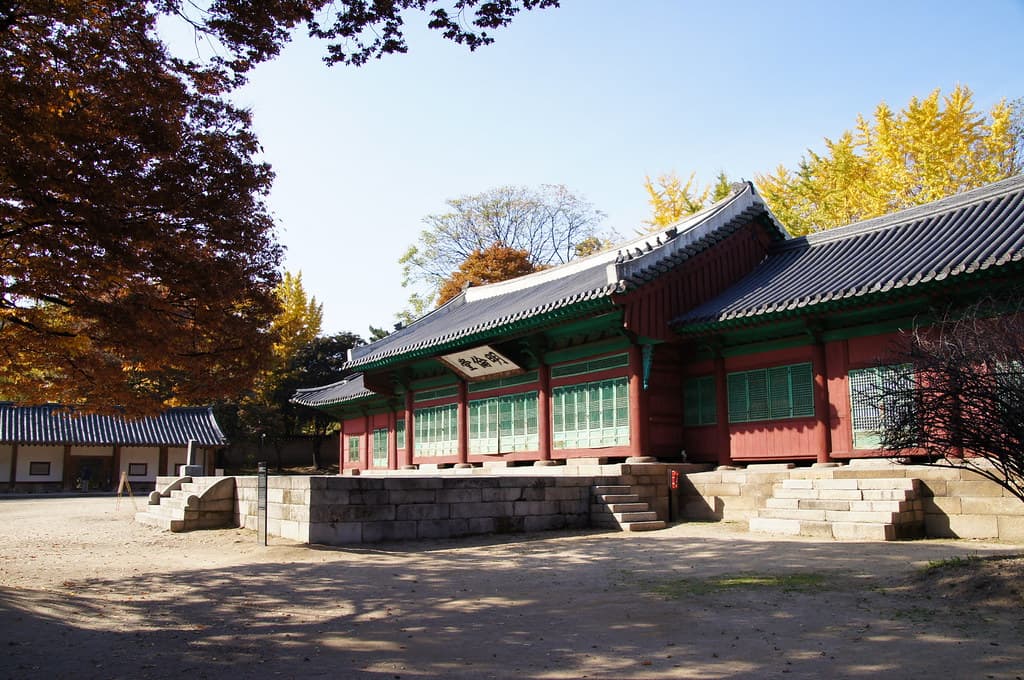
Munmyo Shrine at Sungkyunkwan in Seoul, Jongno District, South Korea. Image source · CC BY-SA 2.0
Visit essentials
A quick read before you go
- Duration
- Allow a calm, condition-aware visit.
- Access
- Prepare for the exact route described above.
Overview
Korea Heritage Service dates the institution’s establishment in Seoul to 1398, while also recording destruction during the Japanese invasions, rebuilding, later fire, and major repair. The present ensemble therefore carries successive phases rather than pristine founding fabric. Those disruptions do not erase continuity of ritual office, texts, tablets, music, or education. They show how a state and community repeatedly renewed a Confucian ceremonial order.
Why this place is sacred
Seokjeon, the Great Rite, remains the clearest expression of active sacred use. Sungkyunkwan and municipal sources describe memorial ceremonies for Confucius held in spring and autumn, with formal offerings, music, dance, officiants, and ordered movement. Calling the site active worship does not imply that every visitor practices Confucian religion. It recognizes that ritual acts directed toward honored sages continue in a protected historical precinct.
Original function follows the cited authorities.
Material continuity is not presumed.
Experience and orientation
Read the layout as an ethical sequence. Gates, courts, shrine halls, academy spaces, old trees, and circulation rules distinguish study from sacrifice while keeping them near. Do not reduce the ceremony to colorful costume or treat tablets as portraits. Confucian reverence is expressed through relation, role, timing, posture, music, and carefully prepared offerings. The architecture makes those obligations public and repeatable.
Use the verified public approach.
Context and lineage
Outside a rite, move slowly around public areas and notice how symmetrical space disciplines attention. During Seokjeon, remain behind designated lines, silence devices, and avoid blocking musicians, dancers, descendants, students, or officiants. Photography may be limited even in an open court; ask organizers before recording participants or altar arrangements. Never touch tablets, vessels, instruments, painted surfaces, or offerings.
Korean Confucianism
Traditions and practice
A suitable reflective exercise is to choose one relationship named by the precinct—teacher and student, ancestor and descendant, officeholder and community—and consider what respectful conduct requires from both sides. This stays close to Confucian ethical cultivation without pretending to perform a formal rite. Visitors should not improvise bows, incense, food offerings, or ceremonial music from online examples.
Current use remains custodian-led.
Attend quietly before drawing conclusions.
Korean Confucianism
ActiveSacred meaning follows the documented local tradition.
Practice remains governed by present custodians.
Perspectives and open questions
Several disciplines illuminate this sacred place.
Scholarly perspective
Munmyo can be approached through religious studies, educational history, architecture, musicology, and civic heritage. A secular visitor may value scholarship while a ritual participant encounters honored presences through prescribed ceremony. Neither perspective should caricature the other. No widespread metaphysical outcome claim was found; the documented spiritual significance rests on reverence, moral formation, communal memory, and continuing rites. The shrine’s plural tablets also complicate simple labels such as deity or ancestor.
Confucius, disciples, and later scholars occupy differentiated places within a Confucian ritual order. Metadata uses target of veneration as a practical field, but visitors should not force these figures into a theological model borrowed from another religion. The site’s own ritual vocabulary, spatial hierarchy, music, and institutional custodianship provide the safer guide.
Living and traditional perspectives
Community meanings retain their own authority.
Open questions
Unsupported effects remain explicitly unverified.
Plan your visit
Access and arrival
Prepare for the exact route described above.
No lodging claim was researched.
Respectful visit
Dress for dignity and terrain.
Ask before recording people or ritual.
Use authorized channels only.
Obey every closure and barrier.
Do not invent or imitate rites.
Current practical details
Address
25-1 Seonggyungwan-ro, Jongno District, Seoul, South Korea
Phone
Hours
Hours, fees, and access can change — verify on the official source before you travel. Practical details last checked Jul 2026.
Location
Map loads as you approach this section.
Pilgrim reflections
A portrait of encounter, not a score
Pilgrims describe what they felt, how present they could become, and whether the place would shape a journey. There are no stars and no ranking of traditions.
No reviewed reflections yet
The first pilgrims can help describe the character of being here.
Share a reflection
Available after an account-backed “Been there.” Every reflection is reviewed before publication.
Nearby sacred places
Explore other sacred places in the region. Proximity does not establish access or travel time; check each place’s guidance.

References
Sources consulted for this page. Source categories describe the publication, not a guarantee that every claim is verified. Traditional accounts and outside interpretations may differ.
- 01Seoul Munmyo and Seonggyungwan — Korea Heritage ServiceofficialExact Historic Site authority for precinct identity and protection.
- 02Interpretive guide to Munmyo and Seonggyungwan — Korea Heritage ServiceofficialOfficial target-of-veneration, foundation, rebuilding, and architectural interpretation.
- 03Seokjeon Daeje — Sungkyunkwan UniversityofficialInstitutional account of twice-yearly rites memorializing Confucius.
- 04Munmyo Shrine — Jongno-gu OfficeofficialMunicipal account of the Great Rite and the shrine’s continuing civic setting.
- 05Seonggyungwan and Munmyo — Google Maps place record — GoogleSource contextStrong exact identity and current address, coordinates, phone, and daily hours.
Share a photo
Help visitors recognize Munmyo Shrine at Sungkyunkwan. Every submission is reviewed before publication.