Ise Grand Shrine (Ise Jingū)
Where the sun goddess dwells and Japan's spiritual heart has beaten for two millennia
Understand sacred places, explore living traditions, and learn how to engage respectfully with Pilgrim Map.
Access has not been verified. Check current local guidance before planning a visit.
Ise, Mie Prefecture, Japan
Visit essentials
A quick read before you go
- Duration
- Half day minimum to visit both Geku and Naiku at a meaningful pace.
- Access
- Train from Nagoya (approximately 1.5 hours on Kintetsu or JR lines) or Osaka (approximately 2…
Overview
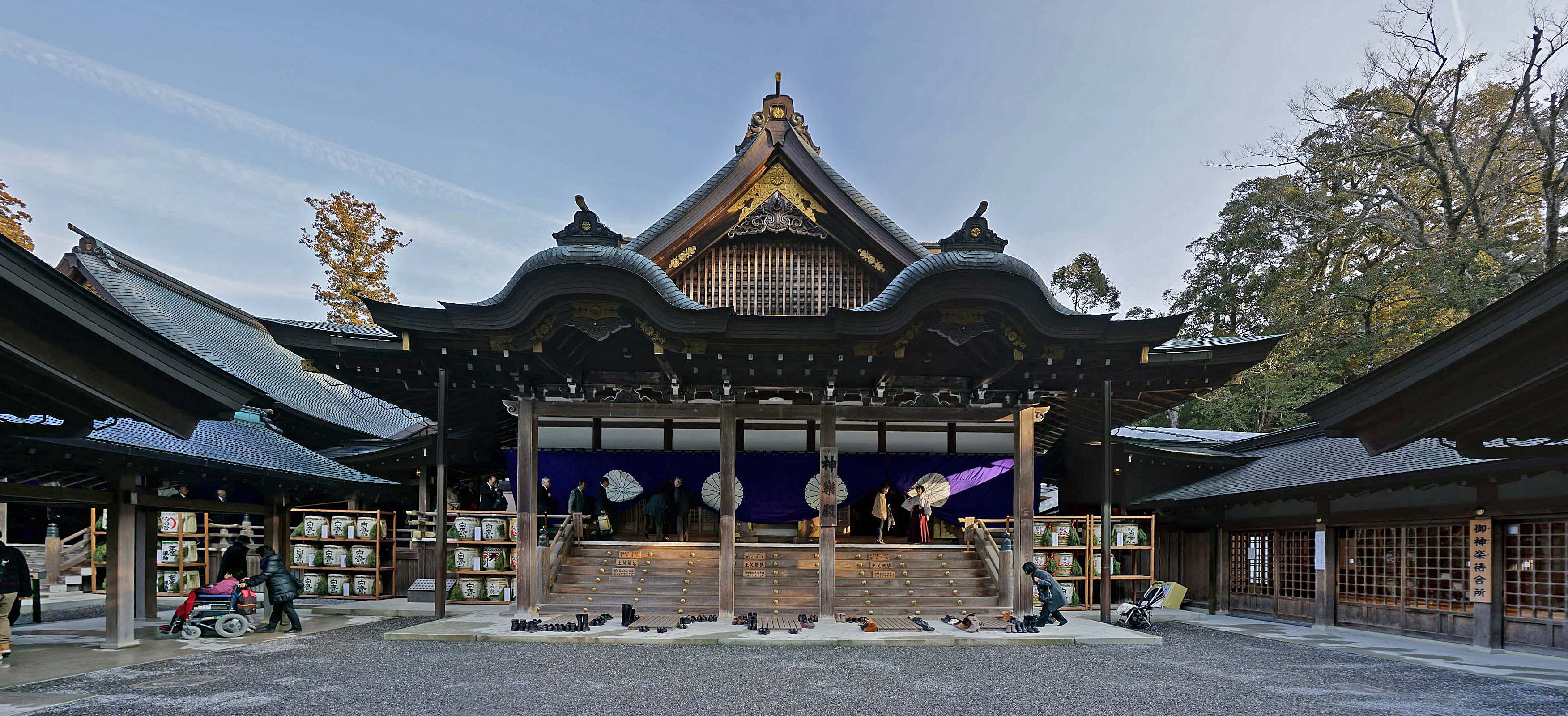
The path to Ise Jingu passes ancient cryptomeria trees older than the buildings but younger than the tradition they shelter. The structures are rebuilt from scratch every twenty years, yet the shrine is nearly two millennia old: continuity rests not in material but in devotion reaching toward Japan's mythic origins.
At Naiku, the Inner Shrine, the Yata-no-Kagami or Sacred Mirror rests beyond view. No one living has seen it; wrapped in silk and housed in a cypress box, it has remained hidden since the third century. Shinto mythology says the mirror lured Amaterasu from the cave where she hid after her brother's violence, returning light to the world. It now serves as the shintai, the divine body in which the sun goddess resides.
Edo-period pilgrimage made Ise a national phenomenon, with 'once in a lifetime' describing every Japanese person's aspiration to visit. In 1830, over a million pilgrims arrived in three days. Millions still come annually, following ancestral gravel paths, purifying their hands in the cold Isuzu River, and standing before gates open only to emperors and high priests. The encounter offers more than tourism: a place understood as Japanese civilization's spiritual wellspring and an exceptional continuity of devotion.
Why this place is sacred
The thinness at Ise operates through multiple dimensions simultaneously. Most fundamental is the presence of Amaterasu herself, believed by Shinto practitioners to genuinely inhabit the inner sanctuary through the medium of the Sacred Mirror. This is not metaphor but sincere belief: the goddess is present here as she is present nowhere else on earth. For those who hold this understanding, every moment at Ise occurs in proximity to divinity.
The architecture reinforces this quality through radical simplicity. The buildings of the Naiku and Geku exemplify shinmei-zukuri style, characterized by unadorned wood, absence of paint, and forms that echo prehistoric granaries. There is no ornamentation to distract from essence. This simplicity makes the sacred visible through what is not present as much as what is.
Yet perhaps the most remarkable dimension of Ise's thinness is the Shikinen Sengu, the complete reconstruction of all shrine buildings every twenty years. This practice, initiated by Empress Jito in 692 CE, has now occurred sixty-two times. Each rebuilding involves about 2,000 artisans working for years, using traditional techniques passed from generation to generation. The transfer of sacred objects from old buildings to new occurs in total darkness, witnessed only by priests and hidden from view by white cloth screens.
In this darkness, something ancient moves from one material vessel to another, the mystery preserved through concealment.
The effect is paradoxical: the buildings are always new, always ancient, perpetually dying and perpetually being reborn. This mirrors Shinto's understanding of renewal and purity, the constant refreshing that keeps sacred things alive. Visitors walking these grounds walk where millions have walked before, yet on gravel laid in the current generation. Time at Ise folds in on itself, past and present coexisting in a way that creates conditions for direct encounter with what transcends ordinary temporal experience.
Ise was established as the permanent dwelling place of Amaterasu-Omikami, previously housed in the Imperial Palace. Princess Yamatohime searched for twenty years before receiving divine revelation that this location was where the sun goddess wished to be enshrined for eternity. The shrine was designed to serve as the central sanctuary of the Imperial ancestor cult and the spiritual heart of Japan.
While the essential purpose has remained constant, the shrine's relationship to political power has evolved. During the medieval period, the shrine's economic resources were depleted by civil wars, and the Shikinen Sengu was sometimes delayed. The Meiji Restoration elevated Ise to supreme importance in State Shinto. After World War II, separation of religion and state made the shrine a private religious institution, though it retains its central symbolic importance.
Today, it serves both as an active religious center and as a destination for those seeking connection with Japanese spiritual heritage.
Experience and orientation
The experience of Ise begins before reaching the shrine proper. The approach through the sacred forest establishes a transition from ordinary to sacred space. Towering cryptomeria trees, some over a century old, line the path, their presence creating a natural cathedral. Light filters through the canopy in shifting patterns. The air carries the scent of cedar and earth. Gradually, the concerns of daily life recede.
At the temizuya, visitors pause to perform purification, washing hands and rinsing mouths with cold water from bamboo dippers. This small act of ritual cleansing marks a psychological threshold. Beyond lies the shrine precinct proper, where gravel crunches underfoot and the massive torii gates frame views of thatched roofs glimpsed through trees.
What visitors encounter at the inner shrine surprises many: rather than an open vista of ornate buildings, they find a high wooden fence beyond which they cannot pass. The main sanctuary is entirely hidden from view. Visitors may only approach a lower gate, beyond which lie three more barriers before the sanctuary itself. This limitation proves spiritually meaningful. The concealment creates mystery, requires imagination, invites the visitor to sense what cannot be seen.
Many report experiences difficult to articulate: a stillness that seems to emanate from the hidden sanctuary, a quality of presence that suggests something beyond the material, a sense of participating in a continuity that dwarfs individual human life. Some speak of feeling purified simply by proximity. Others describe unexpected emotional responses, tears arising without identifiable cause, or a peace so deep it surprises them.
For those who approach with spiritual intention, Ise offers something increasingly rare in the modern world: direct encounter with living tradition unbroken for over a millennium, in a setting that remains remarkably unspoiled. The goddess, according to tradition, truly dwells here. Whether or not one shares that belief, the accumulated devotion of countless pilgrims has left its mark on this place, creating conditions where something profound remains available to those who come with openness.
Approach Ise with the understanding that you visit the most sacred site in Japanese spiritual tradition. Come prepared for walking along gravel paths through forest settings. Allow ample time rather than rushing. If possible, follow the traditional order of visiting Geku first, then Naiku. Perform purification rituals with attention and sincerity. Maintain quiet reverence in shrine precincts. Understand that the most sacred spaces are deliberately hidden, and allow that concealment to work on your imagination rather than feeling excluded.
Consider visiting in early morning when crowds are lighter and the quality of stillness most palpable.
Context and lineage
According to Shinto tradition, Amaterasu-Omikami was originally worshipped within the Imperial Palace by successive emperors. During the reign of Emperor Sujin, the Holy Mirror was removed from the Palace to reduce the weight of divine presence in the royal dwelling. Emperor Suinin then commanded his daughter, Princess Yamatohime-no-mikoto, to find a permanent home for the mirror and the goddess it embodied. For twenty years, the princess journeyed through various provinces, seeking the right location through divine guidance.
Finally, at Ise, she received a revelation from Amaterasu herself: 'This Province of Ise, of the divine wind, is the land where the waves from the eternal world come upon the shore. It is a secluded and pleasant land. In this land I wish to dwell.' There the princess established the shrine, and there it has remained.
The spiritual lineage at Ise runs directly through the Imperial family. The high priest or priestess must be related to the Imperial House. Currently, Princess Sayako Kuroda, daughter of Emperor Emeritus Akihito, serves as High Priestess. This unbroken connection between the shrine and the Imperial line has continued since the shrine's founding, making Ise unique among world sacred sites in its direct link to a reigning royal house.
The priesthood has transmitted sacred knowledge and ritual techniques across sixty-two complete rebuilding cycles, preserving ancient practices while perpetually renewing their material expression.
Amaterasu-Omikami
The sun goddess and supreme deity of Shinto, enshrined at Naiku. Divine ancestress of the Imperial line and source of light for the world.
Princess Yamatohime-no-mikoto
Daughter of Emperor Suinin who searched for twenty years before establishing the shrine at Ise following divine revelation. First high priestess of the shrine.
Empress Jito
Initiated the Shikinen Sengu tradition of rebuilding the shrine every twenty years in 692 CE, establishing a practice that continues today.
Toyouke-Omikami
Goddess of agriculture, industry, and food, enshrined at Geku (Outer Shrine). Called from Tanba Province to provide food offerings to Amaterasu.
Traditions and practice
The ritual life of Ise is anchored by two central practices. The first is the continuous cycle of daily, monthly, and annual ceremonies, with over 1,500 rituals performed each year. These include daily food offerings to Amaterasu prepared with sacred fire at the Geku, monthly observances, and major festivals such as the Kannamesai in October, when the first fruits of the rice harvest are offered to the goddess.
The Emperor himself participates in key ceremonies and sends envoys bearing rice he has personally cultivated.
The second central practice is the Shikinen Sengu, the complete rebuilding of all shrine buildings every twenty years. This massive undertaking involves approximately 2,000 artisans working for years, using only traditional tools and techniques. The wood comes from specially designated forests. The thatching, the metalwork, the textile arts, all must be executed according to methods transmitted across generations. The culmination is the Sengu itself, the transfer of the sacred objects from the old buildings to the new.
This transfer occurs in complete darkness, with artificial lights extinguished and the ritual hidden behind white cloth screens. In this concealed moment, the divine presence moves from one vessel to another, the mystery preserved through forty generations of practice.
Modern visitors to Ise participate in a simplified form of pilgrimage that nevertheless connects them to centuries of tradition. Upon arrival, they pass through torii gates that mark the transition to sacred space. At the temizuya, they perform temizu, purifying hands and mouth with water. They then walk the gravel paths through the forest, approaching first the various auxiliary shrines, then the main sanctuary.
At the worship area (haiden), they offer coins, bow twice, clap twice, bow once, and offer silent prayer. Many collect goshuin, commemorative stamps that serve as proof of pilgrimage, or acquire omamori, protective amulets.
The traditional order prescribes visiting Geku before Naiku, following the principle of approaching the goddess of food before the sun goddess she serves. A pilgrimage might include walking the approaches slowly, taking time at each auxiliary shrine, and perhaps making multiple visits to absorb the atmosphere. Many visitors also explore Oharaimachi and Okage Yokocho, the traditional market streets near Naiku, which have served pilgrims for centuries.
For those seeking a meaningful pilgrimage experience, consider arriving before the crowds, ideally shortly after opening time. Follow the traditional order of Geku then Naiku. Perform purification rituals with full attention rather than as mere formality. Walk slowly, allowing the forest atmosphere to work on your awareness. At the main sanctuary, accept that you cannot see what lies beyond the gates, and allow that hiddenness to become part of your experience.
Spend time sitting quietly in areas where this is permitted. Some find it valuable to visit twice, once for orientation and once for deeper presence.
Shinto
ActiveIse Jingu is the supreme sanctuary of Shinto, housing the sun goddess Amaterasu-Omikami and the Sacred Mirror, one of the Three Imperial Regalia. It represents the spiritual heart of Japan and the center of the Imperial ancestor cult. For Shinto practitioners, this is the most sacred place on earth.
Over 1,500 annual ceremonies including daily food offerings, monthly observances, and major festivals such as Kannamesai. The Shikinen Sengu rebuilding every twenty years represents the highest expression of Shinto understanding of purity and renewal. Pilgrimage (Okage Mairi) has been practiced for centuries.
Perspectives and open questions
Ise Jingu can be understood through multiple lenses: as the dwelling place of the sun goddess, as the center of Imperial ancestor cult, as a masterpiece of traditional architecture, or as a living tradition that has perpetuated itself for over thirteen centuries. Each perspective illuminates different dimensions of the shrine's significance.
Scholarly perspective
Academic scholarship recognizes Ise as an exceptional example of Shinto architecture and continuous religious tradition. The shinmei-zukuri architectural style, with its unpainted wood and raised floors, reflects forms dating to prehistoric Japan. The Shikinen Sengu tradition has preserved ancient building techniques that might otherwise have been lost. Historians note the shrine's complex political history, including its elevation during the Meiji period and its subsequent adaptation to the separation of religion and state after World War II.
The shrine's continued importance to Japanese cultural identity is widely acknowledged across academic disciplines.
Living and traditional perspectives
For Shinto practitioners, Ise is not metaphor or symbol but literal divine dwelling. Amaterasu-Omikami, the sun goddess, genuinely resides in the inner sanctuary, present through the medium of the Sacred Mirror. The shrine buildings are not architecture but vessels for divine presence. The Shikinen Sengu represents not destruction and rebuilding but eternal renewal, the goddess moving from one pure vessel to another in perpetual freshness.
The rituals conducted daily are not performances but actual service to a living deity who requires food, clothing, and shelter.
Alternative interpretations
Some practitioners and researchers understand Ise within broader frameworks of sacred geography and earth energies. The location chosen by Princess Yamatohime may have been recognized for particular qualities beyond mere convenience. The precise geometry of the shrine layout and its cardinal orientations may reflect cosmic principles. The cyclic rebuilding can be seen as working with natural cycles of renewal that operate at multiple levels simultaneously. Some visitors report sensing distinct energy qualities at different locations within the shrine precincts.
Open questions
Significant mysteries remain at Ise. The Sacred Mirror has not been seen by anyone outside the highest priesthood since the third century; its exact appearance and nature are unknown. The precise rituals performed during the Shikinen Sengu, particularly the nocturnal transfer of sacred objects, are closely guarded secrets. Why the twenty-year rebuilding cycle was chosen, and what determines its exact timing, remain subjects of speculation.
What actually occurs in the inner sanctuary during daily rituals is known only to those who perform them.
Plan your visit
Access and arrival
Train from Nagoya (approximately 1.5 hours on Kintetsu or JR lines) or Osaka (approximately 2 hours). Ise-shi Station serves Geku; Naiku requires additional 10-15 minute bus ride. Direct buses connect both shrines. Rental bicycles available for exploring the area.
Ise offers traditional ryokan (Japanese inns) that enhance the pilgrimage experience, as well as modern hotels. Staying overnight allows for early morning shrine visits when the atmosphere is most conducive to spiritual experience.
Respectful visit
Modest, respectful attire is expected. While no traditional dress is required, avoid beachwear, overly casual clothing, or attire that might be considered disrespectful in a religious context. Clean, neat appearance honors the shrine's emphasis on purity.
Photography restrictions increase as you approach the main sanctuaries. At the innermost areas, photography is prohibited entirely. Signs indicate restricted zones. Even where photography is permitted, exercise discretion and avoid interfering with other pilgrims' experiences.
Monetary offerings are made at the worship areas before the main sanctuaries. Coins are traditionally tossed into the offering box before prayer. For those seeking formal offerings, omamori (protective amulets) and ofuda (talismans) are available at designated locations.
{"Inner sanctum areas are accessible only to Imperial family and senior priests","Remain to the side of paths; center is reserved for kami","No photography of main sanctuary buildings","Perform purification before approaching shrines","Maintain quiet, reverent demeanor throughout","Visit Geku before Naiku following traditional order","Do not enter restricted areas or climb on structures"}
Ise is an active religious site, not merely a cultural heritage attraction. Behaviors appropriate at secular tourist sites may be inappropriate here. Loud voices, casual photography, and rushing through sacred precincts all diminish both your experience and that of other pilgrims. Photography becomes increasingly restricted as you approach the main sanctuaries. Some visitors experience unexpected emotional responses; allow space for whatever arises without suppression.
Current practical details
Address
1 Ujitachichō, Ise, Mie 516-0023, Japan
Phone
Hours
Hours, fees, and access can change — verify on the official source before you travel. Practical details last checked Jun 2026.
Location
Map loads as you approach this section.
Pilgrim reflections
A portrait of encounter, not a score
Pilgrims describe what they felt, how present they could become, and whether the place would shape a journey. There are no stars and no ranking of traditions.
No reviewed reflections yet
The first pilgrims can help describe the character of being here.
Share a reflection
Available after an account-backed “Been there.” Every reflection is reviewed before publication.
Dates and observances
Upcoming festivals, feast days, and pilgrimages connected to this place. Add any to your calendar, or browse the full observance calendar.
- Add to calendar
Kanname-sai
Oct 15 – Sat, Oct 17, 2026Festival
One of the three great festivals of Ise Jingu, offering the season's first newly harvested rice to the goddess Amaterasu in thanksgiving, with core rites at the Geku and Naiku on Oct 15-17.
- Add to calendar
Kanname-sai
Oct 16 – Sun, Oct 18, 2026Festival
One of the three great festivals of Ise Jingu, offering the season's first newly harvested rice to the goddess Amaterasu in thanksgiving, with core rites at the Geku and Naiku on Oct 15-17.
- Add to calendar
Kanname-sai
Oct 17 – Mon, Oct 19, 2026Festival
One of the three great festivals of Ise Jingu, offering the season's first newly harvested rice to the goddess Amaterasu in thanksgiving, with core rites at the Geku and Naiku on Oct 15-17.
- Add to calendar
Kanname-sai
Oct 15 – Sun, Oct 17, 2027Festival
One of the three great festivals of Ise Jingu, offering the season's first newly harvested rice to the goddess Amaterasu in thanksgiving, with core rites at the Geku and Naiku on Oct 15-17.
Nearby sacred places
Explore other sacred places in the region. Proximity does not establish access or travel time; check each place’s guidance.


Pilgrim glossary
- Torii
- The traditional Japanese gate marking the entrance to a Shinto sacred area.
Share a photo
Help visitors recognize Ise Grand Shrine (Ise Jingū). Every submission is reviewed before publication.