Meoto Iwa
Sacred rocks bound by rope, framing sunrise between the sea and Amaterasu's realm
Understand sacred places, explore living traditions, and learn how to engage respectfully with Pilgrim Map.
Access has not been verified. Check current local guidance before planning a visit.
Ise, Mie Prefecture, Japan
Read the sources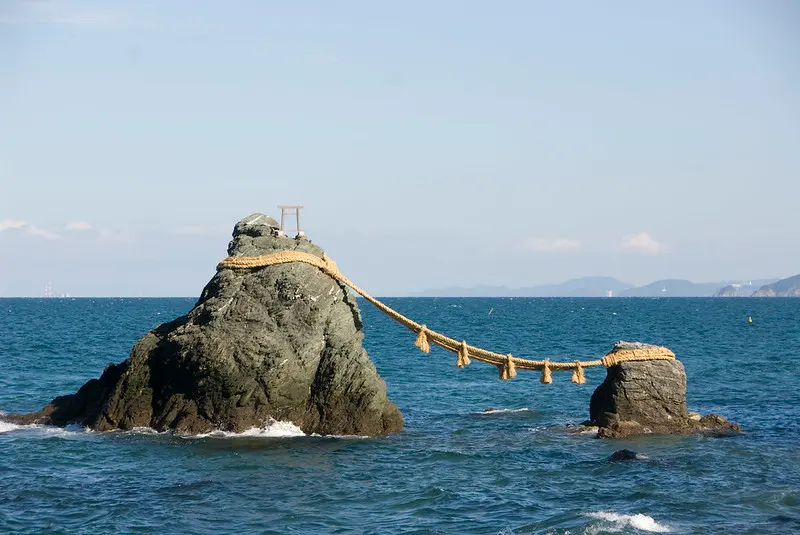
Visit essentials
A quick read before you go
- Duration
- Thirty minutes to one hour for the shrine and rocks.
- Access
- By train: JR Sangu Line to Futamiura Station, then 15-minute walk to the shrine.
Overview
Meoto Iwa—the Wedded Rocks—stands as one of Japan's most recognizable sacred images: two sea rocks bound by a massive rope, framing the horizon where sun and sea meet. The image appears on countless postcards and shrine talismans, yet its power extends far beyond the photogenic.
In Shinto cosmology, these rocks represent Izanagi and Izanami, the divine couple whose creative union brought forth the Japanese islands and countless kami. The larger rock, standing nine meters tall, is Izanagi; the smaller, at 3.6 meters, is Izanami. The shimenawa that binds them—weighing over one ton and ceremonially replaced three times each year—marks the boundary between the earthly realm and something greater.
The rocks function as a natural torii gate, framing the eastern horizon. From May through July, the rising sun appears between them, and on clear summer solstice mornings, Mount Fuji is visible on the distant horizon directly beneath the ascending sun. In that moment, the cosmological threads align: the creator deities, Amaterasu the sun goddess, and Japan's most sacred mountain all present in a single view.
Beneath the waves near the larger rock lies the submerged Okitama-ishi, a sacred stone marking the presence of Sarutahiko—the kami who, according to myth, guided the first divine descent to earth. The adjacent Futami Okitama Shrine honors Sarutahiko and preserves the ancient hamamairi tradition: the practice of purifying oneself in these sacred waters before undertaking pilgrimage to Ise Grand Shrine.
This is a site of active practice. Pilgrims come for blessings related to marriage and relationships—the eternal bond of the rocks serving as model and aspiration. The frog statues throughout the shrine grounds represent kaeru, a word meaning both 'frog' and 'return'—a prayer for safe homecoming, for the return of what is lost or distant.
Why this place is sacred
The concept of the thin place—a location where the membrane between ordinary and sacred reality grows permeable—finds explicit expression in Shinto tradition through sites like Meoto Iwa. Here, multiple factors mark the boundary as thin.
The rocks themselves are iwakura—sacred stones understood as places where kami can be invited to dwell. The Shinto tradition recognizes certain natural features as possessing an inherent quality that makes them suitable vessels for divine presence. The two rocks at Futami, rising from the sea in distinctive form, have been understood this way since ancient times.
The shimenawa rope is not mere decoration. In Shinto practice, shimenawa marks the boundary between sacred and profane space—announcing that what lies within (or in this case, what the rope encompasses) belongs to a different order than ordinary reality. The massive rope binding the Wedded Rocks declares them as threshold, as gate, as marker of transition between realms.
The solar alignment creates a temporal threshold. The summer solstice sunrise—when the sun appears between the rocks above distant Mount Fuji—brings together creator deities (represented by the rocks), sun goddess (Amaterasu, manifest in the rising sun), and sacred geography (Fuji, itself understood as inhabited by divine presence). This alignment occurs at a calendrical threshold, the moment when darkness yields fully to light's triumph.
The hamamairi tradition establishes Meoto Iwa as a threshold to Ise. Before approaching Japan's most sacred Shinto precinct—the Inner Shrine where Amaterasu is enshrined—pilgrims properly purify themselves in these waters. Futami becomes the preparation, the transition, the crossing of boundary that must precede encounter with the highest sacred.
The sea itself provides liminal context. Oceans in many traditions mark the edge of the known world, the boundary between what humans can walk and what belongs to other powers. The rocks emerging from this boundary—one foot in each world, so to speak—participate in the sea's liminal character.
The veneration of these rocks as iwakura—sacred stones where kami are invited to dwell—appears to extend into prehistory. The specific association with Izanagi and Izanami developed as Shinto mythology crystallized around the Kojiki and Nihon Shoki texts (early eighth century CE). The hamamairi tradition linking Meoto Iwa to Ise pilgrimage established the rocks as part of the Ise sacred geography.
The site continues as a place of active Shinto practice. The three annual shimenawa replacement ceremonies maintain ritual engagement with the rocks. The shrine's role in blessing marriages and relationships has become increasingly prominent in contemporary practice. The frogs (kaeru) that populate the shrine grounds represent a more recent development in the site's symbolic vocabulary, drawing on the pun between 'frog' and 'return.'
Experience and orientation
The first encounter with Meoto Iwa often occurs before the physical visit. The image is ubiquitous in Japanese culture: two rocks, thick rope, sea, and sky. Arriving at the actual site, visitors meet this familiar image in three dimensions, with the additions of wind, wave, and the smell of salt air.
The rocks are larger than photographs suggest. The male rock (Izanagi) rises nine meters from the waves; even the smaller female rock (Izanami) stands 3.6 meters. The shimenawa connecting them is massive—over one ton of rope that requires elaborate ceremony three times each year to replace. Standing on the shore and taking in the scale, visitors begin to feel why this place has drawn worshippers for so long.
The shrine grounds surrounding the rocks create their own distinctive atmosphere. Frog statues appear everywhere—on railings, pedestals, around the purification basin. These kaeru figures represent the pun that connects 'frog' to 'return.' Visitors who have lost something or someone, who are waiting for a return of any kind, find companionship in these stone amphibians.
The Mangankaeru—the wish-fulfilling frog—sits in the temizuya (purification fountain). Visitors pour water over this stone frog while making a wish. The practice has accumulated since someone noticed that the frog's posture suggests patient waiting, the attitude appropriate to those who hope.
Timeliness matters here more than at many sacred sites. The sunrise between the rocks is visible from May through July, with the most dramatic alignment occurring around summer solstice (June 21). Arriving before dawn, watching darkness yield to first light, seeing the sun appear between the rocks exactly where it should—this experience differs qualitatively from the midday visit. The moonrise between rocks occurs November through January, offering a complementary experience.
The connection to Ise adds depth for those undertaking the traditional pilgrimage. To purify at Futami before approaching the Inner Shrine is to participate in practice maintained for centuries. The seeker who makes this connection experiences Meoto Iwa not as destination but as threshold—the proper beginning of encounter with Amaterasu.
For the full experience, arrive before dawn during May-July, positioning yourself to watch sunrise between the rocks. Summer solstice (around June 21) offers the most dramatic alignment with Mount Fuji visible on clear days. For the traditional pilgrimage experience, visit Meoto Iwa and Futami Okitama Shrine before proceeding to Ise Grand Shrine. Engage with the shrine's practices—purification at the temizuya, attention to the frog statues, prayer at the main hall.
Context and lineage
According to the Kojiki—Japan's oldest written chronicle, compiled in 712 CE—Izanagi and Izanami stood on the Floating Bridge of Heaven and stirred the primordial ocean with a jeweled spear. The drops that fell from the spear's tip created the first island, Onogoro. The divine couple descended to this island, were married, and through their union produced the islands of Japan and countless kami.
The Meoto Iwa rocks embody this sacred marriage. Whether the rocks were associated with the creator deities from prehistoric times or whether this association developed as Shinto mythology crystallized is unclear. What is clear is that by the historical period, the rocks were understood as representing the divine couple whose creative union brought forth Japan.
Sarutahiko, enshrined at the adjacent Futami Okitama Shrine, features in a later chapter of the mythological narrative. When Amaterasu's grandson Ninigi descended from the High Plain of Heaven to rule the terrestrial realm, Sarutahiko—a powerful kami of the land—met him and guided him to his destination. This role as guide to sacred transition connects Sarutahiko to the site's function as threshold to Ise pilgrimage.
The site represents the continuous stream of Shinto practice extending from prehistoric iwakura (sacred stone) veneration through the mythological framework established in the Kojiki and Nihon Shoki to the living tradition maintained today. The hamamairi purification practice connects the site specifically to the Ise pilgrimage tradition that has been maintained for over a thousand years.
Izanagi (伊邪那岐)
The male creator deity, represented by the larger rock. Together with Izanami, he created the Japanese islands and countless kami.
Izanami (伊邪那美)
The female creator deity, represented by the smaller rock. Her union with Izanagi brought forth Japan. After her death from giving birth to the fire kami, she became associated with the underworld.
Sarutahiko (猿田毘古)
The kami enshrined at Futami Okitama Shrine. He guided Ninigi during the first divine descent to earth. His presence at this site connects to its role as threshold for pilgrims approaching Ise.
Amaterasu (天照大神)
The sun goddess, whose shrine at Ise is Japan's holiest Shinto precinct. The sunrise between Meoto Iwa represents her light. Pilgrims purify at Futami before approaching her shrine.
Traditions and practice
The shimenawa rope replacement ceremony (shimenawa-kake) occurs three times annually: May 5, September 5, and mid-December. These elaborate ceremonies involve shrine priests and volunteers stretching the new rope across the rocks while the old rope is removed. The ceremony maintains the sacred boundary the rope represents.
The hamamairi tradition—purifying oneself in the sacred waters of Futami Beach before undertaking pilgrimage to Ise Grand Shrine—represents the proper preparation for encountering Amaterasu. While the specific practice of ocean purification has diminished (many pilgrims now purify at the shrine's temizuya instead), the understanding of Futami as threshold to Ise persists.
Sunrise viewing, especially at summer solstice, continues as a practice drawing visitors who wish to experience the alignment of rocks, sun, and—on clear days—Mount Fuji. This practice connects to the broader Shinto reverence for the rising sun as manifestation of Amaterasu.
Prayers for marriage, relationship harmony, and safe return comprise the most common contemporary practices. The bound rocks serve as model for faithful partnership; the kaeru (frog/return) symbolism addresses those awaiting someone's or something's return.
All traditional practices continue at the site. Daily worship is maintained at the shrine. Visitors purchase ema (votive tablets) and omamori (protective charms) related to relationships, marriage, and safe travel. The Mangankaeru frog in the purification basin receives countless wishes poured as water.
The shimenawa replacement ceremonies can be observed by visitors—they are public events rather than restricted rituals. The summer solstice sunrise draws particular crowds, though any sunrise during May-July allows viewing the sun between the rocks.
Visitors can participate in standard Shinto practices: purification at the temizuya (water basin), two bows, two claps, one bow at the main hall, coin offering. The Mangankaeru frog accepts wishes—pour water over it while holding your intention. For the full pilgrimage experience, visit Meoto Iwa for purification, then proceed to Ise Grand Shrine (Geku outer shrine first, then Naiku inner shrine, following traditional practice).
Sunrise viewing requires arriving before dawn. The rocks face east; positioning yourself along the shore path provides clear sightlines. The shrine grounds are accessible before dawn. On summer solstice, arrive particularly early, as crowds can be significant.
Shinto
ActiveMeoto Iwa embodies the Shinto concept of iwakura—sacred stones where kami are invited to dwell. The rocks represent Izanagi and Izanami, the creator deities whose union brought forth Japan and countless kami. The massive shimenawa rope binding them marks the boundary between earthly and spiritual realms, making the rocks themselves a natural torii gate framing the eastern horizon where Amaterasu rises.
Shimenawa replacement ceremony three times annually (May 5, September 5, mid-December). Hamamairi purification before Ise pilgrimage. Sunrise viewing, especially at summer solstice when sun rises between rocks over Mount Fuji. Prayers for marriage, relationship harmony, and safe return (kaeru). The Mangankaeru frog receives wishes.
Perspectives and open questions
Meoto Iwa can be approached as an expression of Shinto cosmology, as part of the Ise pilgrimage tradition, as a place of natural beauty holding cultural significance, or as a site for personal prayer and blessing.
Scholarly perspective
Scholars recognize Meoto Iwa as an outstanding example of Shinto iwakura tradition—the veneration of sacred stones where kami are understood to dwell. The representation of divine marriage (shinkon) in natural features connects to broader patterns in Shinto sacred geography. The site's integration into Ise pilgrimage practices demonstrates the importance of purification in Japanese religious culture. The solar alignments connect to documented patterns of sun worship in Shinto tradition.
Living and traditional perspectives
In Shinto understanding, the rocks are sacred iwakura where kami dwell. They represent the union of Izanagi and Izanami whose cosmic marriage created Japan. The shimenawa marks the boundary between earthly and sacred realms—the rocks themselves forming a natural torii gate. The hamamairi tradition establishes Futami as the proper gateway to encountering Amaterasu at Ise. The kaeru (frog/return) symbolism addresses the human longing for restoration, reunion, and safe homecoming.
The submerged Okitama-ishi near the larger rock marks the presence of Sarutahiko, who guided the first divine descent. His role as guide through sacred transition connects to the site's function as threshold.
Alternative interpretations
Some visitors are drawn by the site's reputation as a 'power spot' (pawaa supotto) for relationship blessings. The intersection of sun, mountain, and sea at summer solstice attracts those interested in earth energies and sacred geometry. The paired rocks have become symbols beyond Shinto practice—appearing in contexts addressing partnership, balance, and the union of complementary forces.
Open questions
When the rocks first became objects of veneration is unknown—the practice appears to extend into prehistory. The specific historical development of the association with Izanagi and Izanami, while connected to the Kojiki mythology, is not documented in detail. The relationship between this coastal iwakura site and the inland Ise shrines has evolved over centuries in ways not fully traced.
Plan your visit
Access and arrival
By train: JR Sangu Line to Futamiura Station, then 15-minute walk to the shrine. By car: 10 minutes from Ise IC, 3 minutes from Futami JCT. Parking available.
The site connects naturally to Ise Grand Shrine pilgrimage. Traditional practice places purification at Futami before visiting the shrines. Ise Grand Shrine (both Geku and Naiku) is approximately 20 minutes away by car or bus.
Accommodations available in Futami and the larger Ise area. Traditional ryokan (Japanese inns) offer the pilgrimage experience. The Ise Meotoiwa Meoto Yokocho shopping and dining complex is nearby.
Respectful visit
No specific requirements. Respectful casual attire is appropriate for shrine visits.
Photography of the rocks and shrine grounds is permitted. Exercise discretion during ceremonies and worship activities. Be mindful of other visitors, especially during sunrise viewing.
Coin offerings at the shrine are customary. Frog statues (kaeru) are traditional offerings at this shrine, reflecting the 'return' blessing. These can be purchased at the shrine.
Standard shrine etiquette—no eating or drinking in the worship areas, no loud behavior, maintain respectful demeanor. The rocks themselves are not accessible; they are viewed from the shore.
This is an active shrine; respectful behavior is expected. The rocks themselves are not accessible—they are viewed from the shore. During shimenawa replacement ceremonies, parts of the area may be restricted.
Current practical details
Address
575 Futamichōe, Ise, Mie 519-0602, Japan
Phone
Hours
Hours, fees, and access can change — verify on the official source before you travel. Practical details last checked Jun 2026.
Location
Map loads as you approach this section.
Pilgrim reflections
A portrait of encounter, not a score
Pilgrims describe what they felt, how present they could become, and whether the place would shape a journey. There are no stars and no ranking of traditions.
No reviewed reflections yet
The first pilgrims can help describe the character of being here.
Share a reflection
Available after an account-backed “Been there.” Every reflection is reviewed before publication.
Nearby sacred places
Explore other sacred places in the region. Proximity does not establish access or travel time; check each place’s guidance.


References
Sources consulted for this page. Source categories describe the publication, not a guarantee that every claim is verified. Traditional accounts and outside interpretations may differ.
- 01夫婦岩 - 二見興玉神社 — Futami Okitama ShrineofficialOfficial shrine information
- 02二見興玉神社(夫婦岩)- 伊勢志摩観光 — Ise-Shima TourismSource contextOfficial regional tourism
- 03二見興玉神社 - 観光三重 — Mie Prefecture TourismSource contextOfficial prefectural tourism
- 04Meoto Iwa - JNTO — Japan National Tourism OrganizationSource contextOfficial national tourism
- 05Meoto Iwa (Wedded Rocks) - Japan Guide — Japan GuideguideReliable travel information
- 06Meoto Iwa - Wikipedia — Wikipedia contributorsencyclopediaGood overview of rocks and significance
Pilgrim glossary
- Torii
- The traditional Japanese gate marking the entrance to a Shinto sacred area.
- Shimenawa
- A sacred straw rope marking the boundary of a Shinto holy place.
Share a photo
Help visitors recognize Meoto Iwa. Every submission is reviewed before publication.