Hwagyesa Temple
A rebuilt Seoul temple where Seon crossed languages
Understand sacred places, explore living traditions, and learn how to engage respectfully with Pilgrim Map.
Access has not been verified. Check current local guidance before planning a visit.
Seoul, Seoul, South Korea
Read the sources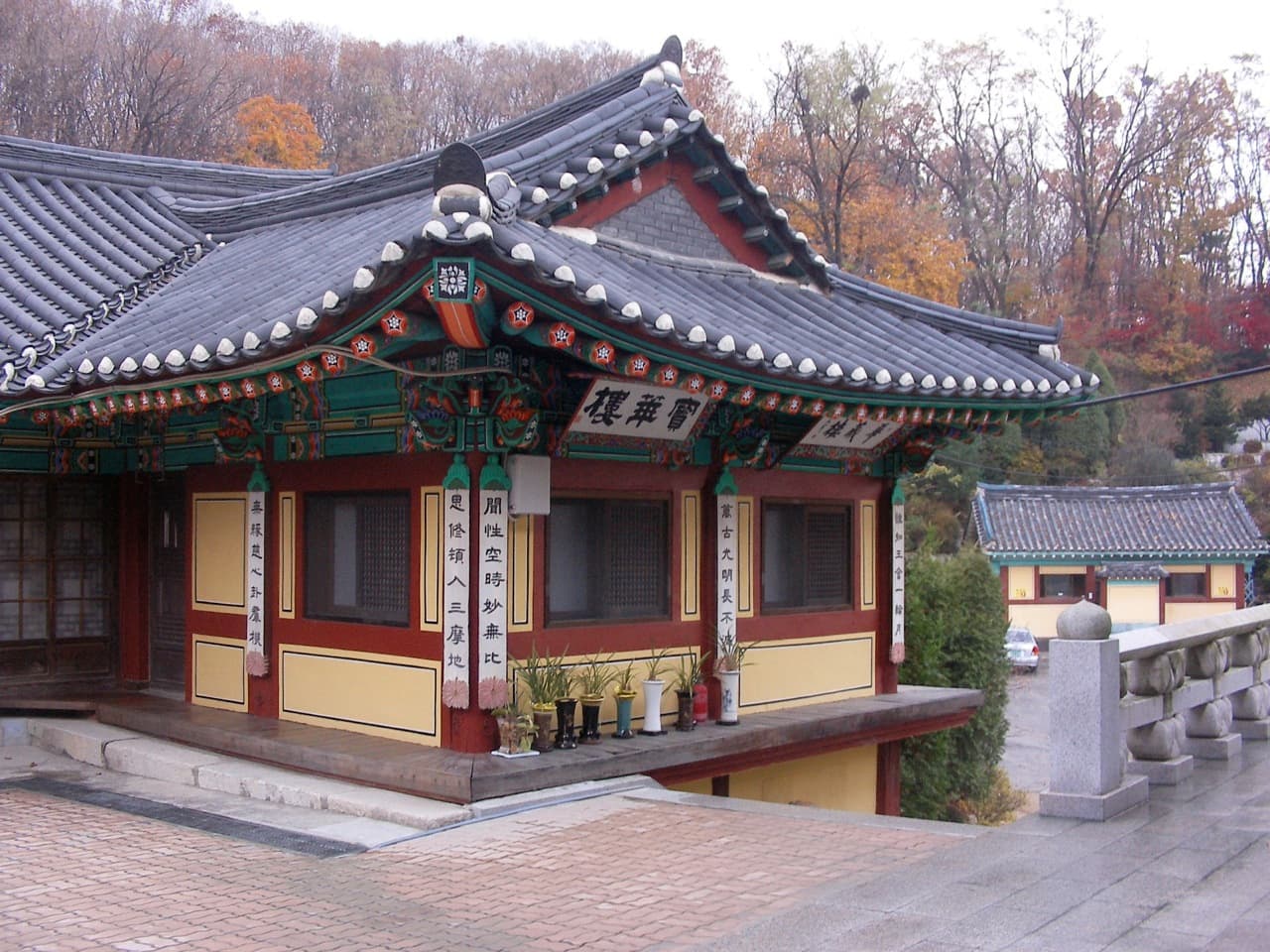
Hwagyesa Temple in Seoul, Gangbuk District, South Korea. Image source · CC BY-SA 2.0
Visit essentials
A quick read before you go
- Duration
- An hour suits a general visit; reserve the full published period for any Templestay activity.
- Access
- KTO lists year-round opening, parking, website hwagyesa.org, and +82-2-902-2663.
Overview
The short climb from Seoul's streets into Hwagyesa's green setting keeps the city close and helped make the temple a meeting point for Korean Buddhist practice and foreign students of Seon. That international story does not displace the resident institution. KTO's chronology records Shinwol's construction in 1522, destruction in 1618, rebuilding the next year, and expansion in 1866. Hwagyesa shows continuity through response: after fire, practice, memory, and communal effort reorganized around what was rebuilt.
Why this place is sacred
A rebuilt temple complicates the wish for ancient authenticity. Its value cannot depend on every beam having survived from the first foundation. At Hwagyesa, continuity resides in the renewed use of halls for chanting, meditation, offerings, study, and retreat. The modern history of international Seon adds another kind of rebuilding: teachings move between Korean and other languages, acquiring new communities while requiring careful transmission. The wooded mountain edge can support attention, but it is not evidence of a healing field.
What the sources support is a temple that repeatedly creates conditions for practice despite fire, urban growth, and cultural distance.
Shinwol established Hwagyesa in 1522 for Buddhist monastic and devotional life.
After the 1618 fire, the monastery was rebuilt in 1619, enlarged in 1866, and later became a notable setting for international Seon engagement.
Experience and orientation
Listen for how traffic recedes without vanishing. Within the precinct, reconstructed architecture and mountain vegetation form a modest scale; do not expect the monumental drama of a royal or UNESCO complex. If a meditation or Templestay group is present, their silence is part of a program, not an invitation to join. Find a public place where sitting is allowed and attend to one cycle of sound—a bell, footsteps, birds, or spoken instruction.
The practice of attention matters more here than manufacturing an exotic atmosphere around foreign monks or Zen anecdotes.
Consult temple notices on arrival and separate public courtyards from residential and program spaces.
Context and lineage
Official tourism information attributes the 1522 construction to Shinwol. Fire destroyed the temple in 1618, rebuilding followed in 1619, and Yongseon and Beomun expanded the complex in 1866. Twentieth-century teachers later made Hwagyesa known to practitioners from abroad, but the precise biographies and lineage claims should be taken from temple or scholarly sources rather than embellished. The enduring fact is that a local monastery became a place where Seon instruction crossed cultural boundaries.
Hwagyesa belongs to Korean Buddhism and is associated with Seon teaching and structured retreat practice.
Traditions and practice
Hall worship follows Korean Buddhist forms. Guests may sit or bow only where permitted and should not present a private meditation style as the temple’s lineage.
Templestay provides scheduled instruction and shared routine; current content and language availability must be confirmed with the custodian.
Sit in an authorized outdoor place and notice each moment when the city enters awareness, returning without treating noise as failure.
Korean Buddhism
ActiveKorean Seon practice survived physical loss and later welcomed disciplined international study.
Meditation, chanting, offerings, teaching, communal routine, and supervised retreat.
Perspectives and open questions
Hwagyesa can be read through architectural recovery, Korean Seon, and the challenges of translating practice.
Scholarly perspective
Reconstruction history shows why institutional continuity should not be equated with original material fabric.
Living and traditional perspectives
Seon is transmitted through teacher, community, discipline, and repeated practice rather than through a scenic feeling.
Open questions
No adequately sourced pattern of metaphysical visitor claims appears in this research.
Plan your visit
Access and arrival
KTO lists year-round opening, parking, website hwagyesa.org, and +82-2-902-2663. Confirm the day’s hall and program access directly.
Overnight access is limited to official Templestay reservations.
Respectful visit
Wear plain, modest clothing and carry layers for a shaded mountain-edge setting.
Ask before photographing interiors, teachers, residents, or retreat participants.
Use only the temple’s designated donation, candle, or incense arrangements.
Do not enter meditation rooms, kitchens, dormitories, or monastic quarters without program authorization.
Avoid romantic claims that foreign participation made the temple more universal or that meditation here guarantees insight.
Current practical details
Address
117 Hwagyesa-gil, Gangbuk-gu, Seoul, South Korea
Phone
Hours, fees, and access can change — verify on the official source before you travel. Practical details last checked Jul 2026.
Location
Map loads as you approach this section.
Pilgrim reflections
A portrait of encounter, not a score
Pilgrims describe what they felt, how present they could become, and whether the place would shape a journey. There are no stars and no ranking of traditions.
No reviewed reflections yet
The first pilgrims can help describe the character of being here.
Share a reflection
Available after an account-backed “Been there.” Every reflection is reviewed before publication.
Nearby sacred places
Explore other sacred places in the region. Proximity does not establish access or travel time; check each place’s guidance.

References
Sources consulted for this page. Source categories describe the publication, not a guarantee that every claim is verified. Traditional accounts and outside interpretations may differ.
- 01Korea Heritage Service public heritage search — Korea Heritage ServiceofficialAuthoritative national search portal retained as a verification route; not used alone for site-specific claims.
- 02Seoul Hwagyesa Temple — Korea Tourism OrganizationofficialOfficial tourism record for the 1522 foundation, 1618 fire and rebuilding, 1866 expansion, natural setting, Templestay, address, and contact.
- 03Hwagyesa Temple — Google Maps place record — GoogleSource contextStrong identity match used only for current practical fields and coordinates.
Pilgrim glossary
- Zen
- A Japanese Buddhist school emphasizing seated meditation and direct insight.
Share a photo
Help visitors recognize Hwagyesa Temple. Every submission is reviewed before publication.