Huyền Không Cave
Huyền Không Cave: daylight, stone, and Buddhist altars inside Marble Mountains
Understand sacred places, explore living traditions, and learn how to engage respectfully with Pilgrim Map.
Access has not been verified. Check current local guidance before planning a visit.
Ngũ Hành Sơn, Da Nang, Vietnam
Read the sources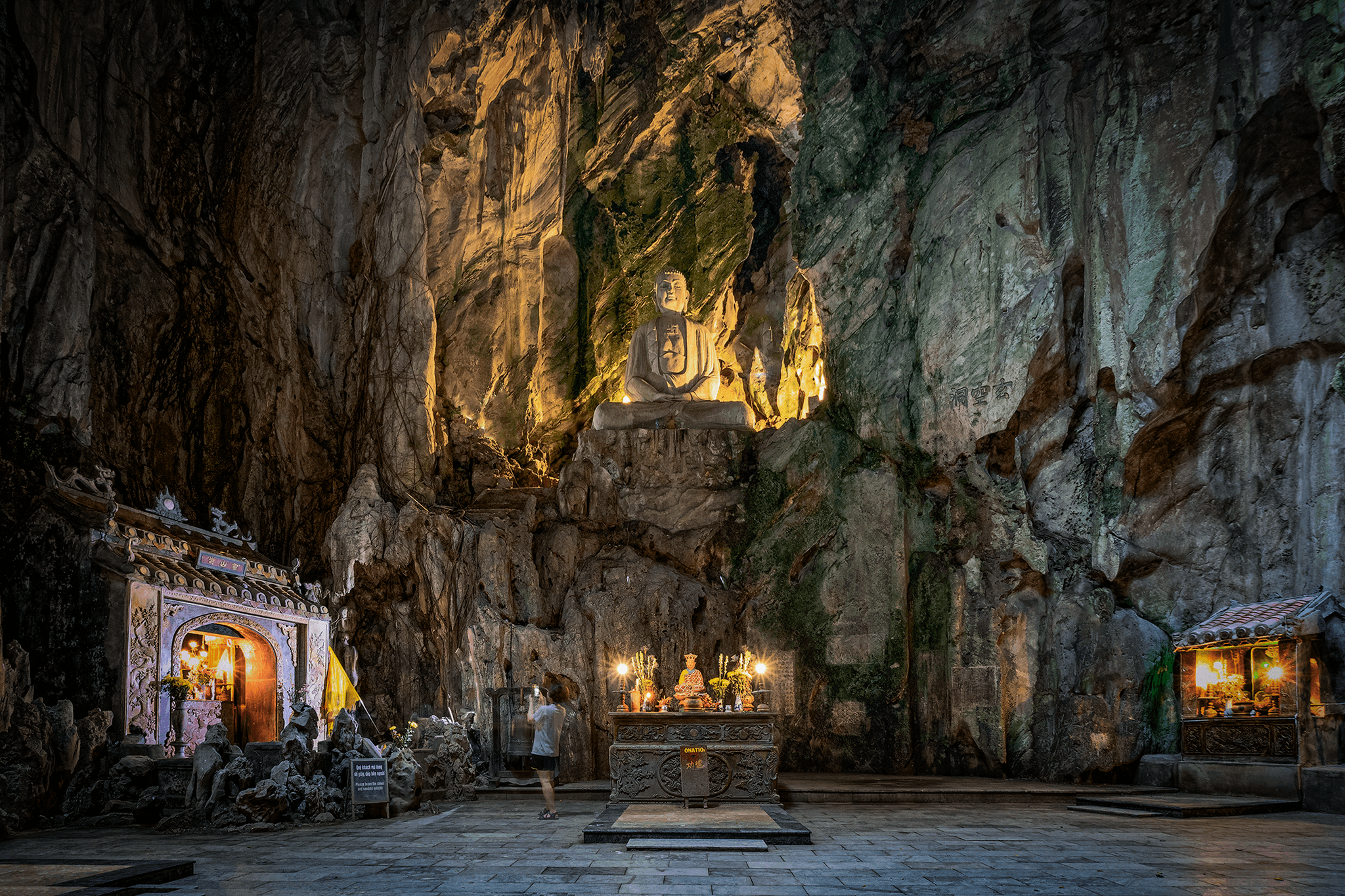
Huyền Không Cave in Ngũ Hành Sơn, Đà Nẵng, Vietnam. Image source · CC BY-SA 4.0
Visit essentials
A quick read before you go
- Duration
- A careful chamber visit need not be long, but it should allow eyes and footing to adjust.
- Access
- The strong Places match identifies Huyền Không Cave; recheck mountain entry and cave…
Overview
Descending from exposed mountain light changes the senses: the air cools, sound reverberates, and roof openings move pools of brightness across the chamber. Buddhist images and altars direct this natural drama toward worship, but the cave is not sacred merely because it is dark or resonant; people assigned devotional use to this geological form. Moisture, worn steps, and fragile surfaces make protection inseparable from reverence. Visitors may personally experience silence or intensity.
The supported claim is that Buddhist practice and memorial use made this named chamber more than an empty scenic cavern.
Why this place is sacred
The roof openings are important because they prevent the cave from becoming a sealed underground room. Sunlight shifts, echoes lengthen, and weather remains perceptible. Altars answer those conditions without erasing them. The result can feel liminal, yet no energy mechanism is established. Sacredness is better located in the continuing relationship between landform, images, offerings, and people who approach the cave with Buddhist intentions.
The cavern is natural; its sacred purpose developed through the establishment and use of Buddhist altars.
Devotion, historical memory, tourism, and cave conservation now occupy the same chamber.
Experience and orientation
Allow your eyes to settle after descent. Look up at the openings, then trace where the light falls in relation to the images and floor. Sound travels, so a quiet conversation can fill the chamber. Give anyone praying a wide margin and avoid stepping backward while photographing. Touching damp rock or placing objects in crevices damages a system that appears durable but is easily marked.
Use the authorized stair, identify the public floor and altar boundaries, and note the exit before lingering.
Context and lineage
The research securely identifies this specific chamber and its Buddhist use. It does not resolve every wartime, miracle, or naming story attached to the wider mountains. Accounts about other caves must not be transferred here. The site has no stand-alone UNESCO World Heritage inscription; its classification is a sacred cave with mixed devotional and heritage activity.
Vietnamese Mahayana Buddhism interprets the altars, while the cave itself remains a natural formation.
Buddhas and bodhisattvas honored in the cave shrines
devotional figures within the chamber
Traditions and practice
Visitors may encounter incense, bows, offerings, or quiet recitation at the altars. Participate only where permitted and never improvise candles or flames in the chamber. A non-Buddhist visitor can stand silently and observe how light, image, and bodily descent shape attention.
Buddhist devotion, memorial visitation, guided tourism, and geological protection continue together.
Watch one patch of daylight move across stone without blocking the route or altar.
Vietnamese Mahayana Buddhism
ActiveBuddhist altars make the naturally lit chamber a place of prayer within the Marble Mountains.
Bows, incense, offerings, recitation, and quiet memorial acts occur within cave-safety limits.
Perspectives and open questions
Karst geology, Buddhist altar practice, wartime memory, sensory response, and conservation must remain distinguishable.
Scholarly perspective
A cave's physical effects can be described without treating them as religious proof. Temperature, echo, and illumination help explain experience; the documented placement and use of altars explain sacred identity. Combining those records is stronger than romanticizing darkness.
Living and traditional perspectives
Buddhist images and acts give the chamber a devotional order that visitors should recognize before interpreting the geology personally.
Open questions
No hidden portal, healing force, or uniform transformation has been independently verified.
Plan your visit
Access and arrival
The strong Places match identifies Huyền Không Cave; recheck mountain entry and cave restrictions on the day.
Use licensed lodging in the Đà Nẵng area.
Respectful visit
Wear modest clothing and shoes with grip for damp, uneven steps.
Check current flash rules and never photograph across an active altar.
Only designated altar areas may receive custodian-approved offerings.
Closed passages, ledges, rock surfaces, and conservation barriers are firm limits.
Do not claim that acoustics, moisture, or light prove a supernatural portal.
Current practical details
Address
2736+PR8, Ngu Hanh Son, Da Nang 550000, Vietnam
Hours, fees, and access can change — verify on the official source before you travel. Practical details last checked Jul 2026.
Location
Map loads as you approach this section.
Pilgrim reflections
A portrait of encounter, not a score
Pilgrims describe what they felt, how present they could become, and whether the place would shape a journey. There are no stars and no ranking of traditions.
No reviewed reflections yet
The first pilgrims can help describe the character of being here.
Share a reflection
Available after an account-backed “Been there.” Every reflection is reviewed before publication.
Nearby sacred places
Explore other sacred places in the region. Proximity does not establish access or travel time; check each place’s guidance.
References
Sources consulted for this page. Source categories describe the publication, not a guarantee that every claim is verified. Traditional accounts and outside interpretations may differ.
- 01Official heritage or tourism context for Huyền Không Cave — Vietnam National Authority of Tourism or responsible heritage authorityofficialSupports the site's physical, cultural, religious, or visitor context.
- 02Marble Mountains — Da Nang Tourism Promotion CenterofficialOfficial identity and visitor context for the Marble Mountains cave landscape.
- 03Ma Nhai stone epitaphs at the Marble Mountains — Da Nang Tourism Promotion CenterofficialOfficial source for the inscriptional and devotional context.
- 04Vietnamese-language reference search for Động Huyền Không — Vietnamese Wikipedia contributorsacademicDiscovery reference only; unsupported details were not promoted into factual prose.
- 05Google Maps listing for Huyền Không Cave — Google MapsSource contextUsed only for strong-match coordinates and practical fields.
Share a photo
Help visitors recognize Huyền Không Cave. Every submission is reviewed before publication.