Guinsa Temple
A modern Buddhist headquarters climbing a narrow mountain valley
Understand sacred places, explore living traditions, and learn how to engage respectfully with Pilgrim Map.
Access has not been verified. Check current local guidance before planning a visit.
Danyang-gun, Chungcheongbuk-do, South Korea
Read the sources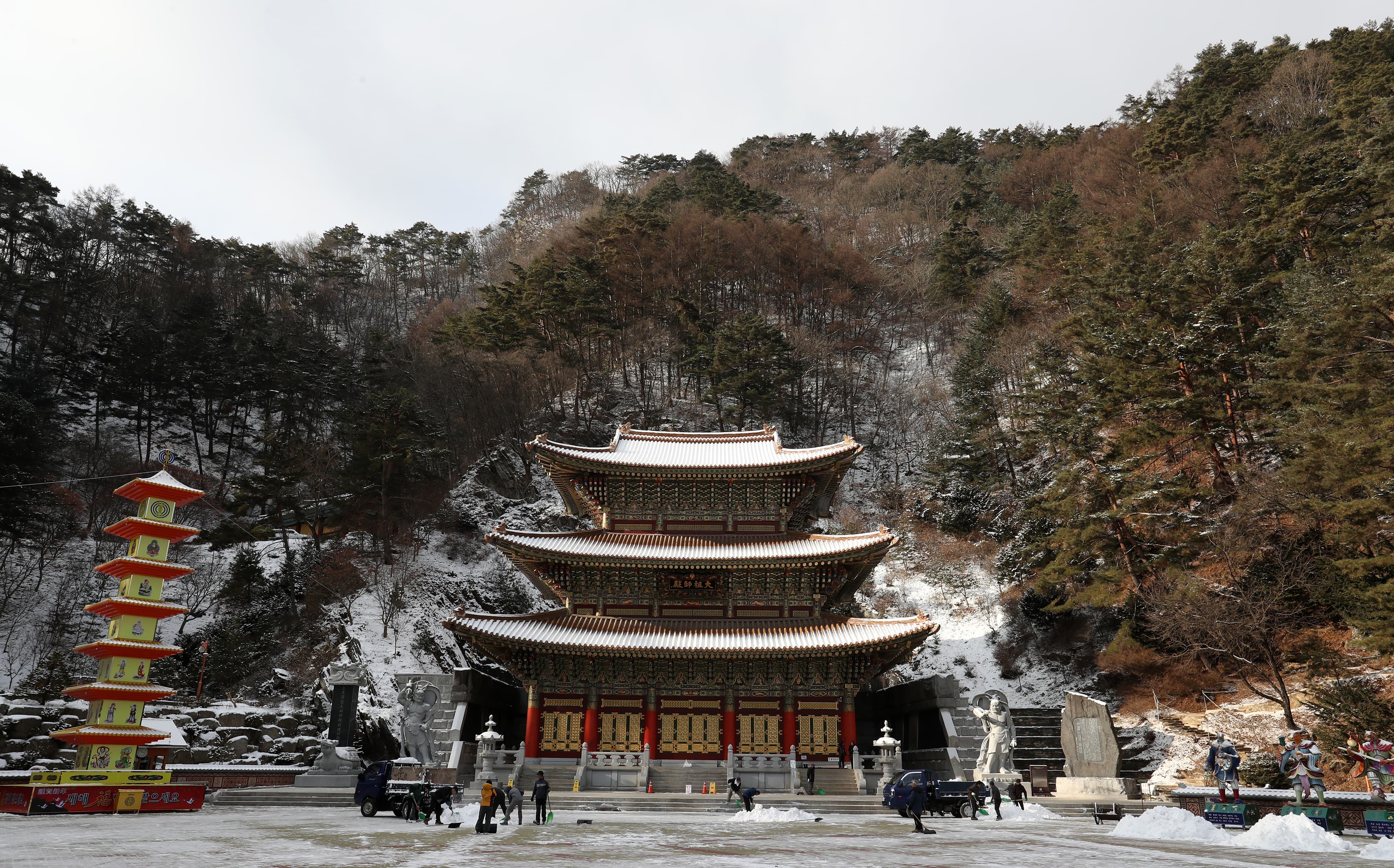
Guinsa Temple in Danyang, North Chungcheong, South Korea. Image source · CC BY-SA 2.0
Visit essentials
A quick read before you go
- Duration
- Allow at least two hours for the steep public route without a program.
- Access
- Google and KTO agree on the address and +82-43-423-7100.
Overview
Guinsa's upward route reveals institutional life: a narrow valley crowds buildings together, and stairs connect public halls with working monastery spaces. KTO notes the Great Dharma Hall and a monument inscribed with teachings of Sangwol Wongak, the monk who founded Guinsa and led the modern revival of Korean Cheontae Buddhism. Its twentieth-century origin is no deficit; the lineage uses modern architecture, a national network, and food for large gatherings to support study, repentance, chanting, and awakening.
Why this place is sacred
Guinsa’s sacred atmosphere is made through coordinated activity, not through a claim that the mountain emits unusual energy. A visitor sees supplies carried uphill, meals prepared at scale, worshippers moving between halls, and residents maintaining an unusually vertical compound. These practical actions give physical form to interdependence. Cheontae teaching emphasizes an integrated path rather than isolating study from practice, and the complex similarly refuses a simple division between spiritual and ordinary work.
The ascent can become contemplative when each landing reveals another layer of community, but tiredness and altitude are bodily facts, not proof of spiritual attainment.
Sangwol Wongak established Guinsa in 1945 as an ascetic and teaching center for the renewal of Korean Cheontae Buddhism.
A small mountain practice site grew into the order’s headquarters, with more than fifty modern buildings and responsibility for a large national network of affiliated temples.
Experience and orientation
Begin with the compression of road, stream, stairs, and roofs rather than searching immediately for one iconic façade. Notice how the Great Dharma Hall accommodates a community larger than an ordinary hermitage could hold. The monument bearing Sangwol Wongak’s teachings belongs to a living lineage memory, so approach it as more than a biographical marker.
When dining or lodging programs are operating, follow staff direction; free hospitality and monastic labor should not be mistaken for a commercial buffet or hotel service. Pause on public landings without blocking residents carrying goods uphill.
Identify the public ascent, Great Dharma Hall, founder-related memorial spaces, dining areas, residences, and restricted service routes.
Context and lineage
The documented foundation belongs to 1945, when Sangwol Wongak created a small practice place in the Sobaeksan valley. Later expansion produced the present headquarters and a network commonly described as exceeding 140 affiliated temples. Those figures should be read as current institutional context and rechecked over time. The site’s modern age does not make it spiritually secondary: its religious authority comes from the active Cheontae community, transmitted teaching, and sustained collective practice.
Guinsa is the headquarters of the Korean Cheontae Order, a modern revival of the Tiantai-derived Buddhist tradition in Korea.
Traditions and practice
Cheontae worship and study are directed by the resident order. Visitors should follow announced forms rather than inventing a mixture of practices from other Korean Buddhist lineages.
The official Templestay page offers supervised programs that may include tea, retreat, and nearby exploration; schedules and language support vary and require current confirmation.
During the ascent, choose one ordinary act of maintenance or food service and consider how institutional care supports visible ritual.
Korean Buddhism
ActiveGuinsa gives the Korean Cheontae revival an institutional, educational, and communal center.
Chanting, Dharma teaching, repentance, communal meals, memorial observance, retreat, and service.
Perspectives and open questions
Guinsa can be read through modern Korean Buddhism, institutional labor, mountain planning, and lineage renewal.
Scholarly perspective
Its twentieth-century foundation permits unusually direct study of how religious authority, architecture, and national organization were constructed together.
Living and traditional perspectives
For Cheontae practitioners, the headquarters supports an integrated path of teaching and practice under a living order.
Open questions
No prevalent paranormal or guaranteed-healing claim was established in this research.
Plan your visit
Access and arrival
Google and KTO agree on the address and +82-43-423-7100. Both list continuous opening, but individual halls, meals, vehicles, and programs follow temple schedules. Check guinsa.templestay.com.
Overnight access is limited to confirmed official Templestay arrangements.
Respectful visit
Wear modest layers and shoes suitable for prolonged steep walking.
Ask before photographing worship, residents, kitchens, dining halls, founder memorial rites, or Templestay participants.
Use only marked donation and offering points; do not leave objects on monuments.
Residential floors, kitchens, offices, teaching rooms, and service corridors require permission.
Do not romanticize unpaid labor, claim the climb purifies karma, or treat founder memorials as wish-granting objects.
Current practical details
Address
73 Guinsa-gil, Yeongchun-myeon, Danyang-gun, Chungcheongbuk-do, South Korea
Phone
Hours
Hours, fees, and access can change — verify on the official source before you travel. Practical details last checked Jul 2026.
Location
Map loads as you approach this section.
Pilgrim reflections
A portrait of encounter, not a score
Pilgrims describe what they felt, how present they could become, and whether the place would shape a journey. There are no stars and no ranking of traditions.
No reviewed reflections yet
The first pilgrims can help describe the character of being here.
Share a reflection
Available after an account-backed “Been there.” Every reflection is reviewed before publication.
Nearby sacred places
Explore other sacred places in the region. Proximity does not establish access or travel time; check each place’s guidance.


References
Sources consulted for this page. Source categories describe the publication, not a guarantee that every claim is verified. Traditional accounts and outside interpretations may differ.
- 01Guinsa Temple (Danyang) — Korea Tourism OrganizationofficialOfficial Korea Tourism Organization record for the exact Guinsa identity, address, telephone, continuous public opening, official Templestay page, activities, and visitor facilities.
- 02Guinsa — Wikipedia — Wikipedia contributorsacademicCorroborates identity, location, and general historical context; key claims require higher-tier support.
- 03Guinsa — Wikidata — Wikidata contributorsSource contextCommunity-maintained structured identity and coordinate cross-check; not treated as scholarship or an official custodian record.
- 04Guinsa Temple — Google Maps place record — GoogleSource contextStrong identity match used only for current practical fields and coordinates.
Pilgrim glossary
- Dharma
- The teachings of the Buddha; also the universal law underlying them.
Share a photo
Help visitors recognize Guinsa Temple. Every submission is reviewed before publication.