Ganesha Shrine at CentralWorld
Ganesha receives prayers for learning, art, work, and new beginnings
Understand sacred places, explore living traditions, and learn how to engage respectfully with Pilgrim Map.
Access has not been verified. Check current local guidance before planning a visit.
Bangkok, Bangkok, Thailand
Read the sources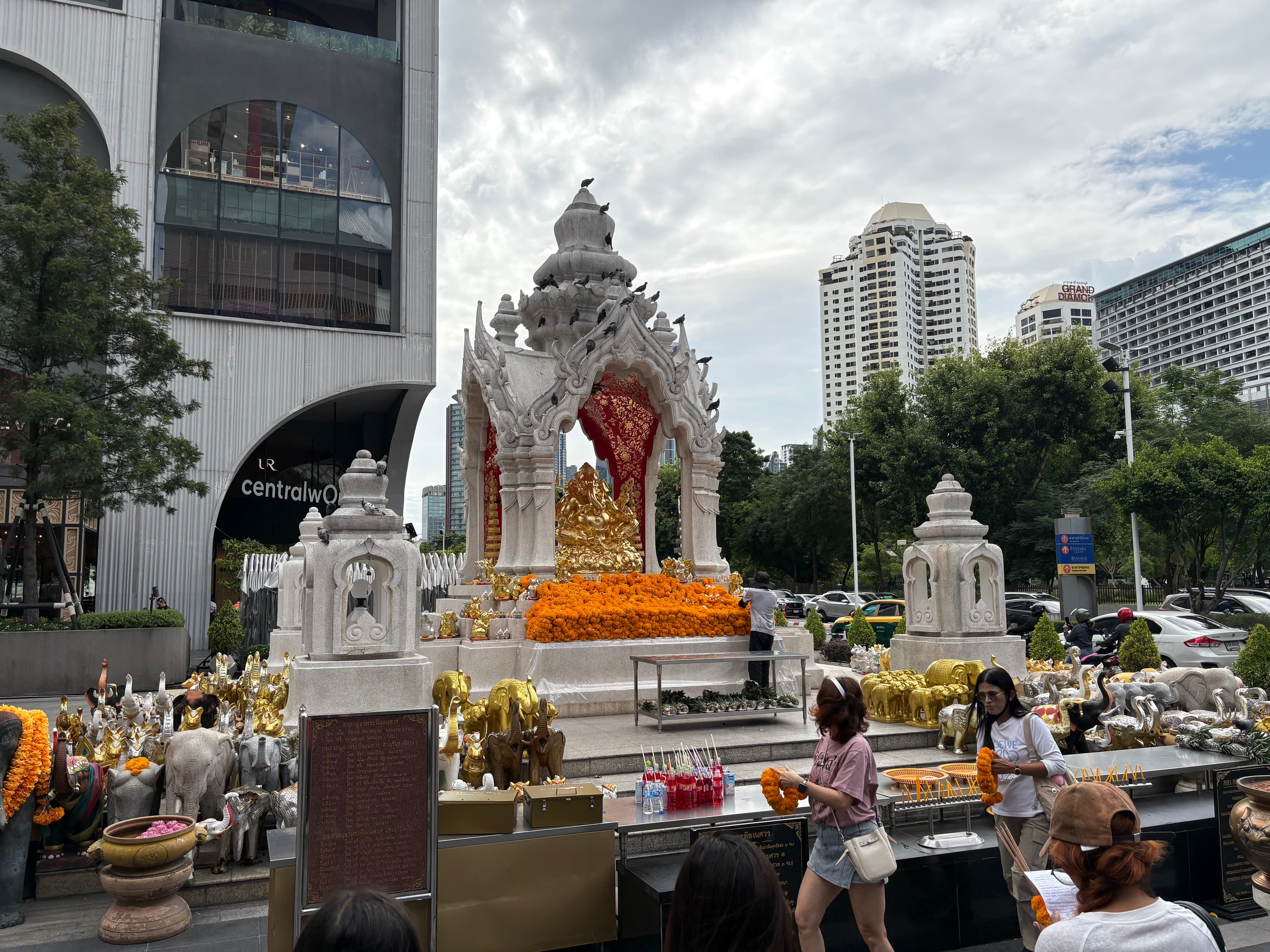
Ganesha Shrine at CentralWorld in Bangkok, Bangkok, Thailand. Image source · CC BY 4.0
Visit essentials
A quick read before you go
- Etiquette
- Protect private petitions, managed flame areas, the deity's platform, and public circulation.
Overview
At a crossing of commerce, commuting, and prayer, worshippers bring the elephant-headed Ganesha garlands and offerings before seeking help with study, creative work, business, or a difficult beginning. His broad South Asian identity as lord of thresholds becomes locally specific through Thai ritual style and Ratchaprasong's constellation of deities. More than a luck symbol, devotion acknowledges obstruction, cultivates resolve, and addresses a deity practitioners trust, without claiming worship replaces skill, planning, consent, or material support.
Why this place is sacred
A busy forecourt can concentrate attention precisely because worship occurs amid interruption. Repeated petitions and testimony have given the shrine a reputation for success in education, art, and enterprise. Tourism sources present those themes, and visitor reviews often describe fulfilled wishes. Such prevalence warrants a careful metaphysical note: users and devotees report help, but the causal claim is not independently verified.
A visitor may find the ritual psychologically clarifying or spiritually meaningful without treating favorable events as proof that every offering produces a result.
Experience and orientation
Identify the Ganesha image separately from the nearby Trimurti shrine; their petitions, iconography, and offering customs should not be merged. Follow the shrine's numbered or posted sequence where present, use managed offering points, and keep walkways open. Do not touch the deity or rearrange another person's flowers. If musicians, dancers, or groups are making offerings, observe from outside their working space. Current hours from Google Places can change, especially during shopping-centre events.
Photography should record the shrine without turning an identifiable worshipper's private request into content. Notice the implements held by the image and use an exact sign or source before assigning each one a meaning.
Context and lineage
The shrine is a modern devotional installation beside CentralWorld, not an ancient temple or archaeological remnant. The reviewed exact sources establish location, deity, and current worship but do not provide a sufficiently detailed official foundation chronology. That gap is stated rather than filled from promotional retellings. Its significance arises from active urban practice and from Ganesha's established place in Hindu and Thai religious culture. The site has no UNESCO inscription and no natural-sacred classification.
Nearby commercial ownership does not make devotion inauthentic, just as popularity does not prove supernatural effectiveness.
Traditions and practice
Common activity includes a wai, flowers, incense where permitted, and spoken or silent petitions. Visitors should learn current rules from posted signs because open flames and food offerings can be controlled differently over time. It is appropriate to ask respectfully or simply observe; it is not appropriate to market a fixed recipe for guaranteed grades, contracts, or artistic fame. Discard no packaging on the shrine platform, and never obstruct devotees while filming.
A useful contemplative frame is to name the obstacle honestly and pair prayer with responsible action.
Hindu and Thai popular devotion
ActiveHindu and Thai popular devotion approaches Ganesha as lord of beginnings and remover of obstacles.
Perspectives and open questions
Hindu theology, Thai reception, artistic patronage, urban practice, and testimonials remain distinct.
Scholarly perspective
Hindu traditions recognize Ganesha through many theologies and stories, while Thai popular devotion gives the CentralWorld shrine a distinctive public role. Artists and students may treat the deity as patron; business visitors may emphasize auspicious beginnings. Urban religion scholarship attends to how sacred practice persists in commercial environments. Testimonials speak in the first person about help received.
The page preserves those voices only as reports and states the evidentiary limit: success, obstacle removal, and blessing are religious interpretations, not predictable services.
Plan your visit
Strong Places identifies the exact shrine and reports continuous access; event restrictions can supersede it.
Respectful visit
Protect private petitions, managed flame areas, the deity's platform, and public circulation.
Current practical details
Address
2978 Rama I Rd, Khwaeng Pathum Wan, Pathum Wan, Krung Thep Maha Nakhon 10330, Thailand
Hours
Hours, fees, and access can change — verify on the official source before you travel. Practical details last checked Jul 2026.
Location
Map loads as you approach this section.
Pilgrim reflections
A portrait of encounter, not a score
Pilgrims describe what they felt, how present they could become, and whether the place would shape a journey. There are no stars and no ranking of traditions.
No reviewed reflections yet
The first pilgrims can help describe the character of being here.
Share a reflection
Available after an account-backed “Been there.” Every reflection is reviewed before publication.
Nearby sacred places
Explore other sacred places in the region. Proximity does not establish access or travel time; check each place’s guidance.

References
Sources consulted for this page. Source categories describe the publication, not a guarantee that every claim is verified. Traditional accounts and outside interpretations may differ.
- 01Trimurti Shrine and Ganesha Shrine — Tourism Authority of Thailand, JapanofficialExact identity, location, paired-shrine context, and living worship.
- 02Spiritual places to visit for blessing in 2025 — Tourism Authority of ThailandofficialExact Ganesha shrine and current worship-point context; blessing language treated as devotion, not proof.
- 03Ganesha Shrine at CentralWorld — Google Maps — Google PlacesSource contextStrong name, country, locality, and type match; used only for identity and practical visitor fields.
Share a photo
Help visitors recognize Ganesha Shrine at CentralWorld. Every submission is reviewed before publication.