Wat Mangkon Kamalawat
Bangkok's Chinese sangha gathers many devotional worlds beneath one roof
Understand sacred places, explore living traditions, and learn how to engage respectfully with Pilgrim Map.
Access has not been verified. Check current local guidance before planning a visit.
Bangkok, Bangkok, Thailand
Read the sources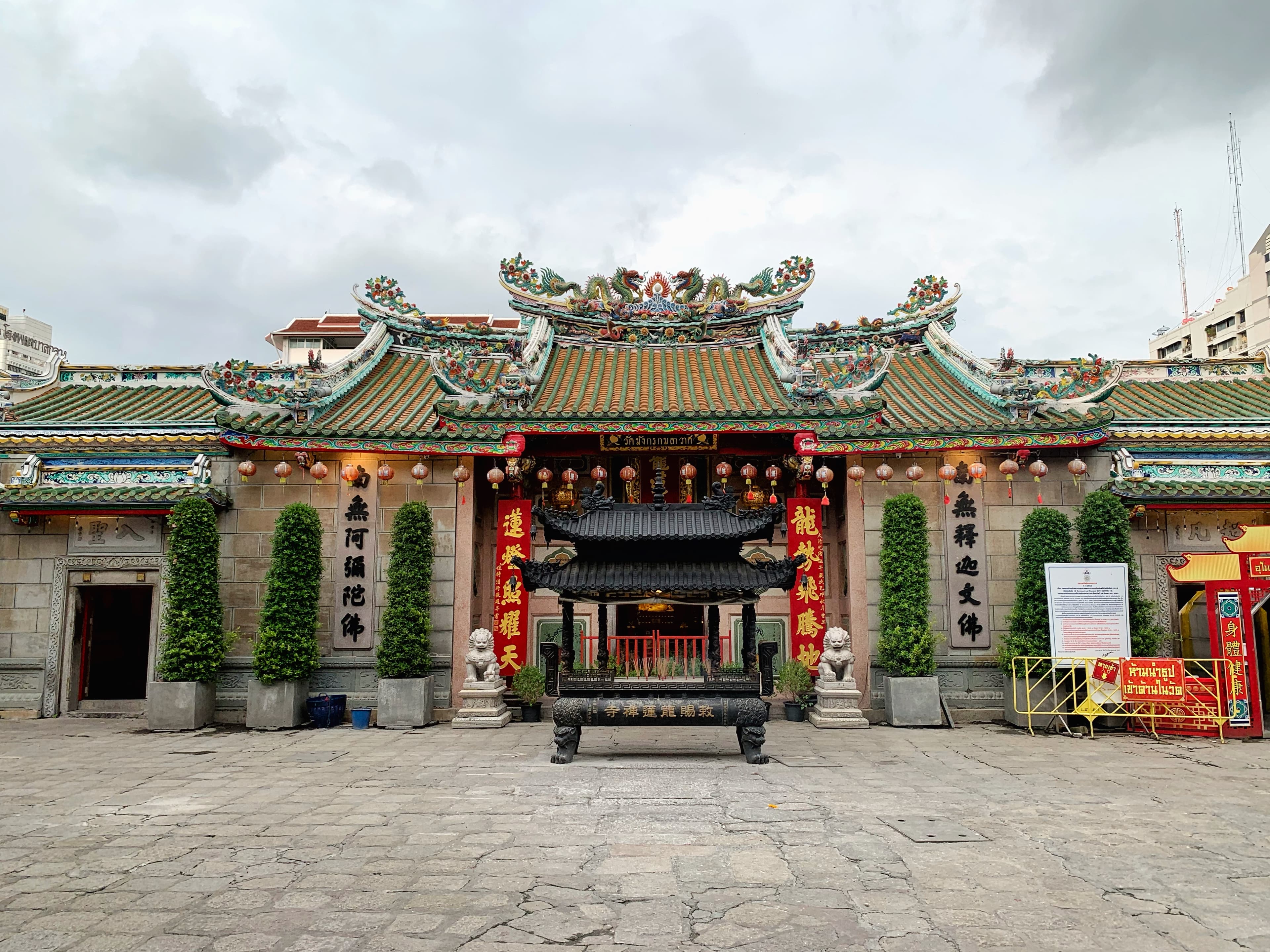
Wat Mangkon Kamalawat in Bangkok, Bangkok, Thailand. Image source · CC BY-SA 4.0
Visit essentials
A quick read before you go
- Etiquette
- Follow the altar order visible on site, keep smoke and offering lanes clear, and never imitate…
Overview
The threshold opens from Chinatown's compressed streets into a layered field of red columns, incense smoke, hanging lamps, guardian figures, Buddhas, bodhisattvas, and deities. Wat Mangkon Kamalawat serves the Chinese sangha in Thailand and supports a ritual calendar closely tied to Bangkok's Chinese communities. The monastery is Mahayana Buddhist, while its devotional life also includes figures and practices familiar from Chinese popular religion. That combination is not confusion.
Altars address different relationships: awakening, compassion, protection, health, ancestors, fortune, and communal renewal. Chinese New Year and the vegetarian festival intensify public activity, but daily prayer and monastic life remain the quieter foundation. A visitor enters a religious ecology whose internal order deserves attention.
Why this place is sacred
Multiplicity gives Wat Mangkon its sacred character. An outsider may search for one main deity, yet the temple's meaning is distributed across a community of revered figures and ritual responsibilities. Guanyin expresses compassion; Maitreya points toward a future Buddha; protectors and other deities occupy their own places; ancestors and family concerns enter through offerings and prayer. Tourism material often emphasizes luck, prosperity, or averting misfortune.
Those hopes are genuine parts of popular devotion, but they should not be turned into guarantees. The deeper pattern is relational: people return at calendrical transitions, bring concerns shaped by family and work, and place them within inherited forms supervised by a living monastery.
Experience and orientation
Pause just inside before joining the clockwise or locally indicated flow. Identify incense points, altar approaches, monastic areas, and exit routes; festival crowds can make these functions hard to distinguish. Do not wave burning incense near other people or place it outside prepared burners. At each altar, watch what regular devotees do without copying every gesture. Photography can intrude quickly in a confined hall, especially when families are praying.
During Chinese New Year or vegetarian observance, allow extra time and expect temporary one-way circulation. The site becomes intelligible through sequence, not through collecting close-ups of every figure.
Context and lineage
Wat Mangkon Kamalawat emerged from Bangkok's nineteenth-century Chinese Buddhist community and became the central seat of the Chinese sangha in Thailand. Sources associate its formal establishment with 1871 and preserve its earlier name, Wat Leng Noei Yi. Royal recognition placed the monastery within Thailand's religious administration while its architecture, liturgy, imagery, and festivals retained Chinese forms. Growth in Bangkok's Chinatown expanded the temple's communal role.
Restoration and dense urban development changed the physical setting, but the monastery continues to anchor Chinese New Year observances, the vegetarian festival, rites intended to avert bad fortune, and ordinary devotion. Exact founding details vary across summaries, so the page keeps the chronology broad rather than pretending all accounts agree.
Traditions and practice
Devotees light incense, bow, present flowers or food where accepted, chant, make donations, honor bodhisattvas and deities, and perform rites connected to the lunar calendar. Some come seeking help with business, health, family, or an unfavorable zodiac year. These aims should be reported as devotional hopes, not as verified outcomes. Guests may offer a simple bow and follow the marked altar sequence, but should not improvise paper burning or place food without guidance. Monastic ceremonies take priority.
During crowded festivals, participation also means practical courtesy: keep passages open, manage flame carefully, and avoid filming people at close range.
Theravada Buddhism
ActiveChinese Mahayana Buddhism connects the temple's Buddhas, bodhisattvas, protective figures, offerings, and festival calendar.
Perspectives and open questions
Chinese Buddhist, bodhisattva, and deity devotion should retain its own vocabulary instead of being recast as generic Thai temple practice.
Scholarly perspective
Mahayana Buddhist interpretation begins with Buddhas, bodhisattvas, compassion, merit, and monastic teaching. Chinese popular practice adds protective and prosperity-oriented relationships without becoming a separate attraction layered on top. Diaspora history reads the temple as an institution through which Bangkok's Chinese communities sustained language, calendar, identity, and mutual support. State history notes its place within Thailand's officially recognized Chinese sangha.
Popular media often calls it a power spot for wishes; the prevalence of blessing language shows what many devotees seek, not that outcomes are independently verified. Respectful writing can acknowledge those claims while locating them within practice and refusing to advertise certainty.
Plan your visit
Lunar New Year and vegetarian-festival periods can transform circulation in both the temple and surrounding Chinatown streets.
Respectful visit
Follow the altar order visible on site, keep smoke and offering lanes clear, and never imitate divination casually.
Current practical details
Address
423 ถ. เจริญกรุง Khwaeng Pom Prap, Khet Pom Prap Sattru Phai, Krung Thep Maha Nakhon 10100, Thailand
Phone
Hours
Hours, fees, and access can change — verify on the official source before you travel. Practical details last checked Jul 2026.
Location
Map loads as you approach this section.
Pilgrim reflections
A portrait of encounter, not a score
Pilgrims describe what they felt, how present they could become, and whether the place would shape a journey. There are no stars and no ranking of traditions.
No reviewed reflections yet
The first pilgrims can help describe the character of being here.
Share a reflection
Available after an account-backed “Been there.” Every reflection is reviewed before publication.
Nearby sacred places
Explore other sacred places in the region. Proximity does not establish access or travel time; check each place’s guidance.



References
Sources consulted for this page. Source categories describe the publication, not a guarantee that every claim is verified. Traditional accounts and outside interpretations may differ.
- 01Bangkok — official destination overview — Tourism Authority of ThailandofficialOfficial overview identifying Bangkok's principal religious and historical sites.
- 02Three temples across three provinces on the Dragon Path — Royal Thai GovernmentofficialOfficial account of Wat Mangkon's Chinese Mahayana identity, 1871 status, deities, access, and living blessing practices.
- 03Wat Mangkon Kamalawat — Wikipedia — Wikipedia contributorsacademicCorroborates identity, location, and basic historical context; key claims require higher-tier corroboration.
- 04Q2242870 — Wikidata — Wikidata contributorsacademicStructured identity and coordinate corroboration; not used alone for spiritual or historical claims.
- 05Wat Mangkon Kamalawat (Wat Leng Noei Yi) — Google Maps — Google PlacesSource contextStrong name, country, locality, and coordinate match; used only for practical visitor data and identity corroboration.
Pilgrim glossary
- Sangha
- The community of Buddhist practitioners, traditionally monks and nuns.
Share a photo
Help visitors recognize Wat Mangkon Kamalawat. Every submission is reviewed before publication.