Erawan Shrine
Four-faced Brahma receives vows, flowers, and dance at a city crossroads
Understand sacred places, explore living traditions, and learn how to engage respectfully with Pilgrim Map.
Access has not been verified. Check current local guidance before planning a visit.
Bangkok, Bangkok, Thailand
Read the sources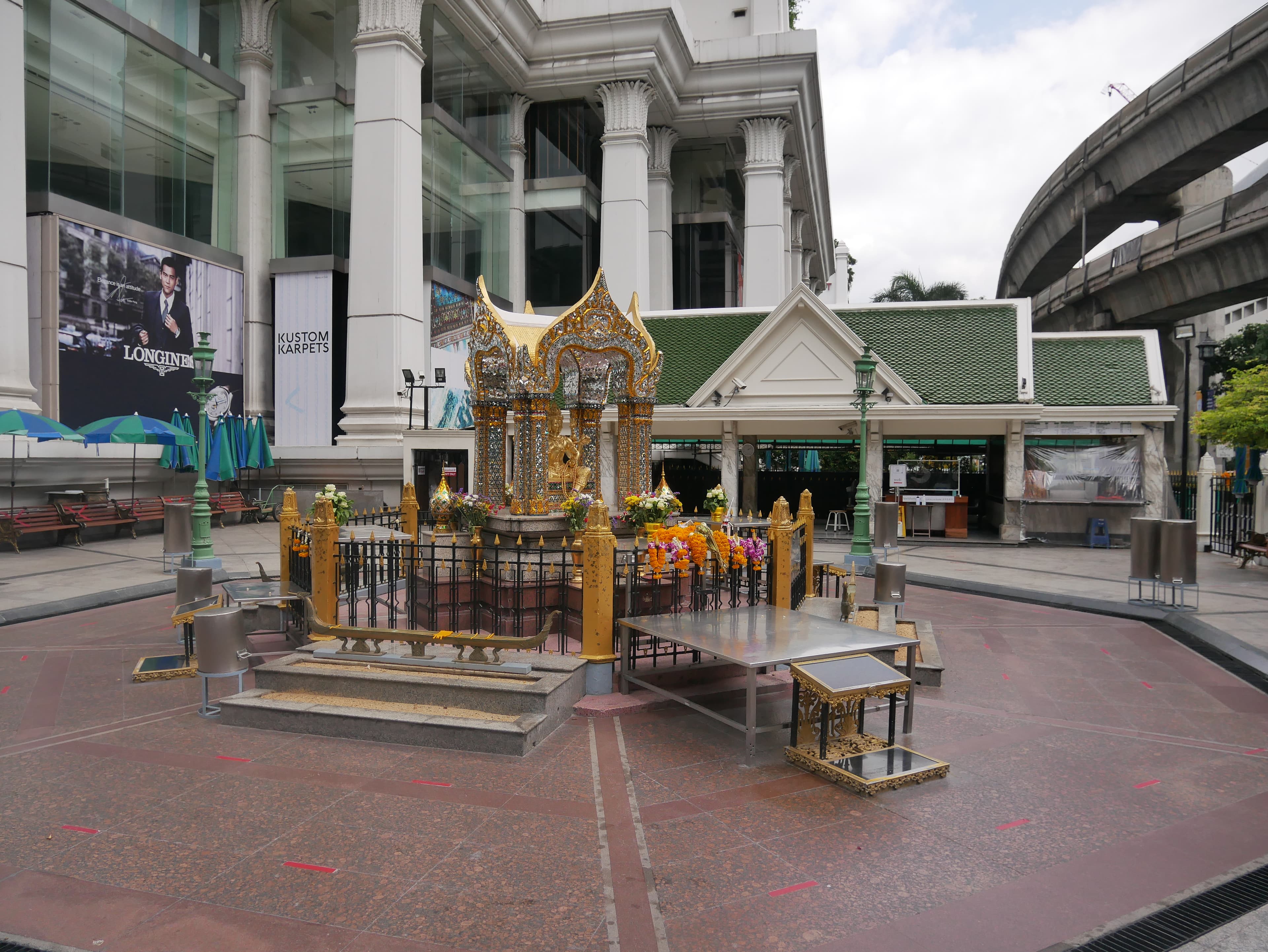
Erawan Shrine in Bangkok, Bangkok, Thailand. Image source · CC BY-SA 4.0
Visit essentials
A quick read before you go
- Etiquette
- Do not obstruct the clockwise devotional circuit or treat the dance pavilion as a free…
Overview
Thao Maha Phrom stands beneath a gilded canopy at one of central Bangkok's busiest intersections. Four faces look outward, turning worship into movement around the image rather than a single frontal approach. Offerings accumulate rapidly: garlands, incense, candles, and small figures. Nearby dancers perform traditional sequences commissioned by devotees, often in fulfillment of a vow. The shrine's scale is modest compared with a monastery, yet its devotional intensity is high.
People arrive before work, during travel, after receiving hoped-for help, or while carrying a new request. The surrounding city never disappears. Elevated trains, traffic, malls, and hotels make the act of pausing conspicuous, but not theatrical. This is living Hindu-inflected Thai devotion in public space.
Why this place is sacred
The shrine is sacred through repeated reciprocity. Devotees ask, promise, return, thank, and commission dance; the relationship is expressed materially in flowers, flame, sound, and movement. Tourism sources commonly describe different concerns addressed at the four faces. These mappings belong to popular practice and should be presented as devotional understanding, not as a verified system for obtaining career, wealth, health, or family outcomes. The shrine's history also invites caution about triumphal stories.
It originated beside a hotel project and survived violence, reconstruction, and urban transformation. Sacred continuity here does not depend on isolation from modern commerce. It depends on a community continuing to recognize the image and fulfill obligations around it.
Experience and orientation
Observe the circulation before buying anything. Devotees generally approach the four faces in an ordered direction, but current signs and attendants should guide the sequence. Carry lit incense carefully in the crowded enclosure and use only prepared holders. Do not step between a person and the face they are addressing. If dancers are performing, remember that the dance answers a devotee's vow; it is not a scheduled tourist show. Record only from a respectful distance and avoid filming worshippers closely.
Heat, smoke, noise, and dense movement can be intense, so a short attentive visit is better than blocking the narrow ritual space.
Context and lineage
The Erawan Shrine was established in the 1950s during construction of the Erawan Hotel, after advisers recommended a Brahma shrine as part of addressing difficulties associated with the project. That foundation account belongs to the documented modern history of the sanctuary, while later retellings often magnify coincidence into supernatural proof. The original hotel is gone, but worship continued. The image has been damaged and replaced, and the site was struck by a deadly bombing in 2015.
Devotees returned after mourning and repair. This history gives the shrine a gravity that should not be hidden behind blessing lists: public devotion has persisted through rupture, and present security measures form part of its custodial reality.
Traditions and practice
Common practice includes a wai, flowers, incense, candles, movement around the four faces, spoken or silent requests, and offerings of thanks. Some devotees hire the dance troupe after a vow is fulfilled. Visitors may participate through established vendors and attendants, but should not invent promises or treat dancers as props. Brahma is addressed here through Thai devotional conventions that combine Hindu identity with local ritual life.
The official source reports widespread hopes associated with each direction; this page does not certify those results. If one chooses to make an offering, the ethical emphasis is sincerity and safe conduct, not the amount spent or the complexity of the request.
Hindu devotion
ActiveThai Hindu devotion addresses four-faced Thao Maha Phrom through offerings, circumambulation, vows, and commissioned dance.
Perspectives and open questions
Claims of answered prayers are prevalent devotee testimony; they are reported as belief, never as a guaranteed supernatural result.
Scholarly perspective
Hindu interpretation identifies the image as Brahma, while Thai practice addresses him as Thao Maha Phrom within a wider religious landscape where Buddhist, Brahmanical, and spirit-oriented forms coexist. Urban history sees a modern shrine created alongside hospitality development. Performance studies attends to vow dances as reciprocal acts rather than entertainment detached from worship. Visitor accounts and official tourism writing frequently describe successful petitions.
That prevalence supports reporting that devotees claim help with worldly concerns, but the outcome remains unverified and personal. A responsible page neither mocks the claims nor markets them. It shows how a highly modern crossroads can hold disciplined, repeated relationships of request, gratitude, memory, and public care.
Plan your visit
Street noise, crowd density, smoke, and security conditions can change quickly despite the shrine's open urban setting.
Respectful visit
Do not obstruct the clockwise devotional circuit or treat the dance pavilion as a free performance stage.
Current practical details
Address
494 Thanon Ratchadamri, Khwaeng Lumphini, Pathum Wan, Krung Thep Maha Nakhon 10330, Thailand
Phone
Hours
Hours, fees, and access can change — verify on the official source before you travel. Practical details last checked Jul 2026.
Location
Map loads as you approach this section.
Pilgrim reflections
A portrait of encounter, not a score
Pilgrims describe what they felt, how present they could become, and whether the place would shape a journey. There are no stars and no ranking of traditions.
No reviewed reflections yet
The first pilgrims can help describe the character of being here.
Share a reflection
Available after an account-backed “Been there.” Every reflection is reviewed before publication.
Nearby sacred places
Explore other sacred places in the region. Proximity does not establish access or travel time; check each place’s guidance.

References
Sources consulted for this page. Source categories describe the publication, not a guarantee that every claim is verified. Traditional accounts and outside interpretations may differ.
- 01Bangkok — official destination overview — Tourism Authority of ThailandofficialOfficial overview identifying Bangkok's principal religious and historical sites.
- 02Spiritual places to visit for blessing in 2025 — Tourism Authority of ThailandofficialOfficial source for the four-faced Brahma identity, clockwise worship sequence, offering practice, and dated hours.
- 03Erawan Shrine — Wikipedia — Wikipedia contributorsacademicCorroborates identity, location, and basic historical context; key claims require higher-tier corroboration.
- 04Q1235886 — Wikidata — Wikidata contributorsacademicStructured identity and coordinate corroboration; not used alone for spiritual or historical claims.
- 05The Shrine of Erawan — Google Maps — Google PlacesSource contextStrong name, country, locality, and coordinate match; used only for practical visitor data and identity corroboration.
Share a photo
Help visitors recognize Erawan Shrine. Every submission is reviewed before publication.