Dodong Seowon
A rebuilt academy where teaching is carried east
Understand sacred places, explore living traditions, and learn how to engage respectfully with Pilgrim Map.
Access has not been verified. Check current local guidance before planning a visit.
Daegu, Daegu, South Korea
Read the sources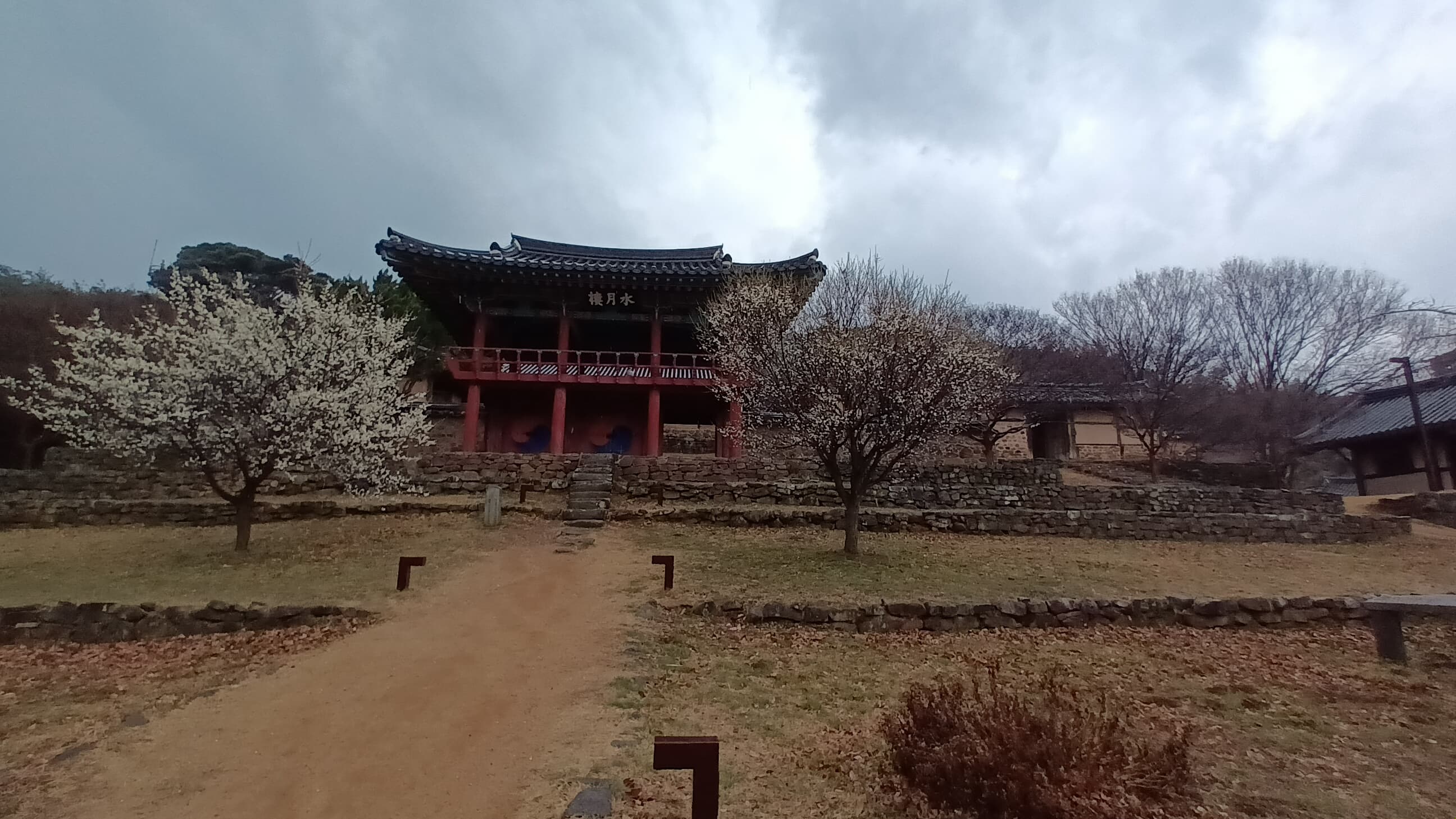
Dodong Seowon in Daegu, Dalseong County, South Korea. Image source · CC BY-SA 3.0
Visit essentials
A quick read before you go
- Duration
- Allow one hour for the academy sequence and landscape relationship.
- Access
- Google’s strong exact record lists 10:00–18:00 daily, while KTO supplies contact and heritage…
Overview
UNESCO inscribes Dodong as component 1498-006 within the nine-academy serial property. The academy's veneration of Kim Goeng-pil belongs to a Korean Neo-Confucian lineage that adapted inherited teaching rather than merely copying China. Architecture stages this work through gates, steep changes of level, lecture space, residence, and an inward shrine. Its survival of Heungseon Daewongun's nineteenth-century academy suppression added another layer of institutional memory.
Survival and World Heritage status do not freeze the precinct: timber, walls, vegetation, rites, and community authority still require maintenance.
Why this place is sacred
The idea that the Way came east can sound triumphal if separated from practice. Dodong’s history corrects that reading. Teaching passed through loss, local reconstruction, royal naming, criticism, and continued rites. A steep route can make hierarchy visible, but it does not confer virtue automatically. The ethical movement is more demanding: receive a tradition, examine it, embody it, and hand it onward without treating it as private property.
The Nakdong landscape offers distance and orientation while the shrine gives gratitude a focus. These relations are historically and ritually grounded, not evidence of a geomantic power field.
The academy was created for Neo-Confucian learning and the veneration of Kim Goeng-pil within the local sarim community.
War destruction, 1605 relocation, 1607 renaming, survival of suppression, conservation, and UNESCO inscription reshaped its public meaning.
Experience and orientation
Begin below the main complex and look for how walls, steps, and gates control what becomes visible. The lecture area opens social and intellectual space; residence buildings show that study required a daily community; the shrine withdraws ritual memory from casual circulation. Do not climb walls or squeeze around locked doors for a complete photograph. Turn back at permitted viewpoints to see how river and plain enter the academy’s outward attention.
The site’s compactness makes a slow route possible without extending the visit into private areas.
Map entrance markers, steep gates, lecture court, residences, shrine, service areas, and the Nakdong-facing landscape.
Context and lineage
KTO dates the first academy to 1568 and states that it burned during the Imjin War. Scholars rebuilt on the current site in 1605, initially using the name Borodong, before the 1607 Dodong name. The nomination materials identify Kim Goeng-pil as the principal venerated scholar and Dodong as the serial property’s sixth component. It is not independently inscribed. Its preservation through the later seowon suppression is historically significant but should not be described as uninterrupted original fabric.
Dodong belongs to the Korean sarim tradition and the intellectual lineage associated with Kim Goeng-pil.
Traditions and practice
Authorized officiants honor Kim Goeng-pil in the shrine with prescribed roles and vessels.
Heritage care and interpretation extend the academy’s teaching role while ritual access remains locally governed.
At the point where the view opens, consider what was changed—not merely preserved—when an idea entered a new place.
Korean Neo-Confucianism
ActiveDodong embodies Korea’s active transformation of Neo-Confucian learning into local education and rites.
Study, teaching, discussion, memorial ritual, offering preparation, stewardship, and landscape contemplation.
Perspectives and open questions
Dodong brings together transmission, war loss, reconstruction, ritual memory, landscape, and heritage governance.
Scholarly perspective
The 1568 predecessor and 1605 current site must remain separate phases in the architectural record.
Living and traditional perspectives
Honoring Kim Goeng-pil affirms that teaching travels through exemplary conduct and committed communities.
Open questions
The meaning of eastward transmission is philosophical and historical, not proof of an invisible force moving through the site.
Plan your visit
Access and arrival
Google’s strong exact record lists 10:00–18:00 daily, while KTO supplies contact and heritage links without a current schedule. Confirm hours with Dalseong or the site before travel.
The academy is a day visit; no on-site lodging is assumed.
Respectful visit
Wear restrained clothing and footwear stable on steep or wet steps.
Ask about shrine, interior, tablet, offering, ceremony, and conservation photography.
Do not add incense, food, coins, or paper; formal rites supply their own offerings.
Shrine interiors, tablets, ritual stores, residential rooms, walls, and conservation zones are restricted.
Do not call Kim Goeng-pil a deity, perform invented bows, handle ritual furniture, or equate physical ascent with moral superiority.
Current practical details
Address
1 Dodongseowon-ro, Guji-myeon, Dalseong-gun, Daegu, South Korea
Phone
Hours
Hours, fees, and access can change — verify on the official source before you travel. Practical details last checked Jul 2026.
Location
Map loads as you approach this section.
Pilgrim reflections
A portrait of encounter, not a score
Pilgrims describe what they felt, how present they could become, and whether the place would shape a journey. There are no stars and no ranking of traditions.
No reviewed reflections yet
The first pilgrims can help describe the character of being here.
Share a reflection
Available after an account-backed “Been there.” Every reflection is reviewed before publication.
Nearby sacred places
Explore other sacred places in the region. Proximity does not establish access or travel time; check each place’s guidance.
References
Sources consulted for this page. Source categories describe the publication, not a guarantee that every claim is verified. Traditional accounts and outside interpretations may differ.
- 01Seowon, Korean Neo-Confucian Academies — UNESCO World Heritage CentreofficialAuthoritative World Heritage property record, dossier 1498; component scope preserved.
- 02Dodong Seowon — World Heritage nomination dossier — State Party of the Republic of Korea / UNESCOofficialPrimary nomination documentation for UNESCO property 1498, including serial-component identity, mapping, and heritage context.
- 03Korean Neo-Confucian academies — Korea Tourism OrganizationofficialLive official tourism record used for site identity, heritage context, and visitor logistics; time-sensitive details require rechecking.
- 04Dodongseowon Confucian Academy [UNESCO World Heritage] — Korea Tourism OrganizationofficialOfficial tourism record for the 1568 predecessor, Imjin War destruction, 1605 rebuilding, 1607 renaming, survival of the nineteenth-century suppression, address, and contact.
- 05Dodong Seowon — Google Maps place record — GoogleSource contextStrong identity match used only for current practical fields and coordinates.
Share a photo
Help visitors recognize Dodong Seowon. Every submission is reviewed before publication.