Gatbawi Buddha
Medicine Buddha petitions on Palgongsan’s Gwanbong
Understand sacred places, explore living traditions, and learn how to engage respectfully with Pilgrim Map.
Access has not been verified. Check current local guidance before planning a visit.
Daegu, Gyeongsangbuk-do, South Korea
Read the sources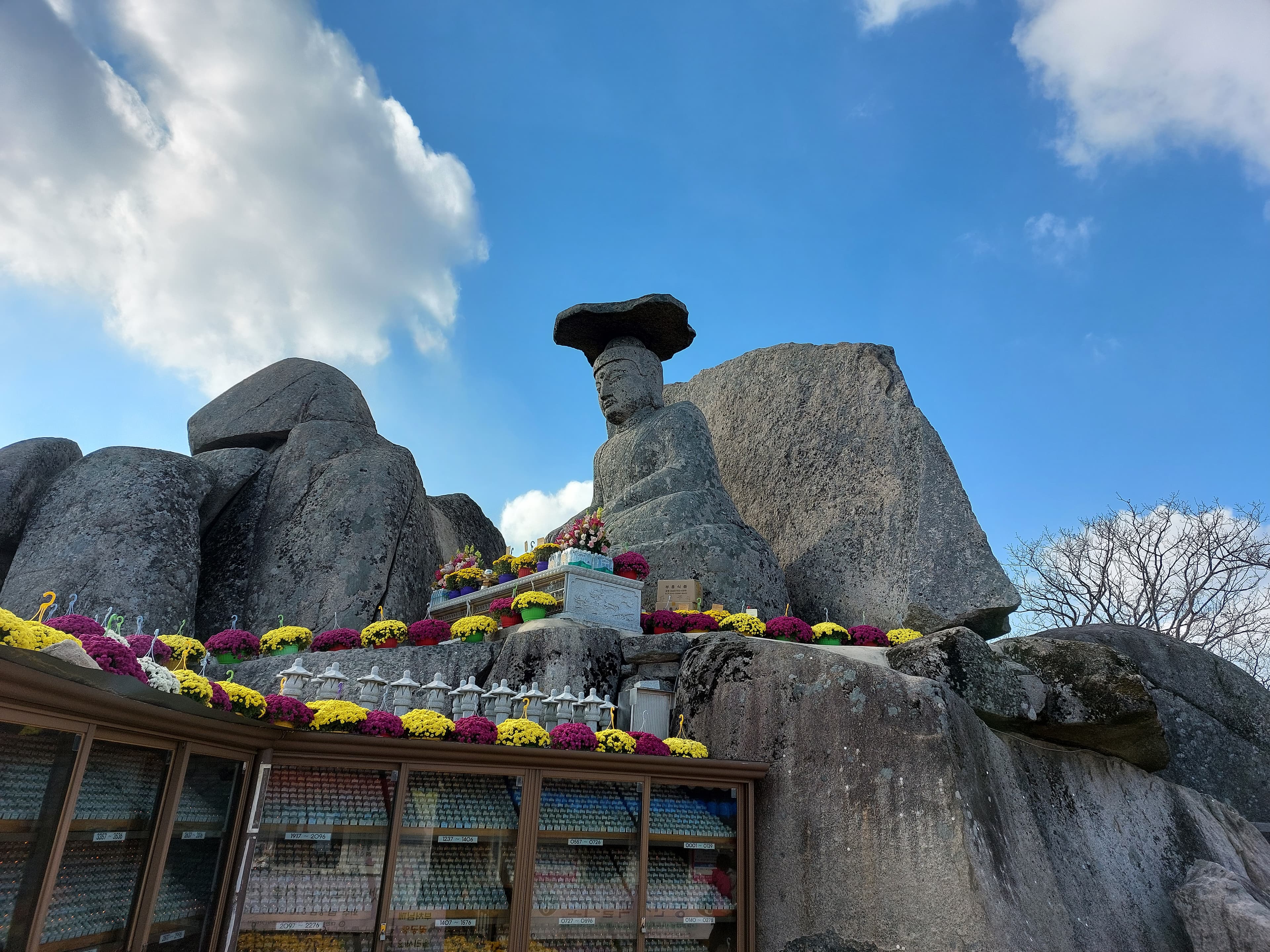
Gatbawi Buddha in Gyeongsan, North Gyeongsang, South Korea. Image source · CC BY-SA 4.0
Visit essentials
A quick read before you go
- Duration
- Allow a calm, condition-aware visit.
- Access
- Prepare for the exact route described above.
Overview
The climb joins mountain exertion to intentional prayer. Petitioners ascend toward a single exposed image, often carrying private concerns about health, family, study, or livelihood. Korea.net and Daegu’s tourism authority both document the renowned belief that sincere prayer here can fulfill one wish. This is a prevalent religious claim, not an established causal result. It is reported as community and visitor testimony and is not independently verified.
Why this place is sacred
Official sources place the heritage object at Gwanbong in Gyeongsan and identify Seonbonsa as owner and manager. Google’s exact landmark record uses a Daegu-side approach address. The discrepancy reflects a summit approached across an administrative boundary, not evidence for two statues. This page preserves the heritage service’s object identity while using Google coordinates only for current navigation. Visitors should choose an official trail and avoid treating a map label as jurisdictional authority.
Original function follows the cited authorities.
Material continuity is not presumed.
Experience and orientation
Gwanbong’s exposure shapes the encounter. Wind, cloud, ice, heat, darkness, and crowded stairs can alter the route quickly. The Buddha’s fixed posture contrasts with the effort and uncertainty of ascent, which helps explain why petitioners experience arrival as consequential. That interpretation needs no claim that the rock emits energy. The documented sacred relationship is already substantial: repeated bodily effort, focused prayer, Medicine Buddha imagery, and custodial continuity.
Use the verified public approach.
Context and lineage
At the summit, keep the devotional axis clear. Do not step between a worshipper and the image, stage prolonged portraits in prayer space, or imitate bows for a photograph. Follow barriers and never touch, lean on, or place objects against the protected carving. Offerings belong only where staff permit them. If chanting or organized prayer is underway, wait quietly at the edge and let participants finish before moving through the limited platform.
Korean Buddhism
Traditions and practice
A grounded personal practice is to formulate one concern before the final ascent, then hold it without demanding an outcome. Notice how fatigue, weather, other petitioners, and the sculpture’s stillness affect attention. The exercise can honor the site’s one-wish tradition while avoiding a promise that a request will be granted. Medicine Buddha symbolism may support prayers concerning illness, but the visit does not replace diagnosis, treatment, medication, or emergency care.
Current use remains custodian-led.
Attend quietly before drawing conclusions.
Korean Buddhism
ActiveSacred meaning follows the documented local tradition.
Practice remains governed by present custodians.
Perspectives and open questions
Several disciplines illuminate this sacred place.
Scholarly perspective
Art history, Buddhist devotion, mountain recreation, and popular petition culture overlap here without becoming interchangeable. A heritage reading asks how the sculpture was made and dated; a practitioner may understand the climb as prayer to Bhaisajyaguru; a safety officer sees an exposed trail. The one-wish narrative is culturally important because it organizes action and hope. Its outcomes remain personal reports, not independently verified evidence of supernatural intervention. The image’s popular hat-name, official heritage title, and devotional identification serve different functions.
Gatbawi helps people recognize the landmark; the heritage title locates and classifies the sculpture; Medicine Buddha names the religious relationship enacted by petitioners. Keeping all three terms prevents tourism vocabulary from replacing Buddhist meaning. It also avoids claiming that a favorable outcome validates either the sculpture’s date or the content of a prayer.
Living and traditional perspectives
Community meanings retain their own authority.
Open questions
Unsupported effects remain explicitly unverified.
Plan your visit
Access and arrival
Prepare for the exact route described above.
No lodging claim was researched.
Respectful visit
Dress for dignity and terrain.
Ask before recording people or ritual.
Use authorized channels only.
Obey every closure and barrier.
Do not invent or imitate rites.
Current practical details
Address
229 Gatbawi-ro, Dong-gu, Daegu, South Korea
Hours, fees, and access can change — verify on the official source before you travel. Practical details last checked Jul 2026.
Location
Map loads as you approach this section.
Pilgrim reflections
A portrait of encounter, not a score
Pilgrims describe what they felt, how present they could become, and whether the place would shape a journey. There are no stars and no ranking of traditions.
No reviewed reflections yet
The first pilgrims can help describe the character of being here.
Share a reflection
Available after an account-backed “Been there.” Every reflection is reviewed before publication.
Nearby sacred places
Explore other sacred places in the region. Proximity does not establish access or travel time; check each place’s guidance.

References
Sources consulted for this page. Source categories describe the publication, not a guarantee that every claim is verified. Traditional accounts and outside interpretations may differ.
- 01Stone Seated Buddha at Gwanbong Peak in Gyeongsan — Korea Heritage ServiceofficialExact Treasure record, Unified Silla dating, stone sculpture identity, and Seonbonsa ownership and management.
- 02Gatbawi — Daegu Metropolitan CityofficialOfficial interpretation identifying Medicine Buddha devotion and the widespread one-wish tradition.
- 03Gatbawi draws petitioners to Palgongsan — Korean Culture and Information ServiceofficialGovernment account of prayer, wish petitions, exam-season visits, mountain setting, and received dating.
- 04Seonbonsa Temple — Korea Tourism OrganizationofficialExact custodian-temple and access context.
- 05Gatbawi — Google Maps place record — GoogleSource contextExact strong landmark identity and approach coordinates; Google’s Daegu-side address is not used to override heritage jurisdiction.
Share a photo
Help visitors recognize Gatbawi Buddha. Every submission is reviewed before publication.