Corycian Cave
A mountain cave of Pan, nymphs, offerings, and refuge
Understand sacred places, explore living traditions, and learn how to engage respectfully with Pilgrim Map.
Access has not been verified. Check current local guidance before planning a visit.
Delphi, Mount Parnassus, Phocis, Central Greece, Greece
Read the sources
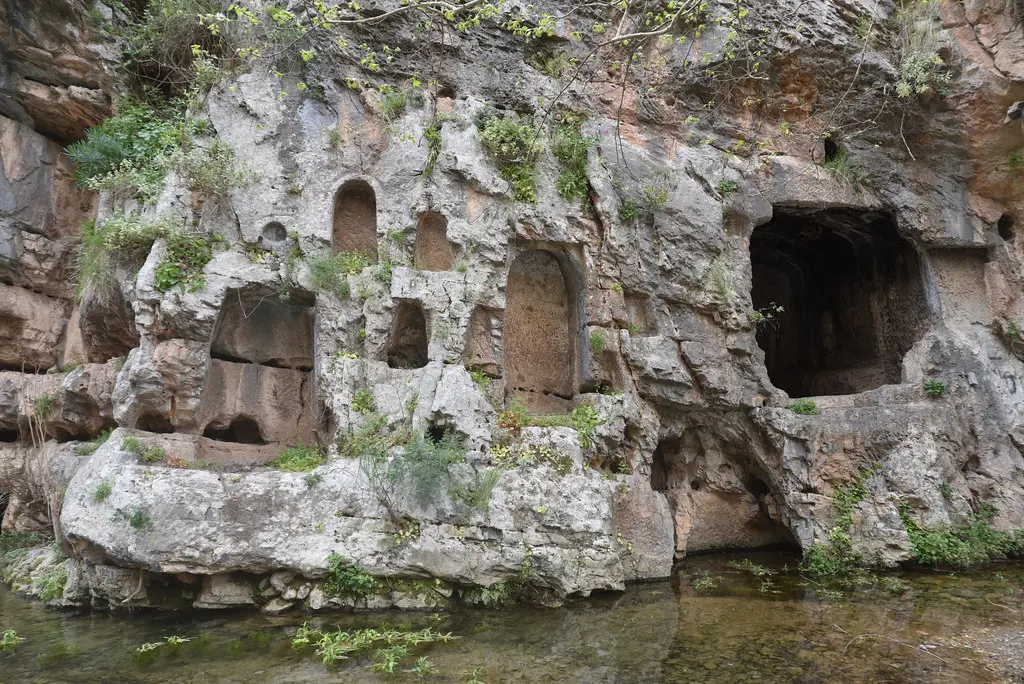
Corycian Cave in Greece. Image source · CC BY-SA 4.0
Visit essentials
A quick read before you go
- Duration
- Allow 1–2 hours at a bounded archaeological site and substantially longer for mountain…
- Access
- Reaching the cave is a mountain outing rather than a museum visit.
Overview
The cave opens high on Parnassus at roughly 1,360 metres. The official Delphi presentation describes two principal chambers, an immense first chamber, and a narrow continuation into the mountain. Archaeological work in 1970–71 recovered pottery and a very large assemblage of animal knucklebones, material that supports long use and ritual activity while leaving the precise form of every practice open to interpretation.
Ancient writers knew the cave as a sacred place and as a refuge: Herodotus connected it with the Delphians' flight during the Persian invasion, while Pausanias described the ascent and the cave's exceptional scale. An inscription at the entrance helped identify the place and attests dedication to Pan and the Nymphs.
Why this place is sacred
Knucklebones have sometimes been described as instruments of divination, but their exact use in this cave is not completely settled. The page therefore reports the assemblage and the scholarly possibility without presenting a single reconstructed rite as fact.
The cave belonged to the wider Delphic landscape without being simply another room of Apollo's sanctuary. Its principal associations are Pan and the Corycian Nymphs; later literary and religious traditions also place Dionysian movement on Parnassus. Darkness, echo, mineral forms, seasonal water, and the effort of ascent shaped ancient encounters, but modern visitors should not claim direct access to lost mysteries. Archaeological objects demonstrate use, not a complete ritual script.
Contemporary personal reflection is possible, yet it should remain clearly modern and should not include fires, food deposits, candles, graffiti, or improvised offerings.
The cave opens high on Parnassus at roughly 1,360 metres. The official Delphi presentation describes two principal chambers, an immense first chamber, and a narrow continuation into the mountain. Archaeological work in 1970–71 recovered pottery and a very large assemblage of animal knucklebones, material that supports long use and ritual activity while leaving the precise form of every practice open to interpretation.
Ancient writers knew the cave as a sacred place and as a refuge: Herodotus connected it with the Delphians' flight during the Persian invasion, while Pausanias described the ascent and the cave's exceptional scale. An inscription at the entrance helped identify the place and attests dedication to Pan and the Nymphs.
Experience and orientation
Reaching the cave is a mountain outing rather than a museum visit. Roads and paths can change with snow, storms, fire restrictions, and forestry work. The approach and entrance are uneven, and the interior quickly becomes dark, slippery, and difficult to navigate. Visit with daylight, suitable footwear, layers, water, a dependable light, and a conservative turnaround point. Do not enter alone or continue into narrow passages without local expertise.
Bats, archaeological deposits, and fragile formations must not be touched or disturbed. The cave's power does not require leaving a physical trace.
The Corycian Cave on Mount Parnassus above Delphi; it is distinct from the similarly named Corycian caves in Cilicia and from the Delphi archaeological enclosure below.
Context and lineage
Knucklebones have sometimes been described as instruments of divination, but their exact use in this cave is not completely settled. The page therefore reports the assemblage and the scholarly possibility without presenting a single reconstructed rite as fact.
The cave belonged to the wider Delphic landscape without being simply another room of Apollo's sanctuary. Its principal associations are Pan and the Corycian Nymphs; later literary and religious traditions also place Dionysian movement on Parnassus. Darkness, echo, mineral forms, seasonal water, and the effort of ascent shaped ancient encounters, but modern visitors should not claim direct access to lost mysteries. Archaeological objects demonstrate use, not a complete ritual script.
Contemporary personal reflection is possible, yet it should remain clearly modern and should not include fires, food deposits, candles, graffiti, or improvised offerings.
Pan and the Corycian Nymphs
ancient cult association
Traditions and practice
Historic practices at Corycian Cave are described from evidence and ancient testimony; they are not instructions for reenactment.
No universal contemporary devotional practice is claimed for Corycian Cave as a protected heritage place.
At Corycian Cave, walk slowly, read the site, notice landscape and material evidence, and leave no physical trace.
Ancient Greek and Roman
HistoricalThe cave belonged to the wider Delphic landscape without being simply another room of Apollo's sanctuary. Its principal associations are Pan and the Corycian Nymphs; later literary and religious traditions also place Dionysian movement on Parnassus. Darkness, echo, mineral forms, seasonal water, and the effort of ascent shaped ancient encounters, but modern visitors should not claim direct access to lost mysteries. Archaeological objects demonstrate use, not a complete ritual script. Contemporary personal reflection is possible, yet it should remain clearly modern and should not include fires, food deposits, candles, graffiti, or improvised offerings.
Historic practices are described, not recreated.
Perspectives and open questions
For Corycian Cave, three kinds of meaning should remain distinct. Archaeology documents structures, deposits, inscriptions, and changes over time. Ancient literary and cult traditions interpret the place through Pan and the Corycian Nymphs. Modern responses to Corycian Cave may include beauty, grief, inspiration, or spiritual resonance, but those responses are personal rather than proof of a recovered rite. Knucklebones have sometimes been described as instruments of divination, but their exact use in this cave is not completely settled.
The page therefore reports the assemblage and the scholarly possibility without presenting a single reconstructed rite as fact. Keeping those categories distinct protects the complexity of Corycian Cave and lets readers value uncertainty instead of filling it with spectacle.
Scholarly perspective
The cave opens high on Parnassus at roughly 1,360 metres. The official Delphi presentation describes two principal chambers, an immense first chamber, and a narrow continuation into the mountain. Archaeological work in 1970–71 recovered pottery and a very large assemblage of animal knucklebones, material that supports long use and ritual activity while leaving the precise form of every practice open to interpretation.
Ancient writers knew the cave as a sacred place and as a refuge: Herodotus connected it with the Delphians' flight during the Persian invasion, while Pausanias described the ascent and the cave's exceptional scale. An inscription at the entrance helped identify the place and attests dedication to Pan and the Nymphs.
Living and traditional perspectives
The cave belonged to the wider Delphic landscape without being simply another room of Apollo's sanctuary. Its principal associations are Pan and the Corycian Nymphs; later literary and religious traditions also place Dionysian movement on Parnassus. Darkness, echo, mineral forms, seasonal water, and the effort of ascent shaped ancient encounters, but modern visitors should not claim direct access to lost mysteries. Archaeological objects demonstrate use, not a complete ritual script.
Contemporary personal reflection is possible, yet it should remain clearly modern and should not include fires, food deposits, candles, graffiti, or improvised offerings.
Alternative interpretations
Some modern visitors interpret Corycian Cave through personal spirituality, landscape, or wellness. Readings of Corycian Cave can be meaningful when clearly identified as contemporary and when they do not overwrite evidence or custodial rules.
Open questions
Knucklebones have sometimes been described as instruments of divination, but their exact use in this cave is not completely settled. The page therefore reports the assemblage and the scholarly possibility without presenting a single reconstructed rite as fact.
Plan your visit
Access and arrival
Reaching the cave is a mountain outing rather than a museum visit. Roads and paths can change with snow, storms, fire restrictions, and forestry work. The approach and entrance are uneven, and the interior quickly becomes dark, slippery, and difficult to navigate. Visit with daylight, suitable footwear, layers, water, a dependable light, and a conservative turnaround point. Do not enter alone or continue into narrow passages without local expertise.
Bats, archaeological deposits, and fragile formations must not be touched or disturbed. The cave's power does not require leaving a physical trace.
Use established services in or near Delphi; no on-site accommodation is assumed.
Respectful visit
Wear clothing and footwear suited to weather, rough terrain, and a public heritage setting.
Follow posted rules; do not photograph people closely without consent or use drones without explicit authorization.
Leave no objects or substances. Use only official donation or ticket channels.
Barriers, locked gates, fragile surfaces, caves, conservation works, and habitat limits must be obeyed.
Knucklebones have sometimes been described as instruments of divination, but their exact use in this cave is not completely settled. The page therefore reports the assemblage and the scholarly possibility without presenting a single reconstructed rite as fact.
Location
Map loads as you approach this section.
Pilgrim reflections
A portrait of encounter, not a score
Pilgrims describe what they felt, how present they could become, and whether the place would shape a journey. There are no stars and no ranking of traditions.
No reviewed reflections yet
The first pilgrims can help describe the character of being here.
Share a reflection
Available after an account-backed “Been there.” Every reflection is reviewed before publication.
Nearby sacred places
Explore other sacred places in the region. Proximity does not establish access or travel time; check each place’s guidance.


References
Sources consulted for this page. Source categories describe the publication, not a guarantee that every claim is verified. Traditional accounts and outside interpretations may differ.
- 01Parnassus and the Corycian Cave — Archaeological Site of DelphiofficialSupports only the identity, history, sacred context, conservation, or visitor information stated by this source.
- 02Les fouilles de l'antre corycien près de Delphes — Pierre AmandryacademicSupports only the identity, history, sacred context, conservation, or visitor information stated by this source.
- 03Hiking on Mt Parnassos — Visit GreeceofficialSupports only the identity, history, sacred context, conservation, or visitor information stated by this source.
- 04Image provenance for Corycian Cave — Claire.KittridgeSource contextImage identity and reuse rights only: CC BY-SA 4.0.
- 05Corycian Cave — OnParnassosSource contextSupports only the identity, history, sacred context, conservation, or visitor information stated by this source.
- 06Corycian Cave — Wikidata contributorsSource contextSupports only the identity, history, sacred context, conservation, or visitor information stated by this source.
Share a photo
Help visitors recognize Corycian Cave. Every submission is reviewed before publication.