Delphi
Where the earth exhaled prophecy and nations came to hear what the gods would say
Understand sacred places, explore living traditions, and learn how to engage respectfully with Pilgrim Map.
Access has not been verified. Check current local guidance before planning a visit.
Municipal Unit of Delphi, Central Greece, Greece
Read the sources
Visit essentials
A quick read before you go
- Duration
- Archaeological site: 3-4 hours minimum for thorough exploration including the Stadium.
- Access
- Approximately 180 km northwest of Athens (2-3 hours by car).
Overview
Greeks understood Delphi literally as the world's center. Zeus sent eagles from creation's eastern and western ends; where they crossed over his grandmother Gaia, he placed the omphalos, the navel stone.
The site first belonged to Gaia and her serpent-guardian Python. Apollo claimed it by killing Python with arrows. Pytho was linked to the corpse's rotting; the prophetess became the Pythia and the quadrennial games Pythian, so each name recalled victory over the older earth religion.
For nearly a millennium, from the 8th century BCE to the late 4th century CE, the Pythia was the Greek world's most authoritative divine voice. Seated on a tripod in the Temple of Apollo's adyton above a vaporous chasm, she entered trance and gave prophecies shaping wars, colonies, and kings. Research confirms geological faults beneath the temple released gases that may have induced altered states—the earth itself, in ancient terms, breathing prophecy.
The oracle fell silent around 393 CE when Emperor Theodosius closed pagan sites. Though temple foundations remain, Delphi's dramatic ground between the Phaidriades, the Shining Rocks, still marks where people asked what they could not know.
Places within this site
Why this place is sacred
What made Delphi thin? The Greeks would have answered with the omphalos. If the world has a center, that center is a thin place by definition—the point from which everything radiates, the axis around which the cosmos turns. The eagles met here. The navel stone was placed here. This was the still point of the turning world.
But Delphi's thinness is older than Zeus's mythology. Before Apollo claimed the sanctuary, it belonged to Gaia, the Earth goddess. Her serpent Python guarded a chasm from which prophetic vapors rose. The site was thin because the earth opened here—literally. The Pythia sat over the fissure, breathing what the earth exhaled, and spoke what she heard.
Modern science has validated this ancient understanding. A four-year geological study found that two faults intersect directly beneath the Temple of Apollo. Analysis detected light hydrocarbon gases—possibly ethylene, possibly benzene, possibly carbon dioxide and methane—in the spring water and rock. The temple was built precisely over the fault intersection. Whatever the Pythia experienced in her trance was induced, at least in part, by what the earth released. The ancients knew: the place itself produced prophecy.
The transition from Gaia to Apollo adds another layer. Delphi is where chthonic (earth) worship gave way to celestial (sky) worship—a shift that shaped Western religion for millennia. The young god killing the ancient serpent; the sky deity claiming the earth shrine; the masculine principle taking over the feminine: Delphi marks this transition. The old power was not destroyed but incorporated. The Pythia continued to sit over the earth's exhalation. The name Pytho survived in Pythia and Pythian Games.
The serpent's death was commemorated forever.
The institutional continuity intensified the thinness. For nearly a thousand years, people came to this exact place seeking prophecy. The accumulated meaning—the countless consultations, the decisions made, the wars waged and colonies founded on Delphic words—layered the site with human significance. Delphi is thin because it is the center of the world, because the earth opens here, because old religion became new religion here, and because generation after generation came here believing they could hear the voice of the gods.
Delphi functioned as a Panhellenic sanctuary—a religious site that transcended the boundaries of individual city-states and unified the Greek world. The oracle was consulted on both private matters and affairs of state: whether to go to war, where to found colonies, which laws to enact. Four Sacred Wars were fought for control of the sanctuary. The Pythian Games, held every four years, were second in prestige only to the Olympics but originally focused on musical rather than athletic competition.
The sanctuary housed treasuries contributed by Greek city-states and accumulated vast wealth.
Inhabited since Mycenaean times (15th century BCE), Delphi became a major sanctuary when priests from Knossos brought Apollo's cult in the 8th century BCE. Peak influence came in the 6th century BCE, when the oracle's authority extended across the Greek world and beyond. The Pythian Games were reorganized and expanded around 582 BCE. Roman control brought changes but maintained the sanctuary's prestige.
The emperor Julian attempted to revive the oracle in the 4th century CE, but the Pythia reportedly delivered a final prophecy declaring the site's power exhausted. Theodosius I closed the sanctuary and destroyed the temple around 390 CE. The village of Kastri occupied the site until 1892, when excavations by the French School at Athens began revealing the ancient sanctuary. UNESCO inscription came in 1987.
Experience and orientation
The first thing you notice is the setting. Delphi clings to Mount Parnassus between two massive cliffs the Greeks called the Phaidriades—the Shining Rocks—because of how they catch the sun. Below, the valley falls away in silver-green olive groves that run to the Gulf of Corinth. The sanctuary occupies a natural amphitheater in the mountainside, terraced and ascending.
The drama of the landscape is immediate: this is not a place you stumble upon but a place you climb to, a place that requires effort to reach.
The Sacred Way begins at the site entrance and ascends through the sanctuary. This was the path ancient pilgrims walked after purifying themselves at the Castalian Spring. Along both sides stand the foundations of treasuries—small temple-like buildings where Greek city-states stored their offerings and displayed their wealth. The Treasury of the Athenians, built around 490 BCE to commemorate the victory at Marathon, has been reconstructed and shows the scale and craftsmanship of these structures.
Twenty-three treasuries once lined this path, each representing a city-state's devotion and political ambition.
The way ascends in switchbacks, each turn revealing different views of the ruins and the valley below. Monuments and statues once crowded every available space—the sanctuary was dense with dedications, a three-dimensional record of Greek piety and competition. Now mostly foundations remain, but the spatial experience persists: the path rising, the scale increasing, the temple platform drawing you upward.
The Temple of Apollo's foundation marks the sanctuary's heart. The temple visible today—columns re-erected in modern times from 4th-century BCE ruins—was the sixth or seventh built on this spot. Within it was the adyton, the innermost sanctum where no one entered except the Pythia. She sat on her tripod over the chasm, breathing the earth's exhalation, speaking in Apollo's voice.
Standing at the foundation's edge, looking down at the level where the adyton would have been, you are as close as visitors ever came to where the prophecies were spoken.
Above the temple, the Theater rises in forty-five rows of limestone seats, capacity 5,000. Built in the 4th century BCE and rebuilt by the Romans, it hosted the musical competitions that were the original heart of the Pythian Games. The view from the upper seats encompasses the entire sanctuary below and the valley beyond—olive groves, mountains, and on clear days, the glint of the distant sea.
The theater's orientation frames the landscape as backdrop to whatever was performed on the stage.
The Stadium sits highest, reached by a further climb of 300 meters. Here the athletic contests of the Pythian Games were held—running, wrestling, boxing, the pentathlon. The starting blocks are still visible, grooves cut in stone where runners braced their feet. The surrounding hillside formed natural seating for thousands of spectators. Unlike at Olympia, women were allowed to compete here. The prize was a laurel wreath, sacred to Apollo, who wore laurel as a crown.
The Archaeological Museum, located at the site entrance, houses the original sculptures and artifacts. The Charioteer of Delphi—a bronze figure of uncanny serenity and presence—is among the finest surviving Greek bronzes. The original omphalos stone, carved with a net pattern, demonstrates the care lavished on this marker of the world's center.
The museum's collection transforms understanding of the site: what stands as foundations outside once supported structures of marble and bronze, painted and gilded, dedicated by wealthy city-states competing for divine favor.
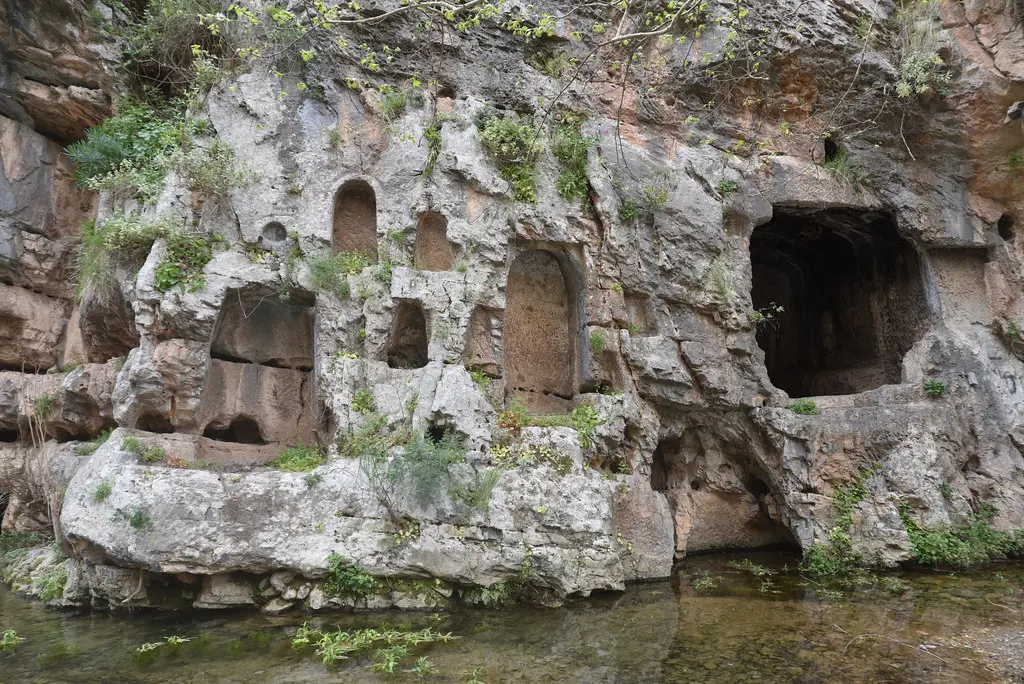
The Castalian Spring, a short walk from the main site, is where pilgrims purified themselves before consulting the oracle. The Pythia herself bathed here before descending to the adyton. The spring still flows, though the basin is now fenced for conservation. The water emerges from the cleft between the Phaidriades—the same geological feature that may have channeled the prophetic vapors.
Enter through the main gate and begin ascending the Sacred Way. Allow 3-4 hours for the archaeological site to reach the Stadium and return without rushing. The climb to the Stadium is steep; visitors with limited mobility may wish to focus on the Temple of Apollo and Theater. The museum requires 1-2 additional hours and should not be missed—see it before or after the site. The Castalian Spring is a short walk from the site entrance, past the gymnasium ruins.
Early morning offers cooler temperatures and better light on the Phaidriades. Bring water, sun protection, and comfortable walking shoes for uneven ancient paving.
Context and lineage
Two origin stories converge at Delphi. The first explains why this site is the center of the world. Zeus wished to find the center of his grandmother Gaia, the Earth. He released two eagles from the eastern and western ends of creation. Where their flight paths crossed—at Delphi—he placed the omphalos, the navel stone, marking the center forever.
The second story explains how Apollo came to rule here. The site originally belonged to Gaia and was guarded by her offspring Python, a monstrous serpent. The young god Apollo came to claim it. He pursued Python and killed the serpent with a volley of arrows—some versions say a hundred, some say a thousand. The serpent's body rotted on the spot. The site was called Pytho from pythein, 'to rot.' The priestess was named Pythia. The games were called Pythian.
Apollo's victory was commemorated in every name that survived.
Some versions say Apollo killed Python to avenge his mother Leto, whom the serpent had pursued during her pregnancy. Others say he simply wanted the oracle for himself. The transition from Gaia's serpent to Apollo's priestess represents a fundamental shift in Greek religion: from earth to sky, from feminine to masculine, from the primordial to the Olympian. Delphi marks where this transition happened.
Delphi represents the evolution of Greek religion from chthonic (earth-based) to Olympian (sky-based) worship. The site's sacredness predates its mythology: it was sacred to Gaia before Apollo arrived. The transition was commemorated but not erased—the Pythia continued to receive inspiration from the earth's exhalation; the names Pytho, Pythia, Pythian preserved the memory of the slain serpent. The sanctuary unified Greek city-states in common worship while serving as an arena for political competition through treasury dedications.
After the oracle ceased, the site's significance continued through excavation and UNESCO recognition. Modern Hellenic polytheism, recognized in Greece since 2017, considers Delphi part of living spiritual heritage.
The Pythia
Oracle priestess
Apollo
God of the sanctuary
Python
Guardian serpent of Gaia
Traditions and practice
Consulting the oracle followed a prescribed process. Pilgrims first purified themselves at the Castalian Spring, washing in the sacred water that emerged from the cleft between the Shining Rocks. They then paid consultation fees to the temple authorities—substantial amounts that funded the sanctuary's operations. Animal sacrifices preceded the consultation: the victim's behavior indicated whether Apollo was disposed to speak that day.
The Pythia prepared separately. She too purified at the Castalian Spring, then descended to the adyton, the innermost sanctum of the Temple of Apollo. This room was below ground level, accessible only to her. She seated herself on a tripod over a chasm or fissure from which vapors rose. Holding laurel branches and possibly chewing laurel leaves, she entered her trance state. Ancient sources describe her as entheos—filled with the god.
What the Pythia experienced is debated. Some ancient sources say she spoke clearly; others say she uttered 'gibberish' that priests interpreted into verse. Scientific research suggests that gases from geological faults—possibly ethylene, possibly other hydrocarbons—may have induced altered states. High priest Plutarch, who served at Delphi in the 1st-2nd centuries CE, explicitly attributed the Pythia's trance to vapors and noted that the oracle's power was waning because the vapors were depleting.
The Pythian Games, held every four years at Delphi, were second in importance only to the Olympics. Originally focused on musical competition—singing hymns to Apollo accompanied by lyre or kithara—the Games expanded to include athletic events around 582 BCE. Unlike at Olympia, women were allowed to compete in both musical and athletic contests. Victors received wreaths of laurel, sacred to Apollo, rather than the olive wreaths of Olympia. The games continued until the late 4th century CE.
No active religious ceremonies are documented at the archaeological site. Delphi functions as a protected heritage zone managed by the Greek government. Modern Hellenic polytheism was officially recognized in Greece on April 9, 2017, granting practitioners the right to worship the Olympian gods. Delphi holds particular significance as Apollo's preeminent sanctuary. However, specific ceremonial activities at the site are not documented in available sources. The archaeological nature of the site and its management may limit traditional ritual practices.
Walk the Sacred Way as pilgrims did, ascending through the treasuries to the Temple of Apollo. Stand at the temple foundation and consider what it meant to come here seeking knowledge of what you could not know. The adyton was below you, invisible and forbidden; the Pythia spoke from a place you could not enter. Climb to the Theater and sit where audiences watched musical competitions three thousand years ago.
Continue to the Stadium and stand at the starting blocks where athletes waited. At the Castalian Spring, consider the ritual purification that preceded every consultation. Let the setting work on you: the Shining Rocks above, the valley of olives below, the sanctuary between.
Ancient Greek Religion (Apollo worship)
HistoricalDelphi was the preeminent oracle of the ancient Greek world, the sanctuary where Apollo spoke through his priestess the Pythia. The site was considered the center of the world, marked by the omphalos stone. For nearly a millennium, the oracle was consulted on matters ranging from personal decisions to affairs of state. Wars, colonization expeditions, and political decisions were made based on Delphic prophecies. Four Sacred Wars were fought over control of the sanctuary. The Pythian Games, second in importance only to the Olympics, were held here every four years.
Pilgrims purified themselves at the Castalian Spring, paid consultation fees, and made animal sacrifices before consulting the oracle. The Pythia prepared separately, purifying herself and descending to the adyton, the innermost sanctum, where she sat on a tripod over a chasm from which vapors rose. In her trance state, she spoke prophecies in Apollo's name. The Pythian Games included musical competitions (originally the primary focus), athletic events, and artistic contests. Unlike at Olympia, women could compete. Victors received laurel wreaths sacred to Apollo.
Pre-Apollo Gaia Worship
HistoricalBefore Apollo's cult arrived in the 8th century BCE, Delphi was sacred to Gaia, the Earth goddess. Her serpent offspring Python guarded the oracle site. The site's original sacredness derived from chthonic (earth-based) worship, likely centered on the chasm from which prophetic vapors rose. The transition from Gaia to Apollo represents a fundamental shift in Greek religion from earth-centered to sky-centered worship—a transition commemorated but never erased in the names Pytho, Pythia, and Pythian Games.
The original practices of Gaia worship at Delphi are largely unknown. The serpent Python guarded the oracle site and was worshipped alongside Gaia. The chthonic nature of the sanctuary suggests earth-centered rituals: worship at the chasm, perhaps offerings buried rather than burned, connection to the underworld rather than the sky gods. The Pythia's practice of sitting over the chasm and receiving inspiration from the earth's exhalation may preserve elements of the older Gaia worship within Apollo's cult.
Modern Hellenic Polytheism
ActiveHellenic polytheism was officially recognized as a 'known' religion in Greece on April 9, 2017, granting practitioners the right to openly worship the Olympian gods, build temples, and perform ceremonies. Delphi, as the preeminent sanctuary of Apollo and the most famous oracle in antiquity, holds particular significance for contemporary practitioners. The site's association with Apollo's inscriptions—'Know Thyself' and 'Nothing in Excess'—continues to resonate.
Modern Hellenic polytheists practice worship centered on kharis—the reciprocal grace between humans and gods—cultivated through offerings, hymns, and ritual observances. Key organizations include YSEE (Supreme Council of Ethnikoi Hellenes) in Greece and Hellenion in the United States. Estimated practitioners number 2,000-100,000 in Greece as of 2005 estimates. Whether and how practitioners conduct specific ceremonies at Delphi is not documented in available sources. The site's status as a protected archaeological zone may limit traditional ceremonial approaches.
Perspectives and open questions
Delphi invites interpretation through multiple lenses: as archaeological site documenting a millennium of religious practice, as the center of the Greek world marked by the omphalos, as the site where earth worship became sky worship, and as a place where geology and spirituality intersected in the oracle's vapors. These perspectives layer upon each other without requiring resolution.
Scholarly perspective
Archaeologists and historians recognize Delphi as the most important oracular site of ancient Greece and essential for understanding Greek religion, politics, and culture. The oracle's influence on history was immense: wars, colonization expeditions, and political decisions were shaped by Delphic prophecies. The Pythian Games rank second only to the Olympics in importance. Scientific research has validated ancient accounts of vapor-induced trance: geological faults beneath the temple release gases that may have affected the Pythia.
Plutarch's observation that the oracle was declining because the vapors were depleting suggests awareness of the geological mechanism. UNESCO's 1987 inscription recognized the site's exceptional significance for understanding ancient Greek civilization.
Living and traditional perspectives
For ancient Greeks, Delphi was literally the center of the world—the omphalos stone marked where Zeus's eagles met. The Pythia spoke with Apollo's voice; her prophecies were divine communication, not human interpretation. The transition from Gaia to Apollo represented legitimate succession, not conquest: some myths say Gaia or Themis willingly gave the site to the young god. The Pythian Games honored Apollo's victory over Python and celebrated human excellence in music and athletics.
Modern Hellenic polytheists, officially recognized in Greece since 2017, may hold similar views of the site's continuing spiritual significance, though specific contemporary perspectives from this community regarding Delphi are not well documented.
Alternative interpretations
Some visitors experience Delphi as a place of continuing spiritual power, connecting the ancient oracle function to broader ideas about earth energies and intuitive knowing. The scientific validation of geological vapors interests those exploring connections between sacred sites and earth science—the possibility that ancient peoples built temples at places where the earth itself produced altered states. The transition from Gaia (earth goddess) to Apollo (sky god) resonates with those interested in the historical shift from goddess-centered to god-centered religion.
The omphalos as 'navel of the world' attracts those interested in axis mundi concepts and sacred geography.
Open questions
Significant mysteries remain. What exactly did the Pythia experience in her trance states? Scientific debate continues: was it ethylene, carbon dioxide, methane, benzene, or some combination? Did she speak clearly or in ecstatic 'gibberish' that priests had to interpret? How did the oracle maintain authority for nearly a millennium despite sometimes ambiguous prophecies? What was the nature of pre-Apollo worship at Delphi—what did Gaia's cult look like before the young god arrived?
Why did the oracle's power eventually wane—was it geological (depleted gas emissions), political (Roman centralization), or religious (Christian ascendance)? How should we understand the genuine historical influence of an institution that claimed divine knowledge?
Plan your visit
Access and arrival
Approximately 180 km northwest of Athens (2-3 hours by car). Public buses depart Athens Liossion station several times daily (KTEL bus service). Many visitors take organized day tours from Athens. The site is best experienced with overnight stay in nearby Arachova (10 km) or Delphi village. The archaeological site involves significant uphill walking; visitors with mobility limitations may not be able to reach the Theater and Stadium.
Arachova (10 km) is a picturesque mountain village with hotels, guesthouses, and restaurants, popular with Greeks for winter skiing. Delphi village (immediately adjacent to the site) has more modest options but the most convenient access. Athens day trips are possible but leave insufficient time for unhurried exploration. For a full experience, overnight in Arachova or Delphi village.
Respectful visit
No dress code applies. Practical, weather-appropriate clothing is essential: comfortable walking shoes with good grip for steep, uneven terrain, sun protection for exposed areas. The site involves significant climbing. Layers are useful in spring and fall when temperatures vary.
Photography is permitted throughout the archaeological site for personal use. Standard restrictions apply: no touching monuments to position shots, no climbing on structures. Flash photography is prohibited in the museum to protect artifacts. Professional photography and drone use require advance permission from the Greek Ministry of Culture.
Visitors should not leave offerings at the site. The sanctuary functions as an archaeological zone, and objects left behind complicate conservation and interpretation. This differs from the ancient practice, when the sanctuary accumulated vast offerings from pilgrims and city-states.
Stay on marked paths. Do not climb on or touch ancient structures—the stone is fragile despite its age. The site closes in late afternoon (hours vary by season). Some areas may be closed for conservation work. Do not remove anything from the site, including stones and pottery fragments.
The site involves significant uphill climbing on ancient stone paving. The ascent to the Stadium is steep and may be challenging for some visitors. Summer heat can be intense; bring water and sun protection. The site is extensive; attempting to see everything quickly leads to exhaustion rather than contemplation. Allow at least 3-4 hours for the archaeological site alone.
Current practical details
Address
Delphi 330 54, Greece
Phone
Hours
Hours, fees, and access can change — verify on the official source before you travel. Practical details last checked Jun 2026.
Location
Map loads as you approach this section.
Pilgrim reflections
A portrait of encounter, not a score
Pilgrims describe what they felt, how present they could become, and whether the place would shape a journey. There are no stars and no ranking of traditions.
No reviewed reflections yet
The first pilgrims can help describe the character of being here.
Share a reflection
Available after an account-backed “Been there.” Every reflection is reviewed before publication.
Nearby sacred places
Explore other sacred places in the region. Proximity does not establish access or travel time; check each place’s guidance.


References
Sources consulted for this page. Source categories describe the publication, not a guarantee that every claim is verified. Traditional accounts and outside interpretations may differ.
- 01Archaeological Site of Delphi - UNESCO World Heritage Centre — UNESCOofficialOfficial UNESCO listing, criteria, and significance
- 02Delphi | Greece, Oracle, History, & Facts — BritannicaencyclopediaComprehensive historical and archaeological overview
- 03Pythian Games | Olympic, Athletic & Musical — BritannicaencyclopediaDetails on the Pythian Games
- 04Delphic Oracle's Lips May Have Been Loosened by Gas Vapors — National GeographicacademicScientific research on geological vapors
- 05The Delphic Oracle: A Multidisciplinary Defense of the Gaseous Vent Theory — J.Z. de Boer et al.academicPeer-reviewed geological research on oracle vapors
- 06Admission hours & best time to visit - DelphiMuseum.gr — Delphi MuseumofficialOfficial visitor information
- 07Delphi - Wikipedia — Wikipedia contributorsencyclopediaDetailed historical information with citations
- 08Pythia - Wikipedia — Wikipedia contributorsencyclopediaDetails on the oracle priestess
- 09Pythia - World History Encyclopedia — World History EncyclopediaacademicEducational resource on the Pythia
- 10PYTHON DELPYNE - She-Dragon of Delphi — Theoi.comacademicComprehensive mythological resource
Photo gallery
8 curated photos
Share a photo
Help visitors recognize Delphi. Every submission is reviewed before publication.