Trofonion Oracle, Livadia, Greece
Ancient Greece's oracle of descent, where seekers entered the earth to receive revelation in darkness
Understand sacred places, explore living traditions, and learn how to engage respectfully with Pilgrim Map.
Access has not been verified. Check current local guidance before planning a visit.
Levadia Municipal Unit, Central Greece, Greece
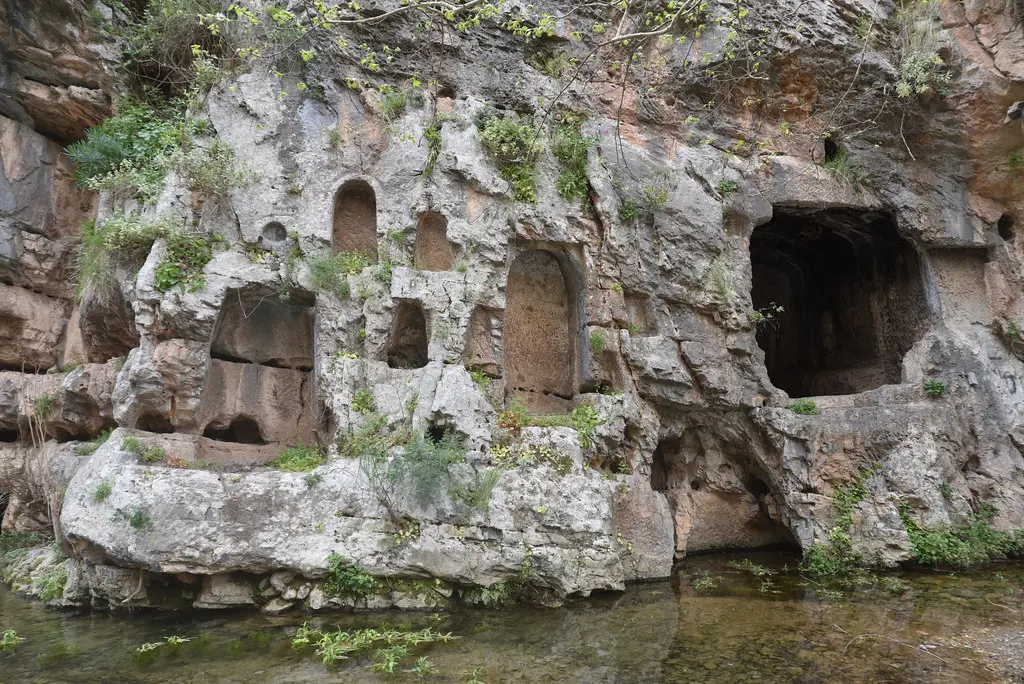
Image of Trofonion Oracle, Livadia, Greece. Image source
Visit essentials
A quick read before you go
- Duration
- One to two hours for the main oracle area along the Herkyna River, including the grottos,…
- Access
- Livadia (Livadeia) is the capital of the Boeotia regional unit in Central Greece, approximately…
Overview
The Oracle of Trophonius asked consultants not merely to listen or pray, but to descend. In the Herkyna River gorge at Lebadeia, they prepared for days through purification, sacrifice, and ritual bathing. Once omens aligned, they drank from Lethe to forget who they were and Mnemosyne to remember what they would see. They then entered a narrow earth opening feet-first, pulled downward by a force Pausanias likened to a rushing river.
Alone in total darkness and constriction, they received the oracle through sight, sound, or means that resisted later explanation.
They emerged transformed. A Greek proverb described someone profoundly and permanently changed as having consulted Trophonius: knowledge could exact an irreversible cost, held with melancholy and awe.
The underground chamber has vanished, collapsed or sealed by time. The gorge remains: clear water from limestone, shallow grottos with ancient rock-cut niches, plane trees, and a quiet missed by most visitors to Greece. Across nearly a thousand years, thousands came here with the same question the landscape still holds: what would you endure to know?
Why this place is sacred
The thinness of this place operates on an axis that runs straight down.
Most sacred sites orient the visitor toward the sky: spires, minarets, mountaintops, the upward gesture of prayer. The Oracle of Trophonius reversed this orientation entirely. The sacred was below. The passage to revelation led downward, into the earth, into darkness, into constriction. The consultant did not ascend to meet the divine. The divine drew the consultant down.
The geology made this legible before anyone built a temple or composed a ritual. The Herkyna River does not simply flow through Livadia. It emerges from the rock, rising from underground sources in the limestone, as though the earth itself is releasing something it held in reserve. The gorge narrows into shallow grottos and caves, places where the stone closes around you and the light diminishes. Water and darkness come from the same direction: from below, from inside the rock.
The ancients did not have to imagine a passage to another world. The landscape was already demonstrating one.
What makes the Oracle of Trophonius singular among Greek sacred sites is that the thinness was not merely observed or acknowledged but entered. At Delphi, the Pythia descended into a trance and spoke on behalf of Apollo. At Dodona, priests interpreted the rustling of Zeus's sacred oak. At Trophonius, you went yourself. You were washed, fasted, sacrificed, anointed. You drank waters designed to dissolve your ordinary identity and prepare your memory for what was coming.
And then you were lowered into a hole in the earth, feet-first, and the darkness took you.
The dual springs of Lethe and Mnemosyne form the conceptual architecture of the threshold. To drink from Lethe was to forget — not merely to set aside ordinary concerns but to undergo a kind of ego dissolution, a ritual erasure of the self that knew how to navigate the world above. To drink from Mnemosyne was to prepare the capacity to bring something back. The sequence is precise: first you forget who you are, then you remember what you see.
Between those two acts lies the entire passage.
Pausanias, the second-century travel writer who personally underwent the descent, described the return in terms that modern cognitive science recognizes as consistent with sensory deprivation and the disorientation of emergence from darkness. But the ancient consultants would not have used the language of neuroscience. They would have said they had been to the underworld and come back.
And the proverb that attached to them — that they were permanently changed — suggests that whatever happened in the darkness was not easily domesticated by return to ordinary life.
The site served as a chthonic oracular sanctuary where individuals could receive personal revelation by physically descending into an underground chamber. Unlike standard Greek oracles where a medium interpreted divine messages, the Oracle of Trophonius functioned as both oracular consultation and mystery initiation, combining the quest for prophetic knowledge with the transformative structure of a katabasis — a ritual descent to the underworld and return.
The oracle was already a major institution by the sixth century BC, when Croesus of Lydia tested it alongside Delphi and Dodona. It operated continuously through the Classical, Hellenistic, and Roman periods. Trophonius himself underwent a theological evolution: originally venerated as a deified hero swallowed by the earth, he was later identified as a daimon, and inscriptions along with the geographer Strabo address him as Zeus Trephonius, suggesting the cult absorbed or merged with worship of the supreme god.
A colossal Temple of Zeus Basileus, sixty meters long, was begun on the hilltop above the gorge but never completed — one of the most ambitious unfinished projects in Greek architecture. The oracle ceased to function during the Christianization of the Roman Empire in the third or fourth century AD. The sacred grove and temples fell into ruin. The underground chamber itself disappeared — collapsed, filled in, or simply lost.
Archaeological excavation in the 1960s uncovered portions of the sanctuary area, but the adyton where the descent took place has never been conclusively identified.
Experience and orientation
The site reveals itself gradually, which is appropriate for a place whose ancient rituals unfolded over days rather than hours.
Begin where the town of Livadia meets the Herkyna gorge. Follow the river upstream along Trofoniou Dios Street. The shift is immediate: the modern town recedes, and the gorge walls rise on either side, narrowing the view to water, stone, and the canopy of old plane trees. The Herkyna runs clear over a bed of pale rock, its source somewhere ahead, inside the limestone.
The first thing the landscape communicates is interiority. The gorge is not wide. The trees close overhead. The walls are close enough to touch in places. Sound changes: the noise of the town gives way to running water and birdsong. This enclosure is not incidental. The ancient sacred precinct was organized around this same quality of entering, of moving from the open world into something contained.
As you walk deeper into the gorge, the rock walls begin to show their use. Shallow grottos open in the limestone, their surfaces carved with rectangular niches that once held votive offerings. These niches are the most tangible remaining evidence of the oracle's operation — hundreds of people over hundreds of years placed objects of devotion in these walls, addressing a god who resided below their feet. The stone retains the marks of that accumulated intention.
The springs themselves are the site's emotional center. The Krya Springs, where the Herkyna emerges from the rock, have the quality that springs always have in limestone country: clarity, coldness, a sense of water arriving from somewhere beyond reach. For the ancient consultants, this was where they bathed in ritual purification before the descent. Somewhere in this area — the exact location debated, possibly lost — stood the twin springs of Lethe and Mnemosyne, the springs of Forgetting and Memory.
Whether the physical springs were distinct from the Herkyna's sources or were ritual installations within the precinct is unknown. What is known is that drinking from them was the last preparation before the descent, the final step in the dissolution of ordinary selfhood.
There is no surviving entrance to the underground chamber. The adyton where Pausanias and thousands of others were lowered into the earth has not been archaeologically identified. It may have collapsed in antiquity. It may be beneath centuries of accumulated sediment. It may be elsewhere in the gorge than the currently visible grottos suggest. This absence is not a disappointment but an intensification.
Standing in the gorge, knowing that somewhere very near this spot people chose to enter the earth in search of revelation — and that the earth has since reclaimed the passage — gives the landscape a quality of withholding that mirrors the oracle's own operations. The knowledge was always given in darkness. The site continues that tradition.
Above the gorge, on the hill of Profitis Ilias, stand the remains of the unfinished Temple of Zeus Basileus. The climb takes thirty to sixty minutes depending on the path, and the reward is a panoramic view of the Livadia valley. The temple's massive foundation, sixty meters long and twenty-three meters wide, conveys the ambition of a project that would have rivaled the great temples of Athens and Olympia.
That it was never completed adds another layer to the site's character: a place of unfulfilled intention, of something begun that the earth or history declined to let finish.
The walk from Livadia town center to the oracle site along the Herkyna gorge takes fifteen to twenty minutes. The gorge area itself can be explored in one to two hours, depending on the attention given to the grottos, niches, and springs. Add thirty to sixty minutes for the climb to the Temple of Zeus Basileus on the hilltop.
The terrain along the river is mostly walkable but uneven near the water and in the grotto areas — sturdy shoes are advisable. Several tavernas and cafes near the Krya Springs make a natural place to rest and reflect before or after exploring the site. Morning visits tend to be quieter.
Context and lineage
The mythological origins of the oracle bind architecture, betrayal, and the earth's claiming of a human being into a single narrative.
Trophonius and his brother Agamedes were legendary architects of extraordinary skill. They built the temple of Apollo at Delphi and, in some accounts, a treasury for King Hyrieus of Boeotia. In the treasury they installed a secret entrance — a removable stone that allowed them to steal from the royal hoard at will. When Agamedes was caught in a trap, Trophonius cut off his brother's head to prevent identification. Fleeing to Lebadeia, Trophonius was swallowed by the earth.
The place where the earth took him became sacred. He did not die in the ordinary sense. He passed into a state between mortal and divine, becoming the oracle's presiding daimon — a being who dwelt in the underground darkness and could communicate with those who had the courage to descend to his realm.
The oracle's discovery followed its own legend. During a severe drought, the Boeotians sent envoys to the Pythia at Delphi for guidance. She directed them to seek the oracle of Trophonius at Lebadeia. A man named Saon followed a swarm of bees into a cavern in the earth and found the oracle. The detail of the bees is telling: in Greek religious thought, bees were associated with prophecy, with the transmission of divine knowledge through natural intermediaries.
A gentler origin story attaches to the Herkyna River. A girl named Hercyna, playing with Persephone near the gorge, lost her pet goose in a cave. When she found it, a spring burst from the rock — the source of the river that would flow through the sacred grove for millennia.
The presence of Persephone in this story is significant: she was the queen of the underworld, and her appearance at the oracle's birthplace links the site to the cycle of descent and return that structured Greek understanding of death.
The Oracle of Trophonius belongs to the tradition of ancient Greek chthonic religion — the worship of powers that reside below the surface of the earth, in contrast to the sky-dwelling Olympian gods. Its closest parallels are the Necromanteion at Ephyra, where the living consulted the dead, and the Amphiareion at Oropos, another oracular healing sanctuary with a descent ritual.
But Trophonius was unique in the intensity of its requirement: the consultant entered alone, underwent a simulated death, and was responsible for carrying the revelation back to the surface. The cult occupied a liminal position between hero worship, oracular practice, and mystery initiation. Inscriptions identifying Trophonius with Zeus suggest an evolution toward theistic worship in later periods. The oracle operated from at least the sixth century BC through the third or fourth century AD.
No continuous tradition connects the ancient cult to any modern practice.
Trophonius (Trophonios)
The legendary architect-hero who was swallowed by the earth at Lebadeia and became the oracle's presiding daimon. Variously understood as a deified hero, a chthonic spirit, and an aspect of Zeus himself (inscriptions address him as Zeus Trephonius). His dual nature — human architect who passed into divine status through an act of the earth — made him unlike any other oracular deity in the Greek world.
Pausanias
The second-century AD travel writer who personally descended into the oracle and recorded the most complete ancient account of the ritual in his Description of Greece (Book 9, Chapter 39). His first-person testimony of the purification sequence, the drinking from Lethe and Mnemosyne, and the physical descent remains the primary source for understanding what the experience entailed.
Plutarch
The philosopher and priest of Delphi who recorded the vision of Timarchus at the oracle in his work De Genio Socratis (On the Sign of Socrates). Timarchus's account describes an elaborate cosmological vision of the afterlife received during the descent, providing the most detailed surviving record of the content of an oracular experience at Trophonius.
Praxiteles
The renowned fourth-century BC sculptor who created the cult statue of Trophonius for his temple in the sacred grove. Pausanias noted that the statue resembled a figure of Asclepius, the healing god, reinforcing the chthonic and therapeutic associations of the cult.
Croesus of Lydia
The wealthy king (r. c. 560-546 BC) who tested the Oracle of Trophonius alongside Delphi, Dodona, and other major Greek oracles. Recorded by Herodotus, this episode confirms the oracle's pan-Hellenic reputation and institutional prominence by the mid-sixth century BC.
Traditions and practice
The procedure for consulting the Oracle of Trophonius is the most thoroughly documented oracular ritual from ancient Greece, preserved primarily through Pausanias's first-person account.
The consultant first took up residence in a building sacred to the Good Daemon and Good Fortune, where they lived for a prescribed number of days. During this period they abstained from hot baths, bathing only in the cold waters of the Herkyna River. They sacrificed to a sequence of deities in a precise order: Cronus, Apollo, Zeus the King, Hera the Charioteer, and Demeter-Europa, who was identified as the nurse of Trophonius.
At each sacrifice the entrails were examined by priests to determine whether Trophonius was willing to receive the consultant.
On the night of the descent, a final sacrifice was performed: a ram was slaughtered over a pit sacred to Agamedes, the brother of Trophonius. Only if the entrails of this ram produced favorable signs would the descent proceed. The system had a built-in refusal mechanism. The oracle could say no.
If the signs were favorable, the consultant was washed and anointed by two thirteen-year-old boys called the Hermae, named for Hermes the psychopomp — the god who guided souls between worlds. The consultant then drank from two springs: first Lethe, the water of Forgetfulness, which erased all previous thoughts; then Mnemosyne, the water of Memory, which prepared the mind to retain what was about to be revealed.
The consultant then viewed and prayed before an ancient Daedalian statue — an archaic wooden image of venerable age — before being dressed in a linen tunic fastened with ribbons and fitted with local boots. They carried barley-cakes kneaded with honey, an offering for whatever they would encounter below.
The descent itself was through a narrow opening. Pausanias describes being drawn in feet-first by an irresistible force, as though caught in the rush of a powerful river. Inside the underground chamber, in total darkness, the oracle was received through sight and sound — the specific nature of which varied by consultant and was never fully disclosed. The return was through the same opening, again feet-first.
Upon emerging, the consultant was immediately seated on the Chair of Mnemosyne, near the entrance. Priests questioned them about what they had seen and heard, recording the account and composing the oracle. The consultant was then returned to the house of the Good Daemon, still dazed and, according to ancient sources, not yet in full possession of their faculties or capable of laughter. Recovery took time. The proverb endured.
No active worship or ritual practice takes place at the oracle site. The area functions as an open archaeological and natural site along the Herkyna River, freely accessible to visitors. The votive relief discovered in 1931 in the bed of the Herkyna — depicting a consultant being led toward the descent — is displayed at the National Archaeological Museum in Athens.
Walk the gorge slowly and alone if possible. The ancient ritual required days of preparation, and while you cannot replicate that, you can give the landscape time to work on you. At the springs, pause long enough to notice the temperature of the water and the way it appears from inside the rock. Consider the experience of the thousands who stood at these springs and drank, knowing what awaited them — the narrow opening, the darkness, the irresistible pull downward.
In the grottos, look at the carved niches and consider what it meant to leave an offering at this particular threshold: not a temple to a sky-god but a place where the earth itself was understood to open.
If you climb to the hilltop to see the unfinished Temple of Zeus Basileus, let the view reorient you. The descent ritual was about narrowing — constriction, darkness, the elimination of everything but the encounter. The hilltop is the opposite: expansion, light, the entire valley laid open. The two experiences together approximate something of the oracle's full range — the contraction of the descent and the return to the width of the world.
Ancient Greek Religion — Chthonic Oracular Cult of Trophonius
HistoricalOne of the five great oracles of ancient Greece, alongside Delphi, Dodona, Abae, and the Amphiareion. Unique among all Greek oracles in requiring the consultant to descend personally into the underground chamber rather than receiving prophecy through a mediating priestess or priest. The ritual combined elements of mystery initiation — purification, symbolic death, sensory transformation, personality change — with oracular consultation, creating a form of sacred experience found nowhere else in the ancient world.
Ancient Greek Religion — Hero Cult of Trophonius
HistoricalTrophonius was venerated as a hero who had been claimed by the earth and subsequently deified, occupying the liminal space between mortal and divine. His temple in the sacred grove contained a cult statue by Praxiteles that reportedly resembled Asclepius, linking the oracle to healing traditions. Over time, the hero cult evolved toward theistic worship, with inscriptions and the geographer Strabo identifying Trophonius as Zeus Trephonius.
Perspectives and open questions
The Oracle of Trophonius can be understood as an archaeological puzzle, a feat of ritual engineering, a proto-psychological technology, or a landscape that still withholds more than it reveals. Each lens brings forward something the others cannot reach.
Scholarly perspective
Scholarly consensus recognizes the Oracle of Trophonius as unique among Greek oracles for its requirement of personal descent by the consultant, combining oracular prophecy with the initiatory structure of mystery rites. Pausanias's first-person account, written in the second century AD, is the most detailed surviving description of any Greek oracular procedure.
The cognitive science perspective, advanced by scholars including Yulia Ustinova (Cambridge University Press), interprets the ritual's elements — fasting, darkness, constriction, sensory deprivation — as a deliberately designed technology for producing altered states of consciousness. The visions reported by consultants are consistent with what modern research identifies as effects of prolonged sensory restriction and acute physiological stress.
The archaeological identification of the exact oracle site remains contested. Excavations in the 1960s uncovered portions of the sanctuary complex near the Herkyna springs, but the underground adyton where the descent took place has never been conclusively located. Some scholars believe the original cave collapsed or was intentionally sealed in antiquity.
The relationship between Trophonius as hero, daimon, and Zeus — three identities attested in different ancient sources — suggests the cult underwent significant theological evolution over its nearly thousand-year history, possibly absorbing local hero worship into a broader framework of Zeus cult.
Living and traditional perspectives
For the people of ancient Boeotia, the Oracle of Trophonius was woven into the landscape of daily sacred life. The foundation myth of the oracle's discovery — following a swarm of bees into a cave during a drought, directed by the Pythia at Delphi — positions Trophonius as a remedy sought in crisis, a power revealed when the earth's usual generosity had withdrawn.
The hero Trophonius, swallowed by the earth after a life of exceptional craft and moral transgression, embodied the Greek understanding that the boundary between human and divine could be crossed through suffering and through the earth's own volition. In the modern town of Livadia, the oracle site has been absorbed into the civic landscape, the Herkyna gorge serving as a pleasant park and gathering place. The ancient sacred geography persists as topography even where its religious meaning has receded.
Alternative interpretations
Some modern esoteric and neo-pagan practitioners view the Oracle of Trophonius as one of the ancient world's most sophisticated consciousness technologies — a carefully engineered sequence of interventions designed to dissolve ordinary identity and open access to non-ordinary states of awareness. The dual springs of Lethe and Mnemosyne are sometimes interpreted as a proto-psychological framework for ego dissolution and memory reconstitution.
The parallels between the descent ritual and cross-cultural shamanic katabasis — the journey to the underworld as a universal motif for accessing hidden knowledge — have attracted interest from researchers in transpersonal psychology and comparative religion. The comparison between ancient accounts of the Trophonius experience and modern reports of near-death experiences is noted but remains speculative.
Open questions
The exact location of the underground adyton has never been conclusively identified, and the original cave may have collapsed, been filled in, or been sealed deliberately in antiquity. The physical mechanism that produced the irresistible force described by Pausanias — drawing the consultant into the chamber as though caught in a river — remains unexplained. Whether this was a real physical phenomenon (air pressure, rushing water), a psychological effect of the elaborate preparation, or a literary embellishment is debated.
What consultants actually perceived in the darkness — the stimulus that produced the reported visions and voices — is unknown: proposed explanations range from natural gas emissions to extreme sensory deprivation to suggestion. The unfinished Temple of Zeus Basileus, which would have been one of the largest temples in all of Greece, raises its own question: what prompted such ambition, and what prevented its completion?
The theological trajectory of Trophonius himself — from mortal architect to hero to daimon to an aspect of Zeus — represents an evolution that no surviving source explains in full.
Plan your visit
Access and arrival
Livadia (Livadeia) is the capital of the Boeotia regional unit in Central Greece, approximately 90 km northwest of Athens. By car, the drive from Athens takes 1.5 to 2 hours via the E75 national road. KTEL bus service operates from Athens (Liosion bus terminal) to Livadia on a regular schedule. From Livadia town center, the oracle site is a 15-20 minute walk east along the Herkyna River on Trofoniou Dios Street.
The gorge area is mostly walkable but terrain is uneven, especially near the grottos and along the riverbanks. Mobile phone signal is available throughout the town and gorge area. Livadia has full town services including restaurants, hotels, ATMs, and medical facilities.
Livadia is a functioning Greek provincial capital with a range of hotels and guesthouses. Accommodation options include budget to mid-range hotels in the town center, most within walking distance of the oracle site. The town is also a practical base for visiting Delphi, Osios Loukas, and Orchomenos. Restaurants and tavernas are plentiful, with several situated directly beside the Krya Springs. Livadia is not a tourist town in the manner of Delphi, and prices reflect local rather than international tourism.
Respectful visit
No dress code applies. Comfortable walking shoes are strongly recommended for the uneven gorge terrain. In summer, sun protection is important, especially for the climb to the hilltop temple. In cooler months, a light jacket is useful in the shaded gorge.
Photography is freely permitted throughout the outdoor site. The gorge, grottos, carved niches, springs, and hilltop temple remains are all accessible for documentation.
Not appropriate in the current context. Do not leave objects, flowers, or materials at the archaeological features. The carved niches in the rock walls are historical artifacts, not active devotional spaces.
Do not climb on or remove material from archaeological remains. Do not enter any cave openings or attempt to access underground spaces. Respect any fenced or restricted areas related to ongoing archaeological work. Some areas near the river may be slippery. Use standard caution near water.
The gorge terrain is uneven and can be slippery near the water. There are no accessible underground chambers to enter — do not attempt to explore any cave openings, as the geological stability of the limestone formations is uncertain. The hilltop climb to the Temple of Zeus Basileus is moderately strenuous and unshaded. Carry water and wear appropriate footwear.
Current practical details
Address
Trofoniou Dios 4, Levádhia 321 00, Greece
Hours
Hours, fees, and access can change — verify on the official source before you travel. Practical details last checked Jun 2026.
Location
Map loads as you approach this section.
Pilgrim reflections
A portrait of encounter, not a score
Pilgrims describe what they felt, how present they could become, and whether the place would shape a journey. There are no stars and no ranking of traditions.
No reviewed reflections yet
The first pilgrims can help describe the character of being here.
Share a reflection
Available after an account-backed “Been there.” Every reflection is reviewed before publication.
Nearby sacred places
Explore other sacred places in the region. Proximity does not establish access or travel time; check each place’s guidance.


Share a photo
Help visitors recognize Trofonion Oracle, Livadia, Greece. Every submission is reviewed before publication.