Cheonjeon-ri Petroglyphs
A rock face where images and names accumulated across millennia
Understand sacred places, explore living traditions, and learn how to engage respectfully with Pilgrim Map.
Access has not been verified. Check current local guidance before planning a visit.
Ulsan, Ulsan, South Korea
Read the sources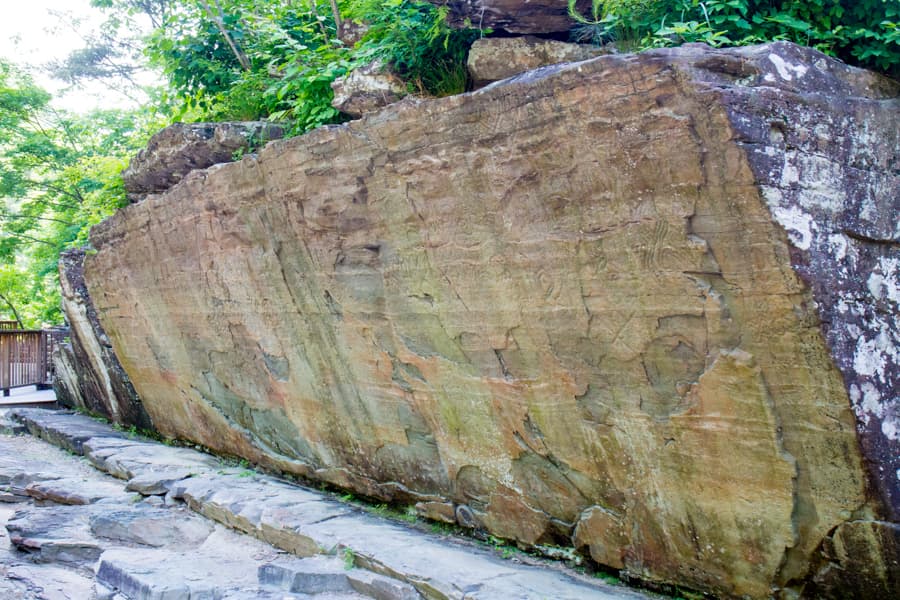
Cheonjeon-ri Petroglyphs in Ulsan, Ulju County, South Korea. Image source · CC BY-SA 4.0
Visit essentials
A quick read before you go
- Duration
- Allow a calm, condition-aware visit.
- Access
- Prepare for the exact route described above.
Overview
UNESCO dates the property's overall carving tradition from about 5000 BCE to the ninth century CE. At Cheonjeon-ri, stone tools produced earlier pecked or ground motifs; later metal points enabled fine-line figures and writing. The panel includes animals, hunting imagery, concentric circles, diamonds, spirals, processions, clothing, and Chinese-character inscriptions. Because not every mark has a secure date or agreed meaning, the page does not assign one continuous religion to six thousand years of cultural expression.
Why this place is sacred
Ulsan identifies 127 Silla inscriptions, many recording who visited, when, and why. Especially important entries concern members of the Silla royal family returning to the valley, including a later visit connected with mourning a deceased husband. These texts show that the cliff became a place of memory, encounter, and inscription in historical time. They do not prove that every prehistoric motif was devotional or that the entire panel functioned as a single shrine.
Original function follows the cited authorities.
Material continuity is not presumed.
Experience and orientation
The site’s spiritual significance must remain bounded by uncertainty. Repeated return, layered animal and geometric imagery, and Silla memorial associations can support reflection on how landscapes hold human attention. Archaeology, however, cannot recover the full intentions of unnamed prehistoric carvers. Current sources do not establish a living cult, named pilgrimage, deity, or verified ceremonial program at the panel. The target of veneration and pilgrimage fields therefore remain empty, and the ceremonial flag is false.
Use the verified public approach.
Context and lineage
The rock itself is a natural surface within a stream-cut landscape, while the World Heritage inscription is cultural rather than natural. Its slight forward tilt created a shelter that helped protect carvings from rain. That geological circumstance is relevant conservation evidence, not a metaphysical property. A useful visitor exercise is to separate what can be seen—tool marks, superimposition, shelter, cliff, water—from what remains interpretation. Patience with the unknown is more respectful than filling silence with invented ritual.
Prehistoric and Silla-period rock-carving traditions
Traditions and practice
Never touch the panel, trace a line with a finger, make a rubbing, wet the surface, use chalk, lean equipment against rock, or cross a conservation barrier. Photograph only from permitted positions and avoid strong artificial light if staff restrict it. Stay on the official approach, keep drones away unless explicitly authorized, and do not remove stone, plants, or sediment. Stream weather and slippery ground can create hazards independently of monument opening, so follow local closures.
Current use remains custodian-led.
Attend quietly before drawing conclusions.
Prehistoric and Silla-period rock-carving traditions
HistoricalSacred meaning follows the documented local tradition.
Practice remains governed by present custodians.
Perspectives and open questions
Several disciplines illuminate this sacred place.
Scholarly perspective
Cheonjeon-ri supports archaeological, epigraphic, artistic, environmental, and memory-focused readings. UNESCO recognizes artistic mastery and a long rock-carving tradition, not a proven supernatural function. No prevalent metaphysical claim met the inclusion rule, and no modern user-review claim should override that absence. The most honest sacred-site account preserves a tension: generations repeatedly marked this cliff, yet much of what those marks meant to their makers remains beyond current evidence.
The modern official name includes both inscriptions and petroglyphs, which is more precise than the CSV shorthand. This page retains the input name for reconciliation while making the dual character explicit. Heritage metadata records dossier 1740 at component scope and does not present Cheonjeon-ri alone as the entire three-kilometre World Heritage property.
Living and traditional perspectives
Community meanings retain their own authority.
Open questions
Unsupported effects remain explicitly unverified.
Plan your visit
Access and arrival
Prepare for the exact route described above.
No lodging claim was researched.
Respectful visit
Dress for dignity and terrain.
Ask before recording people or ritual.
Use authorized channels only.
Obey every closure and barrier.
Do not invent or imitate rites.
Current practical details
Address
산210-2 Cheonjeon-ri, Dudong-myeon, Ulju-gun, Ulsan, South Korea
Phone
Hours, fees, and access can change — verify on the official source before you travel. Practical details last checked Jul 2026.
Location
Map loads as you approach this section.
Pilgrim reflections
A portrait of encounter, not a score
Pilgrims describe what they felt, how present they could become, and whether the place would shape a journey. There are no stars and no ranking of traditions.
No reviewed reflections yet
The first pilgrims can help describe the character of being here.
Share a reflection
Available after an account-backed “Been there.” Every reflection is reviewed before publication.
Nearby sacred places
Explore other sacred places in the region. Proximity does not establish access or travel time; check each place’s guidance.


References
Sources consulted for this page. Source categories describe the publication, not a guarantee that every claim is verified. Traditional accounts and outside interpretations may differ.
- 01Petroglyphs along the Bangucheon Stream — UNESCO World Heritage CentreofficialTwo-component cultural property, 2025 inscription, six-thousand-year carving tradition, chronology, imagery, integrity, and management.
- 02Petroglyphs along the Bangucheon Stream — nomination dossier — Republic of Korea / UNESCO World Heritage CentreofficialExact Cheonjeon-ri panel dimensions, layered motifs and inscriptions, setting, chronology, and conservation boundaries.
- 03Petroglyphs and Inscriptions of Cheonjeon-ri — Ulsan Metropolitan CityofficialExact National Treasure identity, address, approximately 625 marks, tool phases, Silla inscriptions, discovery, and official website provenance.
- 04Petroglyphs of Cheonjeon-ri — Korea Tourism OrganizationofficialNational tourism record for exact identity, approach, cultural interpretation, and responsible visitor context.
- 05ICOMOS evaluation: Petroglyphs along the Bangucheon Stream — ICOMOS / UNESCO World Heritage CentreacademicIndependent heritage evaluation of the property’s two panels, long chronology, authenticity, conservation, and visitor management.
- 06Petroglyphs and Inscriptions of Cheonjeon-ri — Google Maps place record — GoogleSource contextExact strong identity and current address, coordinates, telephone, official Ulsan website candidate, and operational status.
Share a photo
Help visitors recognize Cheonjeon-ri Petroglyphs. Every submission is reviewed before publication.