Seokguram Grotto
A sourced encounter with Seokguram Grotto
Understand sacred places, explore living traditions, and learn how to engage respectfully with Pilgrim Map.
Access has not been verified. Check current local guidance before planning a visit.
Gyeongju, Gyeongsangbuk-do, South Korea
Read the sources
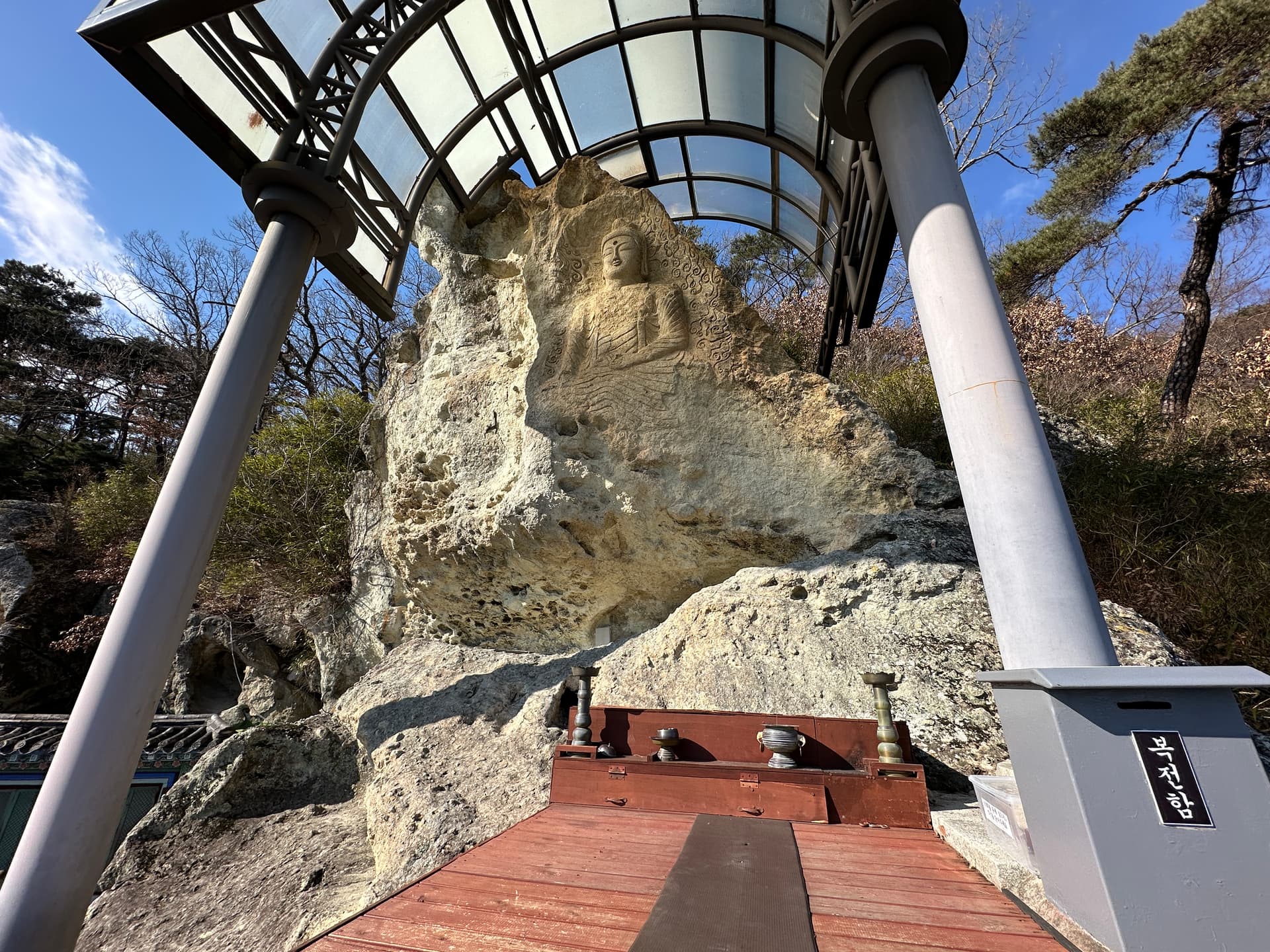
Seokguram Grotto in Gyeongju, North Gyeongsang, South Korea. Image source · CC0
Visit essentials
A quick read before you go
- Duration
- Allow an unhurried circuit appropriate to Seokguram Grotto.
- Access
- 238 Seokgul-ro, Gyeongju, Gyeongsangbuk-do, South Korea
Overview
Seokguram is not a natural cave decorated after discovery. Silla builders assembled a stone grotto on Mount Tohamsan, creating an antechamber, passage, and domed rotunda around a seated Sakyamuni Buddha. Bodhisattvas, disciples, guardians, and other relief figures form an ordered sacred company rather than a gallery of independent statues. The sanctuary belongs historically with Bulguksa below the mountain and was inscribed with it on UNESCO's World Heritage List in 1995. Present access is deliberately constrained.
Visitors see the interior through protective glass and cannot circulate around the main image. That distance is not a failure of hospitality; it is part of the grotto's survival, limiting humidity, contact, and disturbance within an exceptionally sensitive constructed environment.
Why this place is sacred
The grotto's spiritual significance comes from Buddhist iconography and spatial concentration. The seated Buddha's composure, the surrounding assembly, and the progression from entrance to rotunda create an encounter with awakening expressed in stone. Sunrise associations and the eastern setting have inspired many interpretations, but observation should remain separate from claims that light performs a scientifically established mystical mechanism. Seokguram has also undergone rediscovery, intervention, and difficult conservation.
Its present climate-control system and barrier record the fact that preservation is active, imperfect work. Reverence here can take the form of accepting a limited view. The sanctuary does not owe the visitor proximity in exchange for travel effort.
Silla builders assembled an artificial granite sanctuary around Sakyamuni Buddha and an ordered company of Buddhist figures.
Rediscovery, invasive interventions, climate control, and protective glass now shape how the eighth-century sanctuary survives.
Experience and orientation
The route to Seokguram includes a mountain approach and a short final walk, so weather, steps, and seasonal crowding matter. Read the exterior interpretation before reaching the chamber; time at the glass can be brief when groups are waiting. Do not use flash, press equipment against barriers, or attempt to photograph where signs prohibit it. Let the whole assembly register before searching for details through the controlled viewpoint. Silence benefits both worshippers and careful looking.
Opening times, shuttle arrangements, and weather closures should be confirmed against the strong matched Places record and current managing-authority notices.
Study the antechamber, passage, and rotunda sequence outside before joining the limited view through conservation glass.
Context and lineage
UNESCO describes Seokguram and Bulguksa as masterpieces of Silla Buddhist art from the eighth century. The project is traditionally connected with the minister Kim Daeseong, and the grotto is generally placed in the building campaign completed in the later eighth century. Its granite construction required carefully fitted blocks and a sophisticated domed chamber rather than excavation into a continuous cliff. Modern interventions altered the grotto's environmental behavior, making conservation history essential to understanding what visitors see.
The central figure is identified as Sakyamuni Buddha; surrounding figures participate in a larger Buddhist program whose precise identifications and symbolic relationships should follow current scholarship. The site is both a devotional monument and archaeological evidence, not proof of lost technology or supernatural engineering.
Seokguram Grotto belongs within Korean Buddhism.
Traditions and practice
Seokguram remains meaningful within Korean Buddhism even though access resembles a tightly managed heritage visit. A Buddhist guest may bow or pray from the permitted area provided that movement does not block others. Candles, incense, coins, written petitions, and physical offerings must never be placed outside an authorized facility. For a non-Buddhist visitor, a respectful practice is to follow the chamber's sequence mentally: threshold, passage, central Buddha, surrounding assembly. This is an exercise in observation, not a reconstructed initiation.
Custodians determine when ceremonies occur and whether any area beyond the normal viewpoint is accessible.
Buddhist prayer remains possible from permitted space while conservation strictly limits proximity, offerings, and circulation.
Follow the sanctuary mentally from threshold to central Sakyamuni and outward through the surrounding stone assembly.
Korean Buddhism
ActiveSeokguram composes Sakyamuni and a carved Buddhist assembly within an engineered stone sanctuary where devotion, cosmology, and conservation converge.
Quiet prayer or bowing may occur from permitted space; all closer ritual access remains subject to the grotto's custodians.
Perspectives and open questions
Buddhist iconography, Silla engineering, UNESCO history, and climate conservation explain why proximity is deliberately restricted.
Scholarly perspective
Buddhist interpretation reads Seokguram through Sakyamuni, awakening, protection, and the ordered sacred assembly. Art history studies sculptural style and Silla's international Buddhist connections. Architectural analysis examines a built granite dome and the management of a demanding mountain environment. Conservation science focuses on moisture, airflow, temperature, biological growth, and the effects of past repairs. UNESCO joins the grotto to Bulguksa as one cultural property, while visitor management must translate that global recognition into daily restraint.
Claims about perfect astronomical codes or unexplained energies require evidence not supplied by the current sources. Uncertainty is more responsible than using the monument's sophistication to market a mystery.
Living and traditional perspectives
Within Korean Buddhism, the seated Sakyamuni and surrounding assembly express awakening through an ordered stone sanctuary.
Open questions
Eastern light and sunrise inspire interpretation, but no scientifically verified mystical mechanism or uniform visitor response is claimed.
Plan your visit
Access and arrival
238 Seokgul-ro, Gyeongju, Gyeongsangbuk-do, South Korea
No accommodation claim was verified for Seokguram Grotto.
Respectful visit
Wear modest, practical clothing suitable for Seokguram Grotto.
Obey the chamber's current camera and flash restrictions without pressing equipment against glass or conservation barriers.
Leave candles, incense, coins, petitions, and food only in an expressly authorized devotional facility outside protected surfaces.
Never touch stone, glass, reliefs, or environmental equipment, and do not seek access beyond the public viewing line.
Never improvise rites or offerings at Seokguram Grotto.
Current practical details
Address
238 Seokgul-ro, Gyeongju, Gyeongsangbuk-do, South Korea
Phone
Hours
Hours, fees, and access can change — verify on the official source before you travel. Practical details last checked Jul 2026.
Location
Map loads as you approach this section.
Pilgrim reflections
A portrait of encounter, not a score
Pilgrims describe what they felt, how present they could become, and whether the place would shape a journey. There are no stars and no ranking of traditions.
No reviewed reflections yet
The first pilgrims can help describe the character of being here.
Share a reflection
Available after an account-backed “Been there.” Every reflection is reviewed before publication.
Nearby sacred places
Explore other sacred places in the region. Proximity does not establish access or travel time; check each place’s guidance.

References
Sources consulted for this page. Source categories describe the publication, not a guarantee that every claim is verified. Traditional accounts and outside interpretations may differ.
- 01Seokguram Grotto and Bulguksa Temple — UNESCO World Heritage CentreofficialAuthoritative World Heritage property record, dossier 736; component scope preserved.
- 02Seokguram Grotto — World Heritage nomination dossier — State Party of the Republic of Korea / UNESCOofficialPrimary nomination documentation for UNESCO property 736, including serial-component identity, mapping, and heritage context.
- 03Korea UNESCO cultural heritage: Seokguram Grotto — Korea Tourism OrganizationofficialLive official tourism record used for site identity, heritage context, and visitor logistics; time-sensitive details require rechecking.
- 04Seokguram Grotto — Google Maps place record — GoogleSource contextStrong identity match used only for current practical fields and coordinates.
Share a photo
Help visitors recognize Seokguram Grotto. Every submission is reviewed before publication.